
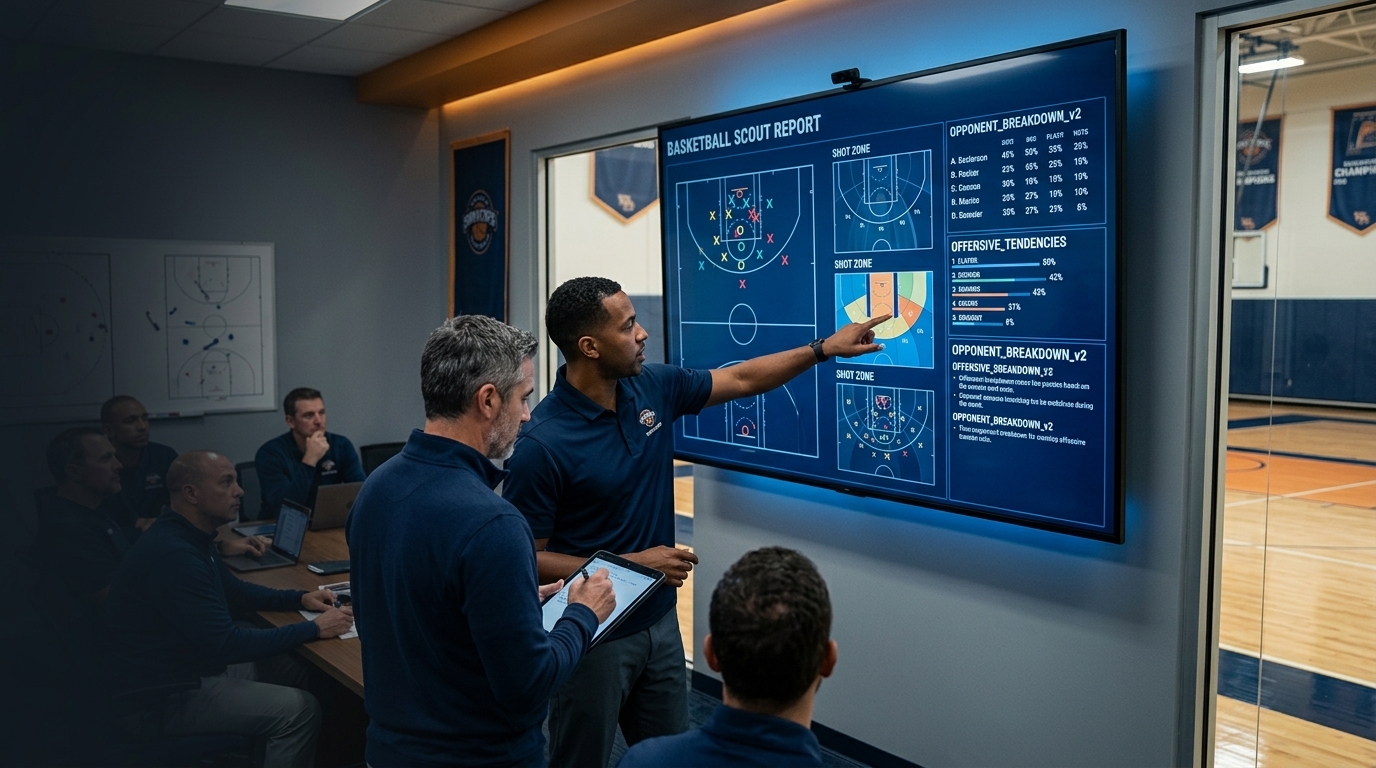
How to Create a Basketball Scout Report in 2026
Key Takeaways
Learning how to create basketball scout report means combining player data with direct observation.
Advanced metrics like PER, TS%, and ORTG give your evaluations real depth.
Scouting4U offers tools built for both professional and amateur scouting workflows.
A clear scouting philosophy reduces inconsistency across your reports.
Avoiding common mistakes - like judging on single-game snapshots - separates good scouts from great ones.
Introduction: How to Create Basketball Scout Report the Right Way
If you want to know how to create basketball scout report that coaches actually use, you need more than a list of stats. A good report blends hard data with what you see on film. It tells a story about a player or a team - their habits, tendencies, and where they break down under pressure. This guide walks you through everything: the structure, the metrics, the tools, and the mindset behind building reports that hold up in real decisions. Whether you are new to scouting or refining an existing process, understanding how to create basketball scout report is the foundation of every good roster decision your program makes.
Why Scout Reports Still Matter in 2026
Some coaches think advanced software has replaced the need for written scout reports. It has not. Data tools give you numbers. A scout report tells you what those numbers mean in context.
When you know how to create basketball scout report properly, you give your coaching staff something they can act on. They can adjust game plans, prioritize defensive matchups, and target specific players in the transfer market - all because someone took the time to write it down clearly.
Daniel Gutt of Scouting4U puts it plainly: the gap between a good season and a championship often comes down to the precision of your preparation. Scouting is preparation made tangible.
Scout reports also protect your decisions. If you recommend signing a player or passing on one, a written report gives you a record of your reasoning. That matters when front offices or athletic directors ask hard questions later. Knowing how to create basketball scout report with that level of rigor is what separates programs that make informed moves from ones that rely on gut feel.
The Core Components of How to Create Basketball Scout Report
Every solid report follows a structure. You can adapt the format, but these sections should always appear in some form. When coaches ask how to create basketball scout report from scratch, the answer always starts here.
Player Evaluation
Start with what the player does well and where they struggle. Be specific. "Good shooter" is not useful. "Shoots 41% from the left corner on catch-and-shoot attempts but drops to 28% off the dribble" - that is useful.
Look at shooting mechanics, ball-handling under pressure, passing reads, and defensive positioning. Use metrics like TS% and AST% to back up what you see. Our guide on true shooting percentage calculation explains how to read those numbers correctly.
Team Analysis
When scouting an opponent, you need to understand how they operate as a unit. What is their primary half-court offense? How do they defend pick-and-roll coverage? Do they switch everything, or do they prefer to hedge and recover?
Map out their rotations and note which players initiate which actions. Teams have tendencies just like individual players do. This part of how to create basketball scout report is often skipped by newer scouts, but it is where game-plan advantages get built.
Statistical Data
Pull game logs, play-by-play splits, and lineup data. Look for patterns over at least five games before drawing conclusions. One bad game or one breakout performance can skew your read if you treat it in isolation.
For a full breakdown of which stats matter most at each position, see our article on advanced basketball statistics and must-know metrics.
Video Analysis
Film is where scouting lives. Numbers tell you what happened. Video shows you why. Watch plays multiple times and tag the moments that reveal a player's decision-making, athleticism, and competitive instincts.
Our game film breakdown guide walks through a step-by-step process for getting the most out of your film sessions. Efficient video tagging also helps - see how in our piece on basketball video tagging for game film analysis.
How to Create Basketball Scout Report: Choosing Your Tools
The tools you use shape how fast and how thoroughly you can work. Anyone learning how to create basketball scout report at a high level needs to pick tools that match their workload and the level of play they are covering.
Scouting4U
Scouting4U was built specifically for basketball scouting workflows. It supports advanced metrics, customizable report templates, and AI-assisted analysis. The platform works for both professional front offices and college programs that need to cover a high volume of players quickly.
You can explore the full list of capabilities on the Scouting4U features page, and review plan options on the pricing page to find what fits your program's budget.
If your program scouts remotely - reviewing players from other countries or leagues - Scouting4U's remote tools are worth a close look. Our article on remote basketball scouting covers how that process works in practice.
Advanced Metrics: The Numbers Behind How to Create Basketball Scout Report
Knowing which stats to use - and which to ignore - separates a shallow report from a thorough one. This is one of the areas where understanding how to create basketball scout report properly pays the biggest dividends.
Player Efficiency Rating (PER)
PER summarizes a player's per-minute production into a single number. The league average sits at 15. A PER above 20 typically marks a strong contributor. Use it as a quick filter, not a final verdict.
True Shooting Percentage (TS%)
TS% accounts for free throws and three-pointers, giving you a more accurate picture of shooting efficiency than field goal percentage alone. A player who looks like an average shooter by FG% might actually be highly efficient once you factor in their free throw volume.
Usage Rate (USG%)
USG% tells you how often a player is involved in possessions when they are on the court. A high USG% with strong efficiency numbers is a very good sign. High usage with poor efficiency means the player is hurting their team.
Defensive Rating (DRTG)
DRTG measures points allowed per 100 possessions with a player on the court. Lower is better. Pair it with film review to understand whether a player is actively causing those stops or just benefiting from good teammates.
Offensive Rating (ORTG)
ORTG shows how many points a team scores per 100 possessions with a player active. When combined with USG%, it tells you a lot about a player's actual offensive impact - not just their scoring output. Anyone working through how to create basketball scout report should have these five metrics committed to memory before writing their first evaluation.
Developing a Scouting Philosophy
How to create basketball scout report with consistency starts with knowing what you are looking for before you start watching.
Your scouting philosophy should reflect your team's system. A team that runs a lot of pick-and-roll offense needs to scout ball-handlers differently than a team built around isolation scoring. If you are evaluating defenders, decide in advance whether you prioritize on-ball ability, help defense positioning, or switchability.
Write your criteria down. Share them with other scouts on your staff. When everyone is using the same framework, you can compare reports across different evaluators and trust that the grades mean the same thing.
Daniel Gutt's approach at Scouting4U is a useful model: balance quantitative data with what you see in person, and always ask whether a player fits the specific context of your program - not just whether they are talented in the abstract. That question is at the heart of how to create basketball scout report that actually drives decisions rather than just documenting players.
Understanding player tendencies is a big part of this. Our article on basketball player tendency analysis goes deep on how to read and document those patterns systematically.
Common Mistakes When Learning How to Create Basketball Scout Report
Even experienced scouts fall into bad habits. Here are the ones that cause the most damage. Recognizing them is part of learning how to create basketball scout report at a high standard.
Judging on Small Samples
One game - especially a standout performance - tells you almost nothing on its own. Watch at least five to seven games before committing to an evaluation. Look for consistency, not peaks.
Ignoring Context
A player who posts 20 points per game against weak competition is not the same as one who does it against strong opponents. Check the quality of competition before you get excited about raw numbers.
Skipping the Negative Space
Most scouts write about what a player does. The best scouts write about what a player avoids doing - the defensive rotations they skip, the shots they pass up, the situations where they disappear. That negative space often predicts performance better than the highlights do.
Not Updating Reports
A report written in November about a player you are signing in March needs updating. Players develop, slump, change roles, and recover from injury. Stale data leads to bad decisions. Build a habit of revisiting your reports throughout the season. This is a discipline problem as much as a process problem, and it is one of the most common gaps in how to create basketball scout report at scale.
For a systematic approach to managing your reports over time, see our guide on building a basketball player scouting reports database.
How AI Is Changing How to Create Basketball Scout Report in 2026
AI tools have entered scouting in a serious way. In 2026, the most efficient programs are using AI to handle the first pass of data review - flagging players who meet statistical thresholds, tagging video clips automatically, and generating draft report text that scouts then refine.
This does not replace human judgment. It speeds up the process so scouts can spend more time on the cases that actually require a human eye. A player with unusual athleticism relative to their stats, or a prospect coming back from injury - those still need a real person watching. Understanding how to create basketball scout report in the AI era means knowing which steps you can delegate to software and which steps you cannot.
Scouting4U's AI tools are built around this philosophy. You can watch how the system works in real time in our post on watching AI write a scout report. The AI scout report two-minute revolution article also shows what the workflow looks like in practice.
The shift toward data-driven recruitment more broadly is covered in our piece on how data analytics transforms basketball recruitment.
Structuring the Written Report
Once you have gathered your data and film notes, you need to write the actual report. Knowing how to create basketball scout report in the field is one thing - translating that into a document your staff can use is another. Here is a structure that works at both the college and professional level.
Header: Player name, position, team, league, age, contract status (if relevant).
Summary: Two to three sentences giving your overall grade and the single most important thing to know about this player.
Strengths: Three to five specific, evidence-backed points. Tie each one to a stat or a film clip reference.
Weaknesses: Same format. Be direct. The people reading your report need to know the real concerns, not a softened version.
Fit Analysis: How does this player fit your team's system? This section separates a general scouting report from one that is actually useful to your coaching staff.
Grade and Recommendation: Make a clear call. "Maybe" is not a recommendation. Use a grade scale your organization has agreed on in advance.
For a ready-to-use structure, our basketball scouting report template gives you a working format you can adapt immediately.
How to Create Basketball Scout Report: Putting It All Together
The process described in this guide covers the full arc of how to create basketball scout report - from building your evaluation criteria to writing the final recommendation. But the real skill is making it repeatable. A report you write once is useful. A system you run consistently is a competitive edge.
Start by picking two or three players to evaluate this week using the structure above. Use five games minimum. Pull the key metrics. Tag the film moments that back up your written observations. Then write the report as if a coach you respect is going to read it and make a roster decision based on what you say.
That standard - write it like a real decision depends on it - is what separates scouts who understand how to create basketball scout report from ones who are just filling out templates. The format matters less than the thinking behind it.
If you want to go deeper on what evaluators at the highest level are looking for, our article on what basketball scouts look for in players covers the ten traits that come up most consistently in professional evaluations. And if you are building toward a scouting career, our guide on how to become a basketball scout maps out what that path actually looks like.
Conclusion
Learning how to create basketball scout report takes practice, but the framework is not complicated. Start with a clear structure. Use the right metrics. Watch enough film to see patterns, not just moments. Build a scouting philosophy that fits your program's needs. And update your reports as the season moves forward.
The scouts who do this well share one habit: they treat the report as a decision-making tool, not a record-keeping exercise. Every section should answer a question someone on your staff is actually asking. When you approach how to create basketball scout report with that mindset, the work gets sharper and the reports get used.
When you know how to create basketball scout report at that level, the reports stop feeling like paperwork and start functioning as a real competitive advantage. The teams winning close games in March are often the ones who did the scouting work in November. Start there.
Frequently Asked Questions
What are the essential elements of a basketball scout report?
A complete report covers player evaluation, team analysis, statistical data, and video observations. Each section should connect to specific decisions your coaching staff needs to make - roster construction, game planning, or player development priorities. When you understand how to create basketball scout report with this structure, each section does real work rather than just filling space.
How many games should I watch before writing a scout report?
Watch at least five to seven games before drawing firm conclusions. Single-game samples are unreliable. Look for patterns that hold across different opponents, game situations, and pressure moments.
What advanced metrics matter most when learning how to create basketball scout report?
PER, TS%, USG%, ORTG, and DRTG are the most consistently useful. None of them work well in isolation - always pair stats with film review and account for the quality of competition the player has faced.
How is AI changing how to create basketball scout report in 2026?
AI tools now handle initial data filtering, automatic video tagging, and draft report generation. This speeds up the process significantly. Human scouts still make the final calls, particularly on players whose numbers and film tell different stories. Knowing how to create basketball scout report in this environment means using AI for the first pass and applying your own judgment to the cases that need it.
How do I avoid common mistakes when creating basketball scout reports?
Focus on trends across multiple games rather than single performances. Always account for competition level. Write about what a player avoids as much as what they do. And make sure your reports are updated regularly - a report from three months ago may no longer reflect a player's current form. The scouts who understand how to create basketball scout report correctly treat it as an ongoing process, not a one-time task.
Enjoyed this article? Share it with others!
Founder & Lead Scout, Scouting4U
2x EuroLeague champion with 30+ years in professional basketball. Daniel won EuroLeague titles with Maccabi Tel Aviv, helped build the staff behind the 2007 European Championship, and has delivered 100+ professional scouting reports across 50+ leagues. If it happened in a European basketball front office, he was probably in the room. He founded Scouting4U in 2010 to bring championship-level scouting intelligence to every club.
No reviews yet. Be the first to share your experience!
Related Articles

Analyzing Basketball Player Potential: Scouting Insights
Key Takeaways Analyzing basketball player potential combines data analysis with scouting intuition. Core metrics includ...

Mastering Basketball Service: Scouting Insights & Tools
Key TakeawaysA strong basketball service covers everything from player evaluation to game strategy analysis.Scouting4U g...

One Shot Chart. Three Insights Visual: Game Plan Revolution
Key TakeawaysA basketball shot chart three insights visual approach reveals high-efficiency zones, player tendencies, an...