
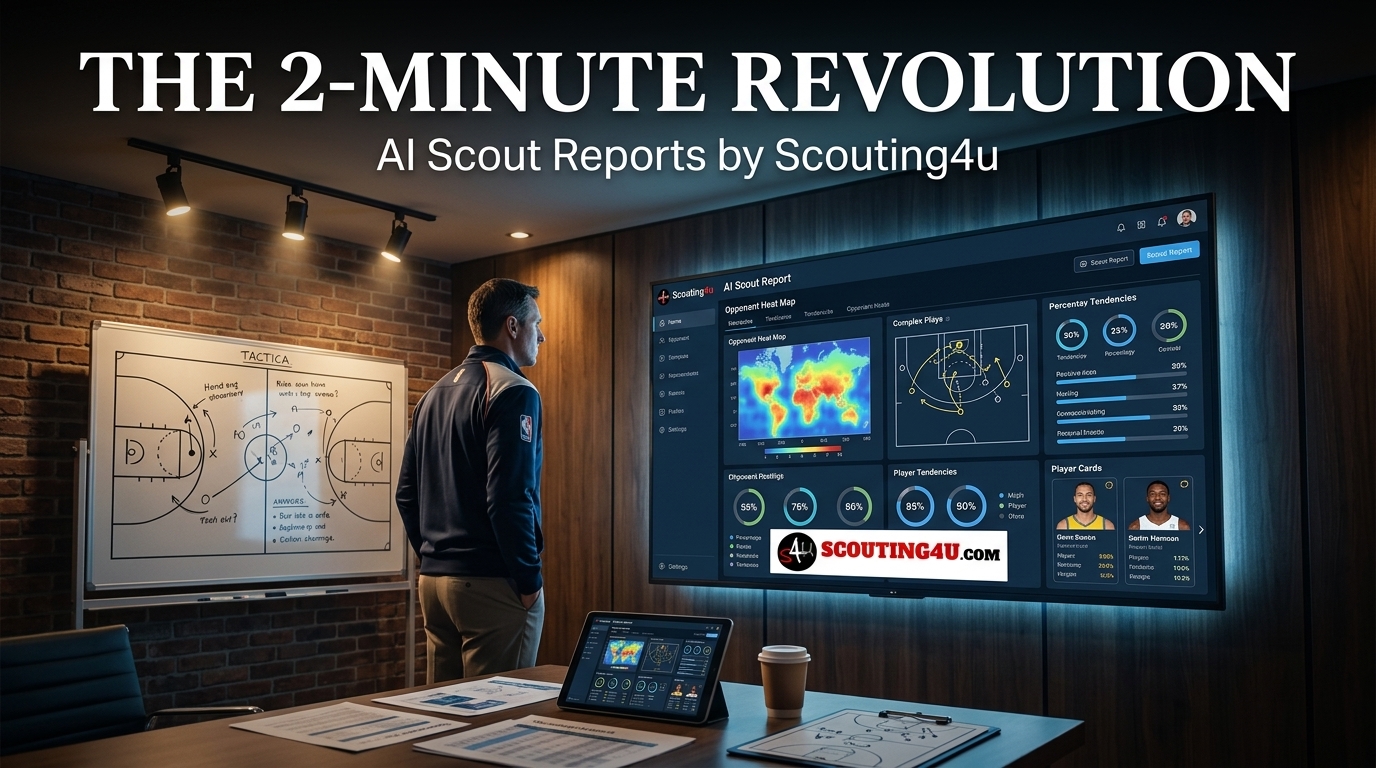
AI Scout Report: 2-Minute Revolution in Analysis
Key Takeaways
An AI scout report before and after comparison shows dramatic time savings - analysis that took hours now takes under two minutes.
AI-powered tools improve accuracy and depth of analysis in basketball scouting.
Scouting4U leads in applying AI technology to generate comprehensive scouting reports.
Adoption of AI tools is driving growth in the basketball analytics market.
Daniel Gutt's EuroLeague expertise shapes how Scouting4U builds practical, on-court solutions.
Why the AI Scout Report Before and After Comparison Matters
Not long ago, building a detailed basketball scouting report meant watching hours of film, entering data by hand, and writing up findings that were already going stale by the time the coach read them. That process was the norm. Scouts were good at it, but it had real limits. The AI scout report before and after comparison puts those limits in sharp relief. When AI can generate the same depth of analysis in two minutes that once took two hours, the entire workflow changes - not just in speed, but in what questions you can even afford to ask.
Run an AI scout report before and after comparison even once and the gap becomes hard to ignore. This article walks through what that shift actually looks like in practice. We cover what manual scouting involved, what AI-powered reporting delivers instead, and where the biggest practical gains show up for coaches, front offices, and scouts working at every level of the game.
Before AI: What Traditional Scouting Actually Looked Like
Manual scouting was labor-intensive by design. A scout assigned to cover an opponent would log anywhere from four to eight hours per report. That time went into rewinding film, tagging possessions, building spreadsheets, and writing narrative summaries - all by hand.
The process also depended heavily on individual judgment. Two scouts watching the same player might emphasize different things. One might focus on pick-and-roll defense; another on transition tendencies. There was no standardized framework to ensure both looked at the same data points. That inconsistency made it harder to compare players across teams or leagues. Any honest AI scout report before and after comparison has to start here - with just how uneven the baseline was.
Data scope was another problem. Manual methods could only capture so much. A scout working alone on a tight deadline would focus on the most obvious patterns and skip the rest. Subtle tendencies - like how a player performs in the fourth quarter of close games, or their shooting efficiency after off-ball screens - rarely made it into the final report.
Then there was turnaround time. Game preparation windows are short. If a report took 48 hours to complete, it might arrive too late to influence practice planning. Coaches made decisions with incomplete information, not because better data didn't exist, but because there wasn't enough time to surface it.
For a deeper look at what went into building reports before AI, see our guide on how to create a basketball pre-game scouting report.
The AI Scout Report Before and After Comparison: What Changes
The AI scout report before and after comparison is most striking when you look at time. Scouting4U's AI report generator produces a full player or team report in roughly two minutes. That's not a rough draft - it's a structured document covering performance metrics, tendency breakdowns, and situational analysis.
Speed matters, but it's not the only thing that changes. Here's what an AI scout report before and after comparison actually shows across several dimensions:
Time per Report
Before AI: 4-8 hours per report. After AI: under 2 minutes. That difference frees scouts to cover more players, more opponents, and more games in the same time window. A staff that could previously scout one opponent per week can now prepare for three or four. The AI scout report before and after comparison on time alone makes a strong case for adoption.
Data Coverage
Manual reports captured what a scout could observe and log within a limited time. AI pulls from full statistical datasets - possession-level data, shot quality metrics, lineup combinations, and player tendencies in specific game states. Nothing gets left out because the analyst ran out of time. When you do an AI scout report before and after comparison on data coverage specifically, the difference is significant.
Consistency
Every AI-generated report follows the same structure and covers the same data points. That consistency makes comparison across players and teams much easier. When you're building a roster or preparing for a playoff run, that standardization is genuinely useful. The AI scout report before and after comparison on structure alone shows how much variation manual reports contained.
Depth of Insight
AI surfaces patterns that manual review often misses. Metrics like Player Efficiency Rating (PER), True Shooting Percentage (TS%), and Usage Rate (USG%) are included automatically. So are situational breakdowns - how a player performs on the second night of a back-to-back, or their defensive positioning in transition. This is the kind of detail that used to require a dedicated analyst with days to spare.
To understand the full range of tools driving this shift, read our overview of mastering basketball player performance analysis tools.
How Scouting4U Builds AI Scout Reports
Scouting4U's platform doesn't just automate data collection. It applies contextual analysis to what the data shows. The AI identifies player tendencies - shot selection under pressure, preferred post-up positions, defensive rotations off-ball - and organizes them into a report that coaches can use directly in practice planning.
The system handles multiple layers of analysis at once. While a manual scout might choose between covering offensive tendencies or defensive habits, the AI covers both in the same two-minute window. The result is a more complete picture with less effort from the staff. Doing an AI scout report before and after comparison at the platform level shows this clearly: the manual version required choices about what to include; the AI version doesn't.
Daniel Gutt, whose EuroLeague background shaped Scouting4U's development, built the platform around the actual questions coaches ask during game prep. Reports aren't just data dumps - they're organized around decisions: Who do we put on their best pick-and-roll ball-handler? How do we attack their drop coverage? Where does their second unit give up easy points?
That focus on practical application is what separates a useful AI scout report before and after comparison from a theoretical one. The goal isn't to prove AI is faster - it's to show that the output is actually useful in a real coaching environment.
For more on how AI transforms scouting at the platform level, see our article on how AI basketball scouting reports technology transforms scouting.
Real Differences for Coaches and Front Offices
The AI scout report before and after comparison plays out differently depending on your role.
For a head coach, the main gain is timing. Getting a full opponent report two days before a game instead of the morning of gives you time to build specific practice segments around what the data shows. You're not reacting to information - you're preparing for it. Coaches who've run their own AI scout report before and after comparison consistently say the timing shift is where they feel it most.
For a front office evaluating free agents or trade targets, the gain is volume. With AI, you can run a serious evaluation on ten players in the time it used to take to build one report. That changes how you approach the roster-building process entirely. You can afford to look at players you would have skipped simply because there wasn't enough time.
For scouts working in player development, the gain is specificity. AI reports can track how a player's tendencies evolve over a season, week by week. That kind of longitudinal tracking was nearly impossible to do manually without a large analytics staff. The AI scout report before and after comparison for a development context is really a comparison between snapshots and continuous tracking.
If roster construction is where you're applying these insights, our guide on data-driven basketball recruitment for front offices covers the practical steps in detail.
The AI Scout Report Before and After Comparison Across Levels of the Game
This shift in scouting efficiency is happening alongside broader changes in how the basketball analytics market is growing. Teams at every level - from youth programs to professional leagues - are investing in data infrastructure. The barriers that once kept advanced analytics limited to NBA front offices have dropped considerably.
Scouting4U works with teams across Europe and beyond, which means the AI scout report before and after comparison isn't just a story about elite-level basketball. It applies to semi-professional leagues, development programs, and college programs where staff sizes are small and every hour of analyst time matters. A youth program coordinator doing an AI scout report before and after comparison will notice the same time savings as a professional front office director.
The consistency of AI-generated reports also matters when you're comparing players across different leagues - say, evaluating whether a player from the Turkish Basketball League fits your EuroLeague roster. Manual scouting across multiple leagues requires multiple scouts and significant coordination. AI can generate comparable, standardized reports across those contexts in the same workflow. The AI scout report before and after comparison across leagues shows just how much friction used to exist in cross-market evaluation.
For context on how analytics is spreading across the market, see our breakdown of basketball analytics market growth trends through 2026.
What AI Doesn't Replace
The AI scout report before and after comparison should be read honestly. AI handles data processing and pattern recognition better than any human analyst working alone. But it doesn't watch a player's body language during a timeout. It doesn't pick up on locker room dynamics or how a player responds to a coach's correction in real time.
Experienced scouts bring context that data alone can't fully capture. The best teams use AI to handle the analytical heavy lifting, then apply human judgment to the questions that don't have a clean statistical answer. That combination - fast, comprehensive AI analysis plus experienced human interpretation - is more effective than either approach alone.
This is worth stating plainly because the AI scout report before and after comparison can make the manual approach look entirely obsolete. It isn't. The data side improves dramatically. The human side still matters.
Conclusion: What the AI Scout Report Before and After Comparison Actually Proves
The AI scout report before and after comparison makes a specific, measurable case. Reports that took hours now take minutes. Coverage that required a large staff is now achievable with a small one. Insights that used to require dedicated analysts are now built into the standard output.
This isn't about technology for its own sake. It's about giving coaches and front offices better information, faster, so they can make better decisions with the time they have. Every AI scout report before and after comparison points to the same conclusion: the gap between what was possible before and what's possible now is large enough to change how programs operate. The tools are available. The question is whether your staff is using them.
If you want to see what this looks like for your program, explore the Scouting4U platform features or review the subscription plans and pricing to find the right fit for your organization.
Frequently Asked Questions
What does an AI scout report before and after comparison actually show?
It shows the difference between manual scouting - which typically took 4-8 hours per report - and AI-generated scouting, which produces a comparable report in under two minutes. Beyond speed, the AI scout report before and after comparison shows broader data coverage, consistent structure, and deeper situational analysis that manual methods rarely achieved.
How does AI improve the accuracy of basketball scouting reports?
AI pulls from complete statistical datasets rather than a subset of observations. It applies the same analytical framework to every report, removing the inconsistency that comes from different scouts prioritizing different things. The result is a more complete and standardized picture of a player or team.
Can smaller programs benefit from AI scout reports?
Yes. In some ways, smaller programs gain the most. A college or semi-professional staff with one or two analysts can now produce the volume and depth of scouting that previously required a much larger operation. The AI scout report before and after comparison is as relevant for a youth program coordinator as it is for a professional front office.
Does AI replace the need for experienced scouts?
No. AI handles data processing and pattern recognition at a scale no individual analyst can match. But experienced scouts bring contextual judgment - reading a player's competitive temperament, assessing coachability, understanding league-specific dynamics - that isn't captured in statistics. The strongest programs use both. The AI scout report before and after comparison shows AI winning on data; it doesn't show AI winning on judgment.
How does Scouting4U generate AI scout reports so quickly?
Scouting4U's platform applies machine learning algorithms to structured basketball data, identifying tendencies, performance metrics, and situational patterns automatically. Reports are organized around the decisions coaches actually need to make, not just raw statistics. That combination of automated analysis and practical framing is what makes the two-minute turnaround possible.
Enjoyed this article? Share it with others!
Founder & Lead Scout, Scouting4U
2x EuroLeague champion with 30+ years in professional basketball. Daniel won EuroLeague titles with Maccabi Tel Aviv, helped build the staff behind the 2007 European Championship, and has delivered 100+ professional scouting reports across 50+ leagues. If it happened in a European basketball front office, he was probably in the room. He founded Scouting4U in 2010 to bring championship-level scouting intelligence to every club.
No reviews yet. Be the first to share your experience!
Related Articles
Future of Basketball Scout Reports: AI & Innovation
Key Takeaways Basketball scout reports are changing fast because of AI. Data collection and analysis now happen in a fr...
AI Scouting Reports in Basketball: The Scouting Edge
Key Takeaways AI scouting reports basketball tools give coaches faster, clearer data on players. Scouting4U pairs AI an...
Analyzing Basketball Player Potential: Scouting Insights
Key Takeaways Analyzing basketball player potential combines data analysis with scouting intuition. Core metrics includ...