
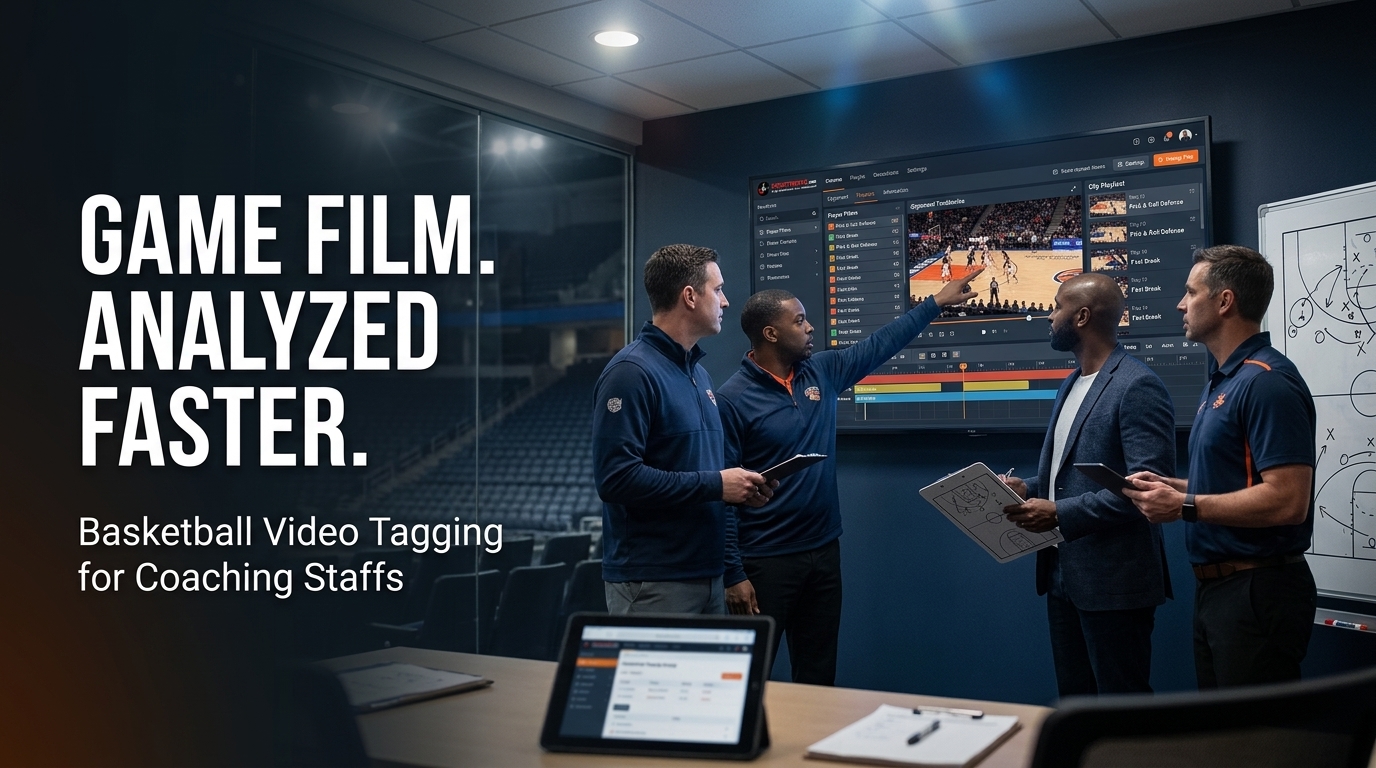
Basketball Video Tagging: Efficient Game Film Analysis
Key Takeaways
Basketball video tagging breaks down game film into actionable play-by-play data for coaches and analysts.
The right software makes basketball video tagging faster and more consistent across your entire staff.
Scouting4U offers purpose-built tools that streamline the entire tagging workflow.
Linking tagged plays to advanced metrics gives you a fuller picture of player and team performance.
A consistent tagging protocol is what separates useful film sessions from wasted ones.
Introduction to Basketball Video Tagging
Basketball video tagging has become one of the most practical skills in modern basketball analysis. It lets coaches and analysts mark specific moments in game film - pick-and-rolls, defensive breakdowns, transition possessions, whatever matters most to the team - and pull them up instantly. Instead of scrubbing through hours of footage, you go straight to the plays that matter. That efficiency is hard to overstate, especially during a busy season when staff time is limited.
Scouting4U was built around this exact workflow. The platform lets you tag footage, attach stats, and share clips across your staff without jumping between five different apps. Whether you are a college assistant coach or a front-office analyst, basketball video tagging is the foundation that everything else sits on.
This guide walks through why basketball video tagging matters, which tools and techniques work best, and how to build a tagging system that actually holds up over a long season. If you want sharper film sessions and better scouting reports, basketball video tagging is where the work starts.
Why Basketball Video Tagging Matters for Coaches and Analysts
Raw statistics tell you what happened. Basketball video tagging tells you why. A player might post a low assist-to-turnover ratio, but tagging reveals whether those turnovers came from bad decisions, miscommunication, or just tough defensive pressure. That distinction changes how you coach the player.
Tagging also solves a common problem in film sessions: finding the right clip fast. When every pick-and-roll coverage is tagged the same way, your staff can pull a complete library of those possessions in seconds. That turns a two-hour film session into a focused 45-minute conversation about the things that actually need fixing.
Beyond in-house use, basketball video tagging powers better scouting reports. When opponents are tagged consistently across multiple games, patterns emerge - tendencies in the fourth quarter, favorite spots off the dribble, defensive habits in drop coverage. Those patterns are what separate a good scouting report from a generic one. For more on building that kind of depth, see our guide on basketball player tendency analysis as a scouting tool.
Improving Player Performance Through Basketball Video Tagging
Individual player development is one of the clearest benefits of basketball video tagging. When you tag every shot attempt by location, shot type, and defensive context, you can show a player exactly where they are efficient and where they are not. That specificity is more persuasive than a coach just saying "you struggle off the dribble." The clip library proves it.
Basketball video tagging also helps track progress over time. If you tag a player's defensive positioning at the start of the season and again three months later, you can show concrete improvement - or flag that the same problem keeps showing up. That feedback loop is useful for both the player and the coaching staff.
Scouting4U's platform supports this level of player-level detail. You can filter tagged clips by individual player, assign notes, and build a clip package for a development conversation in minutes. The system draws on the kind of detailed workflow that scouts like Scouting4U founder Daniel Gutt have used in professional environments for years.
Using Basketball Video Tagging to Build Team Strategy
Team strategy depends on understanding how your players interact - not just how each one performs in isolation. Basketball video tagging lets you study those interactions. You can pull every possession where two specific players were on the floor together, or every play that ran through a particular set, and assess what worked and what did not.
This is especially useful for late-game situations. Coaches who have tagged every fourth-quarter possession across a season can see exactly how their team performs under pressure, which lineups hold up defensively, and which plays generate good looks in crunch time. That information is far more reliable than gut feeling.
For a closer look at lineup-level analysis, our article on basketball lineup analysis and optimizing your starting five goes deeper into how basketball video tagging data feeds into those decisions.
Opponent scouting follows the same logic. When you tag an opponent's possessions consistently, you build a database of their tendencies. That database drives your game plan. Teams that do this well come into games with specific answers for what the opponent does most, not general principles about defense or ball movement.
Choosing the Right Basketball Video Tagging Software
Not all basketball video tagging tools are built the same. Some are designed for broadcast professionals and are overly complex for a coaching staff. Others are too simple to handle the volume and specificity a serious program needs. Here is what to look for when evaluating options.
Speed of tagging. You should be able to tag a play with two or three keystrokes, not navigate through menus. During live film sessions, slow basketball video tagging breaks the rhythm and frustrates the staff.
Customizable tag categories. Every program uses different terminology and tracks different actions. Your software needs to match your system, not force you to adapt to someone else's categories.
Integration with stats. Basketball video tagging is more useful when clips are linked to quantitative data. Look for platforms that connect tagged footage to metrics like points per possession, effective field goal percentage, or defensive rating. That connection turns video into evidence, not just illustration.
Sharing and collaboration. Coaching staffs work across multiple devices and locations. A platform that makes it easy to share clip packages, leave comments, and export footage saves hours of back-and-forth.
Scouting4U covers all of these. You can see the full breakdown of what the platform offers on the Scouting4U features page. If you want to compare subscription options, the Scouting4U pricing page lays out what is included at each level.
Best Practices for Basketball Video Tagging
A tagging system is only as good as the consistency behind it. If two analysts tag pick-and-roll coverage differently, your database becomes unreliable and comparisons fall apart. Here are the practices that keep a basketball video tagging operation running cleanly.
Build a Shared Tagging Dictionary
Before the season starts, agree on what every tag means. Define "ball screen coverage" the same way for every analyst on staff. Write it down. Review it at the start of each season and update it when the team changes how they play. This sounds simple, but most inconsistencies in film databases trace back to this step being skipped.
Tag in Real Time When Possible
Live basketball video tagging during games is faster than going back through footage after the fact. With Scouting4U, you can tag possessions as they happen. That cuts post-game processing time and lets you pull clips for a next-day film session the same night.
Review and Audit Your Tags Regularly
Set aside time each month to audit a sample of tagged footage. Check whether tags are being applied consistently across different analysts. Catching drift early prevents problems from compounding over a long season. Basketball video tagging databases lose their value quickly when definitions start to slip.
Use Historical Data to Spot Long-Term Trends
One season of basketball video tagging data is useful. Two or three seasons of consistently tagged data is a different order of magnitude. You can track how a player has developed, how the team's defensive identity has shifted, or how opponents have adjusted to your tendencies. That longitudinal view is one of basketball video tagging's most underused benefits. For more on building that kind of archive, see our guide on creating a basketball player scouting reports database.
Connecting Basketball Video Tagging to Advanced Analytics
Basketball video tagging and analytics are most useful when they work together. Metrics like player efficiency rating, usage percentage, and defensive rating mean more when you can click through to the possessions behind the number. Did that high usage rate produce efficient offense or forced shots? The tag tells you.
Scouting4U integrates video with analytics so you never have to cross-reference a spreadsheet and a video platform separately. You can go from a stat that catches your attention to the underlying footage in one step. That connection makes the analysis faster and more convincing - both for internal staff discussions and for conversations with players.
For teams moving deeper into analytics, our piece on mastering basketball analytics for coaches covers how to build a broader analytics workflow around tools like basketball video tagging.
Basketball Video Tagging in Scouting and Recruitment
Basketball video tagging is not just for coaching your own team. It is equally useful on the scouting side. When evaluating a prospect, tagged footage lets you build a complete picture of how they play - not just highlight moments, but the decisions they make in different defensive schemes, how they move without the ball, and what their shot chart looks like across a full season.
That depth matters in recruitment. A basketball video tagging database built around a player's college or professional career gives you evidence for decisions that involve significant investment. It also makes conversations with the player more specific. Instead of general praise, you can point to particular tendencies and show how they fit - or need to develop - within your system. For more on this approach, see our article on data-driven basketball recruitment for front offices.
The same applies when evaluating international players. Basketball video tagging across multiple leagues and competitions lets you compare prospects on a consistent framework, even when the competition level varies. That consistency is what makes cross-league comparisons meaningful rather than speculative.
Common Basketball Video Tagging Mistakes to Avoid
Most programs run into the same problems when they start building a basketball video tagging system. Knowing what to watch for saves a lot of frustration later.
The first mistake is tagging too many categories at once. It is tempting to track everything - every action type, every player decision, every set play. But if the tagging burden becomes too heavy, analysts cut corners and consistency suffers. Start with the ten or fifteen categories your coaching staff actually uses in film sessions. Add more as the workflow matures.
The second mistake is siloing the data. Basketball video tagging is only useful if the people who need the clips can actually access them. When video libraries live on one analyst's laptop, the system breaks down the moment that person is unavailable. Build your process around shared access from the start.
The third mistake is disconnecting video from stats. A clip library without metrics attached is a reference tool, not an analytical one. The moment you link basketball video tagging output to quantitative performance data, you can answer much harder questions - and answer them faster.
Finally, avoid treating basketball video tagging as a one-person job. The workflow works best when multiple staff members contribute to the database and all of them use the same definitions. That shared ownership is what keeps the system reliable when the schedule gets crowded.
How Basketball Video Tagging Fits Into a Broader Scouting System
Basketball video tagging does not exist in isolation. It connects to every other part of how a program builds and uses information. Your scouting reports are only as good as the tagged footage behind them. Your recruitment decisions are only as reliable as the player databases you have built through consistent tagging. Your in-game adjustments depend on your staff being able to pull clips fast enough to matter.
Think of basketball video tagging as the data entry layer for everything that follows. Done well, it feeds your analytics, your scouting reports, and your player development conversations. Done poorly, those downstream products suffer too. That is why programs that invest in a real tagging process - with good software, shared definitions, and regular audits - end up with a genuine information advantage over programs that still rely on memory and handwritten notes.
For scouts in particular, basketball video tagging changes the nature of the job. Instead of writing impressionistic reports based on a few watched games, a scout can build a tagged library across an entire season and draw conclusions from a much larger sample. That sample size matters. One game tells you what a player did on one night. Fifty tagged games tell you who the player actually is.
If you are building out a scouting operation and want to understand how basketball video tagging fits into the broader workflow, the look inside an NBA scouting department is worth reading. It gives context for how professional organizations structure their information systems around tagged video.
Basketball video tagging also connects directly to opponent preparation. The more tagged footage you have on an upcoming opponent, the more specific your game plan can be. Rather than telling your players "they like to run pick-and-roll," you can show them exactly how the opposing point guard uses the screen - whether he turns the corner or pulls up, what shoulder he favors, how he reacts when the big shows hard. That level of detail is only possible through systematic basketball video tagging over multiple games.
For a look at how this feeds into defensive preparation specifically, see our guide on basketball defensive scouting and identifying opponent weaknesses. Basketball video tagging is what makes that kind of preparation scalable rather than dependent on one analyst's memory.
Conclusion
Basketball video tagging is not a luxury for well-funded programs. It is a practical workflow that any serious coaching staff can build and maintain. Done consistently, basketball video tagging makes film sessions shorter, scouting reports more specific, and player development conversations more honest. Done poorly - with inconsistent labels, siloed data, and no connection to analytics - it creates more work without delivering better decisions.
The difference usually comes down to two things: the right software and a disciplined tagging protocol. Scouting4U was built for exactly this workflow. If you want to see what the platform looks like in practice, the features page is the best starting point, and the pricing page shows what each tier includes. Building a real basketball video tagging system takes some upfront work, but the payoff shows up every time you walk into a film session or sit down to write a scouting report.
Frequently Asked Questions
What exactly is basketball video tagging?
Basketball video tagging is the process of marking specific events or actions in game footage - such as pick-and-roll possessions, defensive rotations, or shot attempts - so they can be retrieved and analyzed quickly. Each tag acts like a label that lets coaches and analysts filter footage by action type, player, or game situation without scrubbing through full-game video.
How does basketball video tagging improve coaching decisions?
It replaces general impressions with specific evidence. Instead of saying a player struggles in transition defense, you pull every transition defensive possession they were involved in, watch them together, and identify the exact habit causing problems. That specificity makes both coaching conversations and game planning more accurate.
What should I look for in basketball video tagging software?
Look for fast tagging speed, customizable tag categories that match your system's terminology, integration with statistical data, and easy sharing across your staff. Scouting4U covers all of these and is designed specifically for basketball workflows rather than adapted from general video editing tools.
Can basketball video tagging help with opponent scouting?
Yes. Tagging an opponent's footage across multiple games builds a database of their tendencies - favorite sets, defensive habits, individual player patterns. That database drives a game plan built on actual evidence rather than general scouting notes. The more games you tag, the more reliable the picture becomes.
How do I keep basketball video tagging consistent across multiple analysts?
Create a written tagging dictionary before the season starts. Define every tag category precisely and make sure every analyst uses the same definitions. Audit a sample of tagged footage monthly to catch any drift in how tags are being applied. Consistency in the database is what makes long-term trend analysis possible.
Enjoyed this article? Share it with others!
Founder & Lead Scout, Scouting4U
2x EuroLeague champion with 30+ years in professional basketball. Daniel won EuroLeague titles with Maccabi Tel Aviv, helped build the staff behind the 2007 European Championship, and has delivered 100+ professional scouting reports across 50+ leagues. If it happened in a European basketball front office, he was probably in the room. He founded Scouting4U in 2010 to bring championship-level scouting intelligence to every club.
No reviews yet. Be the first to share your experience!
Related Articles

Basketball Analysis: Elevate Game Insights with Video
Key TakeawaysSystematic video breakdown improves decision-making at every level of the game.Video tagging software makes...

Mastering Basketball Video Analysis for Coaches
Key TakeawaysBasketball video analysis helps coaches evaluate players and teams more accurately.Scouting4U offers advanc...

True Shooting Percentage Basketball: Calculation & Insights
Key TakeawaysTrue shooting percentage basketball offers a comprehensive efficiency metric that goes beyond simple field ...