
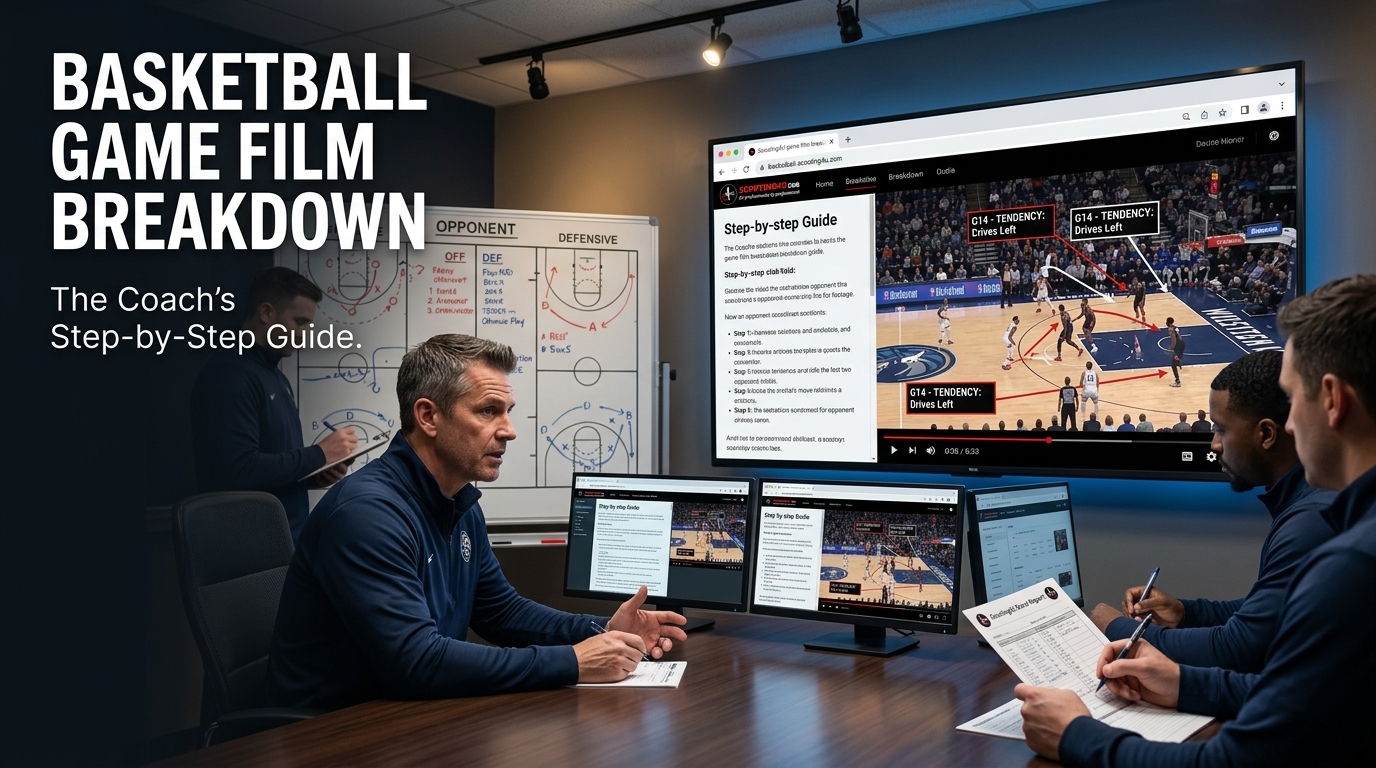
Basketball Game Film Breakdown: Coach's Step-by-Step Guide
Key Takeaways
A basketball game film breakdown is one of the most direct ways to improve team performance and player development.
Scouting4U offers tools that streamline video analysis and tagging for coaches at every level.
Player metrics like PER, TS%, and USG% become far more useful when paired with visual film analysis.
Effective breakdowns require a structured, step-by-step approach for both offense and defense.
The right video analysis software makes a basketball game film breakdown faster and more accurate.
Introduction to Basketball Game Film Breakdown
Breaking down game film is a cornerstone of modern basketball coaching. Numbers tell part of the story, but a basketball game film breakdown reveals what statistics miss - the late rotation, the missed screen, the spacing that collapses under pressure. Coaches who run a consistent basketball game film breakdown process gain a sharper picture of player decisions, team habits, and strategic gaps. This guide walks through exactly how to do it, step by step, using tools and methods that work at any level of the game.
Why a Basketball Game Film Breakdown Matters
A basketball game film breakdown gives coaches something no box score can: context. You can see whether that turnover was a bad pass or a miscommunication. You can see whether the defense broke down because of a scheme problem or an individual mistake.
That distinction matters enormously when you are trying to improve. If you blame the scheme when the player is at fault - or vice versa - you will drill the wrong thing all week. A proper basketball game film breakdown cuts through that confusion.
Beyond diagnosis, film review builds player accountability. When athletes watch themselves make a decision, the feedback lands differently than a verbal correction on the sideline. Most players are more self-critical after watching film than coaches expect. That self-awareness accelerates development.
Opponents benefit from film work too. A structured basketball game film breakdown of upcoming opponents can expose tendencies - where a point guard likes to go in pick-and-roll, which wing shoots off the catch, where the defense gambles for steals. That knowledge changes how you prepare your team each week.
Analyzing Offensive Plays
Offensive film analysis centers on three questions: Are we getting good shots? Are we moving the ball efficiently? Is our spacing creating opportunities or collapsing them?
Metrics like Offensive Rating (ORTG) and True Shooting Percentage (TS%) help you measure efficiency. But the basketball game film breakdown tells you why those numbers look the way they do. A low TS% might mean players are settling for mid-range pull-ups. Or it might mean the offense is generating good looks but players are missing open threes. Those are very different problems.
Look for how players read the defense on drive-and-kick situations. Watch whether ball handlers attack the right side of screens. Check whether off-ball players are staying wide or drifting into the paint. Each of these details shapes your shooting percentages in ways that the stats alone cannot explain.
Assist Percentage (AST%) and Usage Percentage (USG%) give you a sense of ball distribution, but watch the film to see whether the assist came from a pre-designed play or from a player creating something off script. Both are valuable. The basketball game film breakdown tells you which is which.
Defensive Play Assessment
Defense is where a basketball game film breakdown earns its keep. Defensive breakdowns are hard to measure statistically, but they are usually visible on film within seconds.
When you review defensive possessions, focus on positioning, communication, and help rotations. Defensive Rating (DRTG) gives you the big picture, but watch the film to find which situations your defense is losing - late switches, transition defense, baseline drives. Steal Percentage (STL%) tells you if a player gambles, but film shows you whether those gambles are calculated or reckless.
Tag your defensive clips by possession type - ball screen defense, post defense, transition defense, zone sets. That categorization makes it much easier to identify patterns. If you notice your team gives up 70% of its points off ball screens, that is a specific problem you can address in practice. Without the basketball game film breakdown, you might not even notice the pattern.
For a deeper look at identifying defensive weaknesses through systematic film review, see our guide on Basketball Defensive Scouting: Identify Weaknesses.
Using Basketball Video Analysis Software
The right software changes how practical a basketball game film breakdown actually is. Without it, tagging clips is slow, searching for specific play types is tedious, and sharing clips with players or staff requires extra steps. With it, the whole process becomes manageable even for coaches who do not have a full support staff.
Look for software that handles video tagging, play-by-play categorization, and integration with statistical data. Scouting4U's platform is built specifically for basketball analysis - not adapted from generic video tools. That means the tagging categories, the workflow, and the output formats are designed around how basketball coaches actually think about the game.
Highlight reel creation is another feature worth using. When you pull together clips of a player's best reads, best defensive rotations, or worst shot selection decisions, you give them something concrete to study. For tips on building effective clip packages, read our article on Basketball Highlight Reel Tips: Create Impactful Reels.
Explore the full range of analysis tools available at Scouting4U platform features and tools to see what fits your workflow.
Steps for an Effective Basketball Game Film Breakdown
Step 1: Collect and Organize Footage
Start by gathering clear, complete footage. Broadcast feeds work well, but in-house recordings are often better because you control the camera angle. Wide-angle shots showing all five players are more useful for diagnosing team concepts than close-up broadcast angles that follow the ball.
Organize footage by game date and opponent before you do anything else. A consistent file structure saves time when you need to pull clips weeks later for comparison.
Step 2: Set Clear Objectives
A basketball game film breakdown without a clear purpose often becomes a long session where you watch a lot of film and come away without actionable conclusions. Before you press play, decide what you are looking for.
Are you preparing for a specific opponent? Focus on their tendencies. Are you reviewing your own team's execution? Focus on a specific scheme or player. Are you evaluating a recruit? Know what traits you are measuring before the film starts. Clear objectives keep the session focused and short enough to stay productive.
Step 3: Tag and Categorize Plays
Tagging is where a basketball game film breakdown becomes searchable and reusable. Categorize plays into broad buckets first - offense, defense, transition - then get more specific. Ball screen offense, post-up defense, late-game situations, set plays.
Good tagging turns one game film session into a database you can draw from all season. Want to show a player every time they turned the ball over on the right side of the floor? If you tagged it, you can pull it up in 30 seconds. Our detailed guide on Basketball Video Tagging: Efficient Game Film Analysis covers best practices for building a tagging system that actually holds up over a long season.
Step 4: Analyze and Interpret Data
Once your clips are tagged, look for patterns rather than isolated incidents. One bad decision does not tell you much. Five of the same bad decision in three games tells you something real.
Cross-reference what you see with statistical data. If USG% shows a player is handling a heavy load but your film review shows they struggle against pressure, that combination tells you something about how to adjust their role. Film and stats answer different questions. The basketball game film breakdown answers the "why" that stats raise.
Step 5: Develop Actionable Insights
Analysis without action is just watching film. Every basketball game film breakdown session should end with specific outputs: a drill to address a defensive breakdown, a practice rep to reinforce a set play, a conversation with a player about a decision pattern you spotted.
Write your findings down immediately after the session. Your memory of what you noticed will fade faster than you expect. A written summary - even a few bullet points per game - builds a record you can reference when you revisit the same issues later in the season.
Integrating Analytics with Film Breakdown
Film and analytics work best together. Neither replaces the other. A basketball game film breakdown gives you the visual context; analytics give you the scale to know how significant what you are seeing actually is.
Player Efficiency Rating (PER) and Win Shares are aggregate measures. They tell you a player is performing well or poorly, but not in what specific situations. The basketball game film breakdown narrows that down. You might find that a player's PER drops sharply in the fourth quarter - and film confirms they are making poor decisions under fatigue. That is a specific, addressable finding.
Opponent analytics work the same way. Knowing a team ranks in the bottom quartile in transition defense tells you to run. Watching their film breakdown tells you exactly how and where to attack that weakness. For a broader look at combining statistics with visual scouting, see Mastering Basketball Analytics for Coaches: A Guide.
Shot chart analysis is another area where film and data reinforce each other. A shot chart shows where attempts are coming from. The basketball game film breakdown shows how those shots are being created - which is often more important than where they are landing. See our guide on How to Analyze Basketball Shot Charts Effectively for a practical walkthrough.
Building a Repeatable Film Breakdown Process
The coaches who get the most out of film review are not the ones who watch the most footage. They are the ones who have a repeatable process that runs efficiently every week.
A sustainable basketball game film breakdown system has a few qualities. It takes a predictable amount of time - ideally under two hours per game. It produces consistent outputs: a written report, a clip package for players, notes for practice planning. And it involves the right people. Some coaches review film alone. Others bring assistant coaches or even players into certain sessions. Each approach has trade-offs.
If you are building a film review process for the first time, start simple. Pick two or three focus areas per game - one offensive concept, one defensive scheme, one player development priority. Do that consistently for a month before adding complexity. A focused basketball game film breakdown done every week beats an exhaustive one done twice a season.
Over time, your film library becomes one of the most useful resources on your staff. Every tagging session adds to it. Every breakdown of an opponent goes on record. When you face that opponent again six months later, you have a head start.
The Role of Scouting4U in Film Breakdown
Scouting4U was built around the realities of basketball analysis work - not adapted from generic sports software. The platform handles the full basketball game film breakdown workflow: video upload, tagging, statistical integration, clip export, and report generation. Coaches and scouts can run a complete basketball game film breakdown inside one platform without switching between tools.
For teams that do not have large analytics departments, that matters. The basketball game film breakdown process should not require a technical specialist to run. Scouting4U is designed so that coaches can drive the analysis themselves, without needing to outsource the data side to someone else.
To see what subscription options fit your program's needs, visit the Scouting4U subscription plans and pricing page. If you want to see the platform in action before committing, the contact and demo requests page makes that straightforward.
Frequently Asked Questions
How often should coaches run a basketball game film breakdown?
Most competitive programs review at least one game of their own footage per week, plus film on upcoming opponents. The frequency depends on your staff size and schedule, but consistency matters more than volume. A focused basketball game film breakdown done every week is more useful than an exhaustive session done sporadically.
How long does a basketball game film breakdown take?
A thorough breakdown of a single game typically takes between 90 minutes and three hours, depending on how much you tag and how deep you go on specific sequences. With good software and clear objectives set before you start, you can usually keep sessions under two hours without missing much.
What is the best way to present film findings to players?
Short clip packages work better than full-game reviews in team settings. Pull five to ten clips that illustrate the specific points you want to address, and keep the session under 20 minutes. Players retain more from focused clip reviews than from watching long stretches of game footage. One-on-one film sessions with individual players can go deeper on personal development topics.
Can a basketball game film breakdown be useful at the youth level?
Yes, though the approach needs to match the age group. Younger players benefit most from short, positive clip packages that reinforce what they are doing well. At the high school level, you can introduce more tactical analysis. The core process - tag, analyze, find patterns, address them in practice - scales down to any level where you have access to game footage.
How does film breakdown differ from opponent scouting?
A self-scout basketball game film breakdown focuses on your own team's execution, habits, and development needs. Opponent scouting focuses on tendencies, set plays, and individual player patterns in the team you are preparing to face. Both use the same tools and many of the same techniques, but the questions you are asking are different. Many programs run both types of breakdown each week during the season.
Enjoyed this article? Share it with others!
Founder & Lead Scout, Scouting4U
2x EuroLeague champion with 30+ years in professional basketball. Daniel won EuroLeague titles with Maccabi Tel Aviv, helped build the staff behind the 2007 European Championship, and has delivered 100+ professional scouting reports across 50+ leagues. If it happened in a European basketball front office, he was probably in the room. He founded Scouting4U in 2010 to bring championship-level scouting intelligence to every club.
No reviews yet. Be the first to share your experience!
Related Articles

Basketball Analysis: Elevate Game Insights with Video
Key TakeawaysSystematic video breakdown improves decision-making at every level of the game.Video tagging software makes...
Mastering Basketball Video Analysis for Coaches
Key TakeawaysBasketball video analysis helps coaches evaluate players and teams more accurately.Scouting4U offers advanc...

True Shooting Percentage Basketball: Calculation & Insights
Key TakeawaysTrue shooting percentage basketball offers a comprehensive efficiency metric that goes beyond simple field ...