

Basketball Scouting Report Template: Create Winning Reports
Key Takeaways
A basketball scouting report template makes player evaluation faster and more consistent.
Metrics like PER, TS%, and USG% are the backbone of any solid report.
The right template structure helps coaches and front offices compare players across leagues.
Technology - especially AI-powered tools - is changing how scouts build and use reports.
Scouting4U gives scouts a professional platform to create, store, and analyze reports at scale.
Why Every Scout Needs a Basketball Scouting Report Template
A basketball scouting report template is the foundation of any serious evaluation process. Without one, scouts record different information in different formats. Comparisons become guesswork. Decisions slow down. A good template fixes all of that.
Whether you work in an NBA front office, scout European leagues, or evaluate players for a college program, the basketball scouting report template gives you a repeatable system. You collect the same data points on every player. You can compare a shooting guard from the EuroLeague to one from the G League using the same criteria. That consistency is what separates professional scouting from casual watching.
This guide covers what goes into a basketball scouting report template, how to use one well, and how modern tools are making the whole process faster and more reliable.
What Is a Basketball Scouting Report Template?
A basketball scouting report template is a structured document that guides scouts through the evaluation of a player. It tells you what to look for, where to record it, and how to organize it so someone else can read it quickly.
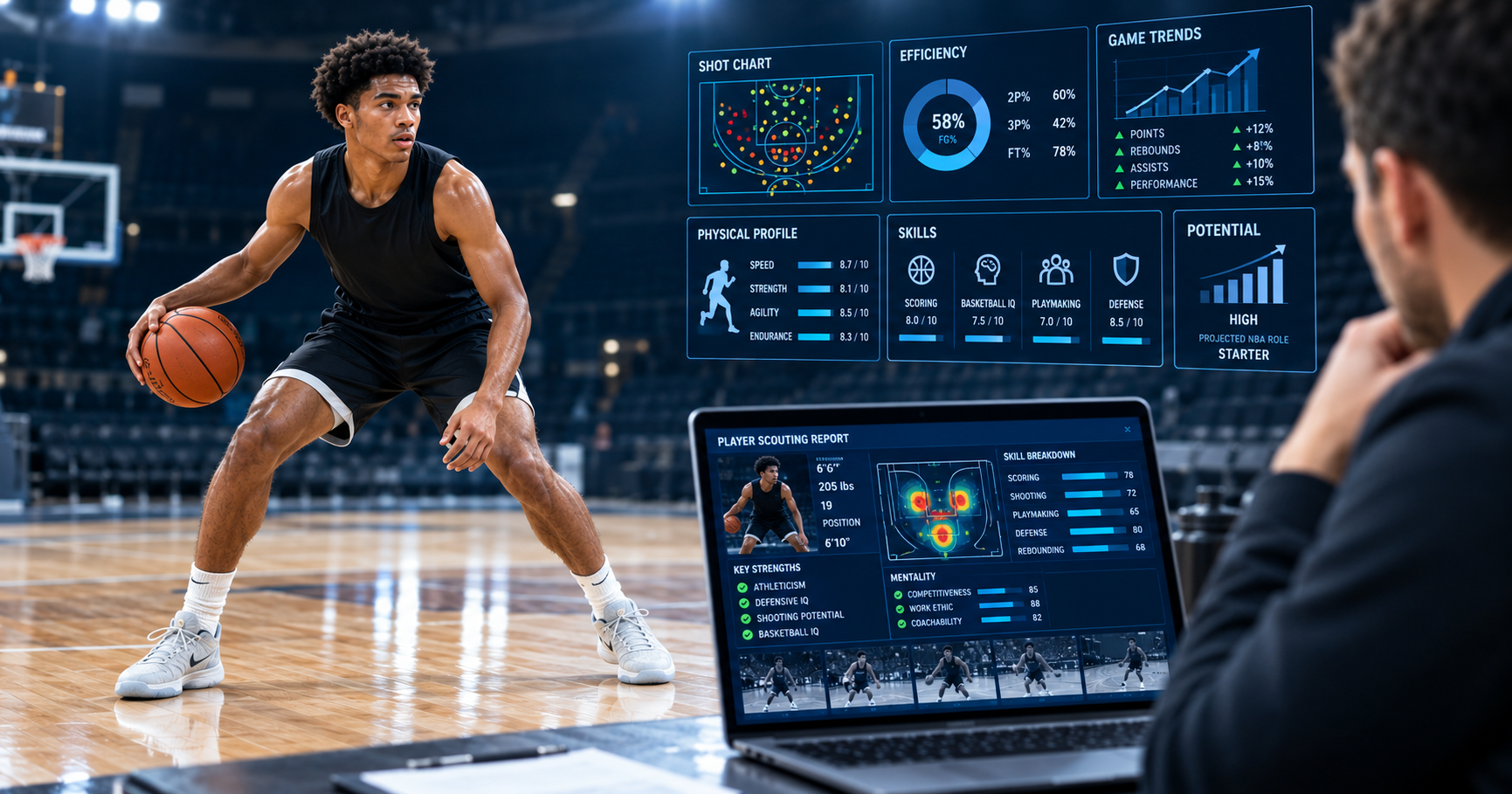
A strong basketball scouting report template covers physical profile, statistical performance, skill assessment, and fit analysis. Each section serves a purpose. Physical data provides context. Stats reveal patterns. Skill ratings capture what you saw with your eyes. Fit analysis ties it all to a specific team's system.
The best templates are not rigid checklists. They are flexible enough to capture nuance while staying consistent enough to support comparison. That balance is what makes a basketball scouting report template actually useful in practice.
Core Sections of a Basketball Scouting Report Template
Player Profile and Physical Data
Every basketball scouting report template starts with the basics. Name, age, position, height, weight, wingspan, and current team. These details seem obvious, but they matter. A 6'8" wing who plays like a guard reads differently once you know his wingspan is 7'1".
Include contract status and league context here as well. A player finishing a deal in a weaker domestic league looks different from one wrapping up a EuroLeague contract. That context changes how you interpret everything else in the report.
Statistical Performance Metrics
Numbers give your observations structure. The most useful stats for a basketball scouting report template include:
PER (Player Efficiency Rating) - summarizes a player's per-minute contribution across multiple statistical categories.
TS% (True Shooting Percentage) - accounts for two-pointers, three-pointers, and free throws to give a true picture of shooting efficiency.
USG% (Usage Percentage) - shows how often a player is involved in possessions when on the court.
AST/TO ratio - tells you how efficiently a player distributes the ball relative to turnovers.
DRTG (Defensive Rating) - points allowed per 100 possessions when the player is on the floor.
Do not stop at counting stats. Points, rebounds, and assists per game tell you what happened. Advanced metrics tell you why it happened and whether it is likely to continue. For a deeper look at how to apply analytics within your template, read our guide on mastering basketball analytics for coaches.
Skill and Tendency Assessment
This is where the basketball scouting report template goes beyond what any box score can capture. You rate specific skills - ball handling, shot creation, off-ball movement, pick-and-roll defense, transition play - and you note the tendencies behind them.
Tendencies are patterns. Does the player always go right off the dribble? Do they stop attacking in the fourth quarter? Do they switch defensively without being told, or do they freeze? These details do not show up in a stat line. They show up in film and live observation. Your template needs a place for them.
Understanding player tendencies at this level is one of the biggest edges a scout can develop. It is also one of the most underused sections in a basic basketball scouting report template. For more on this, see our post on basketball player tendency analysis as a scouting weapon.
Team Fit and Role Projection
A player does not exist in isolation. The basketball scouting report template should always include a section on fit. What role would this player fill? What system suits their game? Can they play alongside your current roster without creating redundancy?
A player who averages 20 points per game as a first option might be a perfect third scorer for a contender - or a disaster if the team already has two ball-dominant wings. The fit section of your basketball scouting report template forces you to think about this before you make a recommendation.
How to Use a Basketball Scouting Report Template Effectively
Train Everyone on the Same Standards
A basketball scouting report template only works if every scout uses it the same way. That means agreeing on rating scales. If one scout rates a "good defender" as a 7/10 and another rates the same player as a 4/10, you have a comparison problem, not a scouting advantage.
Run calibration sessions where scouts evaluate the same player independently and then compare scores. Identify where the gaps are. Discuss what the template's criteria actually mean. This is not glamorous work, but it is what separates organizations that use templates well from those that just have them sitting in a folder somewhere.
Combine Live Observation with Data
The basketball scouting report template should never be filled out using only statistics. Stats without context mislead you. A player averaging 18 points per game in a weak league against slow competition looks different than one averaging 12 points per game in a high-paced, competitive system.
Watch the player live or on film. Fill in the statistical sections with data. Then go back and make sure the numbers and your observations align. When they do not align, that is worth noting explicitly in the template. It usually signals something interesting - either the stats are missing context or your initial observation needs adjusting.
Review and Update Reports Over Time
A basketball scouting report template is not a one-and-done document. Players develop. Their tendencies shift. A 21-year-old wing you scouted two years ago is not the same player today. Build a habit of updating reports when you see a player again or when new data becomes available.
The organizations that do this well build actual databases of reports, not just folders of PDFs. Every new observation layers onto the old one. Over time, that depth of history becomes a real competitive advantage when evaluating players for recruitment or trade targets.
The Basketball Scouting Report Template in Different Contexts
NBA and Professional Scouting
At the professional level, the basketball scouting report template is highly detailed. Reports often run several pages per player and include video timestamps, advanced data, and projected contract value. Front office teams use these reports to build draft boards, evaluate trade targets, and assess free agent fits.
The stakes are high, so the template needs to be thorough. Missing a key tendency or skipping the fit analysis can cost a team millions of dollars and years of competitive development. For more on data-driven approaches at this level, see our guide on data-driven basketball recruitment for front offices.
College and Amateur Scouting
At the college level, the basketball scouting report template tends to focus more on potential and physical upside. Statistical context matters less because competition levels vary so widely. The skill and tendency sections carry more weight here.
College scouts are often projecting what a player will become, not just evaluating what they are now. That projection work requires a template that explicitly asks for developmental assessment - not just current ratings but realistic ceiling estimates based on age, athleticism, and work ethic.
International and European Scouting
European scouting adds another layer of complexity. Statistical formats vary by league. Physical measurement standards differ. Cultural and system context shapes how you interpret a player's role in ways that do not always translate directly.
A good basketball scouting report template for international work includes league-adjusted context fields. It notes whether a player operated in a motion offense or a set-play system, whether their team was a top-four contender or a mid-table side, and whether they faced elite competition regularly.
How Technology Is Changing the Basketball Scouting Report Template
The traditional basketball scouting report template lived in a notebook or a Word document. Today, it lives in software. Platforms built for professional scouting let you fill out templates digitally, attach video clips directly to specific ratings, and run comparisons across your entire database instantly.
AI tools are pushing this further. Some platforms can now generate a draft basketball scouting report template in minutes, pulling data automatically and flagging tendencies from video analysis. The scout's job shifts from manual data entry to verification and judgment - which is where human expertise actually matters.
This shift does not make the basketball scouting report template less important. It makes the structure of the template more important, because the software is only as useful as the framework you feed it. Garbage in, garbage out - whether a human or an algorithm is doing the analysis.
To see how AI is reshaping this process in practice, read how AI basketball scouting reports technology transforms scouting. And if you want to explore the tools Scouting4U offers for building and managing your reports, visit our platform features page.
Common Mistakes Scouts Make With Report Templates
The most common mistake is treating the basketball scouting report template as a form to fill out rather than a thinking tool. Scouts rush through sections, assign ratings without explanation, and skip the fit analysis because it takes time. The result is a report that checks boxes but does not actually help anyone make a decision.
Another mistake is using a template that never changes. The game evolves. New positions emerge. Three-point volume changes how you evaluate shooting efficiency. Your basketball scouting report template should be reviewed and updated at least once per season to reflect how the game is actually being played.
Finally, some scouts over-rely on statistics and under-invest in tendency analysis. Stats are descriptive. Tendencies are predictive. The best basketball scouting report template balances both.
Conclusion
A well-designed basketball scouting report template is one of the most practical tools in a scout's arsenal. It creates consistency across your organization, speeds up comparison, and forces you to think about fit and role - not just raw performance. The template itself is not the answer to finding great players, but it is the structure that makes good judgment scalable.
Start with the core sections: player profile, statistical metrics, skill and tendency ratings, and fit analysis. Train your team to use the basketball scouting report template consistently. Update it as the game changes. And take advantage of the platforms and tools that can automate the low-value parts so you can focus on the analysis that actually separates good scouts from great ones.
If you want to see what a professional-grade basketball scouting report template looks like in action, explore Scouting4U's platform features or check our subscription plans to find the right tier for your organization.
Frequently Asked Questions
What should a basketball scouting report template always include?
At minimum, a basketball scouting report template should include the player's physical profile, key performance metrics (such as PER, TS%, and USG%), a skill and tendency assessment, and a team fit analysis. Without all four sections, you are missing either context, evidence, observation, or application - and each one matters for making a good evaluation.
How is a basketball scouting report template different from a simple stat sheet?
A stat sheet tells you what happened numerically. A basketball scouting report template tells you what those numbers mean in context, what you observed beyond the box score, and whether a player fits a specific role or system. The template is an analytical document. The stat sheet is just raw data.
How often should you update your basketball scouting report template structure?
Review the structure at least once per season. The game changes - shooting volumes shift, defensive schemes evolve, new position types emerge. A basketball scouting report template that made sense three years ago may not capture the most relevant information today. Keep it current.
Can a basketball scouting report template be used for youth or amateur players?
Yes, but the emphasis shifts. For younger players, the template should weight developmental potential and physical projection more heavily than current statistical output. The core structure stays the same - profile, stats, skills, fit - but the fit section becomes a projection of future role rather than an immediate deployment analysis.
How does AI change the way scouts use a basketball scouting report template?
AI tools can automate the data-gathering and initial draft stages of a basketball scouting report template, pulling statistics and flagging patterns from video automatically. This frees scouts to focus on judgment - verifying AI-generated findings, adding contextual observation, and making the fit and tendency calls that require human expertise. The template structure becomes more important, not less, because the AI is only as useful as the framework it is working within.
Enjoyed this article? Share it with others!
Founder & Lead Scout, Scouting4U
2x EuroLeague champion with 30+ years in professional basketball. Daniel won EuroLeague titles with Maccabi Tel Aviv, helped build the staff behind the 2007 European Championship, and has delivered 100+ professional scouting reports across 50+ leagues. If it happened in a European basketball front office, he was probably in the room. He founded Scouting4U in 2010 to bring championship-level scouting intelligence to every club.
No reviews yet. Be the first to share your experience!
Related Articles

Future of Basketball Scout Reports: AI & Innovation
Key Takeaways Basketball scout reports are changing fast because of AI. Data collection and analysis now happen in a fr...

AI Scouting Reports in Basketball: The Scouting Edge
Key Takeaways AI scouting reports basketball tools give coaches faster, clearer data on players. Scouting4U pairs AI an...
Analyzing Basketball Player Potential: Scouting Insights
Key Takeaways Analyzing basketball player potential combines data analysis with scouting intuition. Core metrics includ...