
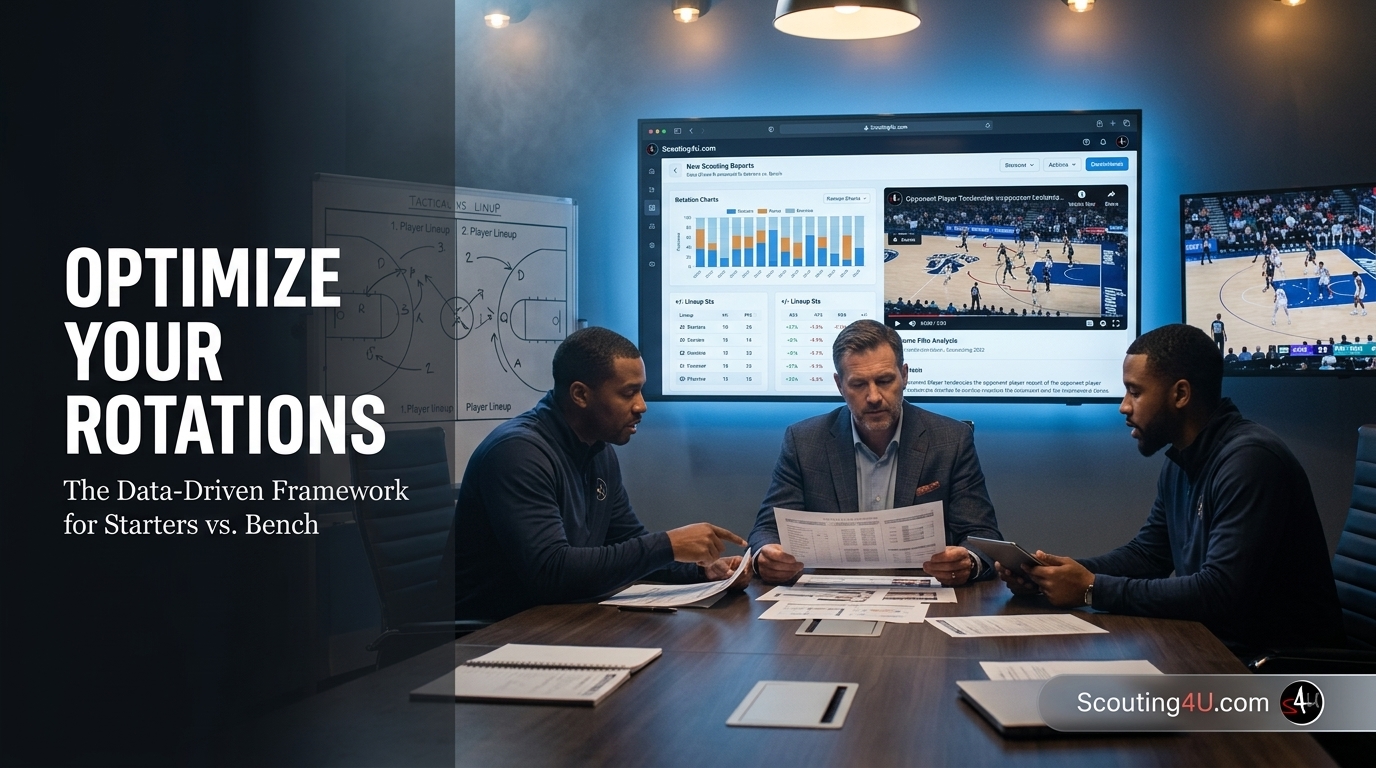
Optimize Your Basketball Rotation: Starters vs Bench
Basketball Rotation Optimization Starters Bench: A Complete Guide
Basketball rotation optimization starters bench strategy sits at the heart of how coaches win or lose games. Get your rotations right, and you control pace, energy, and matchups. Get them wrong, and even a talented roster falls flat. This guide walks through the data, the decisions, and the practical steps coaches need to build smarter rotations - from tip-off through the final buzzer.
Why Basketball Rotation Optimization Starters Bench Decisions Matter
Every coach knows the feeling: your starters go cold in the second quarter, the other team goes on a 10-2 run, and suddenly you're scrambling. That scenario is often a rotation problem, not a talent problem.
Basketball rotation optimization starters bench planning means you decide in advance who plays when, for how long, and against which opponents. It removes guesswork during high-pressure moments. It also protects your starters' legs for the fourth quarter, when games are won.
The starters set the tone. The bench holds the lead - or blows it. Both groups need clear roles.
Research across professional leagues consistently shows that teams with deep, well-managed rotations outperform teams that rely heavily on six or seven players. Fatigue is a real factor. A starter logging 38 minutes per game in February is not the same player in April.
Core Metrics for Smarter Rotation Decisions
Basketball rotation optimization starters bench work starts with the right numbers. Raw scoring totals don't tell the full story. You need metrics that show efficiency, not just volume.
Here are the numbers worth tracking for every player in your rotation:
Usage Rate (USG%) - how often a player is involved in offensive plays while on the floor
Player Efficiency Rating (PER) - a single number capturing overall production per minute
True Shooting Percentage (TS%) - measures scoring efficiency including free throws and three-pointers
Net Rating - how the team performs per 100 possessions with a given player on the floor
On/Off splits - how lineup performance changes when a player enters or exits
For a deeper look at how to calculate and apply these numbers, check out our post on True Shooting Percentage Basketball: Calculation & Insights. Understanding TS% alone can change how you evaluate which bench players are actually helping you win.
The key is combining metrics rather than relying on one number. A player with a high PER but a negative net rating might be hurting team defense. Basketball rotation optimization starters bench decisions require the full picture.
Building Your Starting Five Around Fit, Not Just Talent
The best players don't always make the best starting lineup. Fit matters. Chemistry matters. Matchup considerations matter.
Basketball rotation optimization starters bench strategy begins with asking: what does this starting group need to accomplish in the first six minutes? Usually, the answer is establish tempo, control the paint, and limit easy transition buckets. Your starters should be selected to do exactly that - not simply because they're your five best individual players.
A few practical questions to ask when setting your starting lineup:
Does this group have enough floor spacing?
Can they guard the opponent's best offensive players without switching problems?
Are there obvious mismatches the opponent will exploit immediately?
Do two or more starters have overlapping roles that create redundancy?
European basketball provides some instructive examples here. Coaches in leagues like EuroLeague often prioritize tactical balance in their starting five over raw individual ratings. The result is cleaner ball movement and better defensive structure from the opening tip. For more on those tactical differences, read our breakdown of Comparing European and American Basketball Styles: Key Insights.
Managing Your Bench: Roles, Minutes, and Momentum
Basketball rotation optimization starters bench management means treating your bench as a strategic weapon, not a backup plan.
Your first wave off the bench - usually two or three players entering together around the five-minute mark of the first quarter - sets the tone for how your team responds to adversity. These players need defined roles. A bench scorer who tries to do too much disrupts flow. A defensive specialist who understands his job can completely change a possession sequence.
Minutes management is where a lot of coaches leave points on the table. A common mistake: waiting too long to pull a starter who's struggling, because the coach feels loyal to the player's reputation. Basketball rotation optimization starters bench decisions should be driven by what's happening in the game, not by a player's contract or starting history.
Staggering your rotations also helps. If you pull all five starters at once, you lose continuity and give the opponent a chance to go on a big run. Instead, pull two or three players, let the remaining starters stabilize the lineup with fresh legs, then complete the substitution.
For a framework on how analytics can speed up these in-game decisions, the 30-Minute Game Prep: AI Scouting Tips Made Easy guide is worth reading before your next practice or film session.
Pick and Roll Defense and Rotation Adjustments
Pick and roll defense is where basketball rotation optimization starters bench decisions get most complicated. Your choice of defensive scheme - hedge, drop, switch, or blitz - changes which players you can use together.
A lineup with two slow-footed bigs cannot switch every ball screen. A lineup with three perimeter players might struggle to hedge without giving up paint touches. These constraints directly shape which bench players can sub in without breaking your defensive structure.
When preparing for an opponent with a heavy pick and roll offense, map out which of your players can credibly defend ball screens in your chosen scheme. If your backup center can't hedge effectively, you either need to adjust your scheme when he plays or limit his minutes in those situations. This kind of advance planning is what separates reactive coaching from proactive basketball rotation optimization starters bench work.
Scouting the opponent's tendencies matters here too. A point guard who attacks drop coverage will punish you differently than one who relies on the roll man. For building those scouting reports efficiently, see our guide on Mastering Basketball Analytics for Coaches.
Using Data Tools to Refine Rotations Over a Season
Basketball rotation optimization starters bench decisions shouldn't be static. What works in October may not work in February. Players develop. Opponents adjust. Injuries change your options.
Data tools like Scouting4U allow coaches to track lineup performance across weeks and months, not just individual games. You can identify which two-player combinations consistently produce positive net ratings, and which pairings - however talented individually - consistently hurt your margin.
Some patterns only appear over 20 or 30 games. A bench unit might look fine on the surface but be giving up too many second-chance points every time they play together. Without tracking that data, you'll never see it.
The Scouting4U platform features include lineup tracking, player performance splits, and scouting report generation that feeds directly into rotation planning. Coaches at the amateur level now have access to the same analytical tools that professional staffs use - that's a real change in how rotation decisions can be made.
For amateur teams still figuring out where to start with analytics, the article on Why Amateur Basketball Teams Need Analytics Now outlines the practical starting points without requiring a statistics background.
Practical Rotation Templates by Game Situation
Basketball rotation optimization starters bench planning works best when you have default templates for different game situations. Here are three common scenarios and how to approach each:
Close game, fourth quarter: Reduce to your seven or eight most trusted players. Bench usage should be limited to rest breaks of two or three minutes for starters, not extended runs. Defense and free throw shooting become the main criteria for who's on the floor.
Blowout win: Get your bench extended minutes with real responsibility. These are development reps that pay off later in the season. Don't just run out the clock - use the time to run half-court sets and work on things you need in March.
Blowout loss: Resist the urge to bring back starters and chase the game. If you're down 20 in the third quarter, use bench players to maintain competitiveness while resting starters for the next game. Basketball rotation optimization starters bench thinking is season-long, not just game-by-game.
Historical Examples of Rotation Mastery
Some of the most successful teams in basketball history got there through rotation discipline. Gregg Popovich's San Antonio Spurs ran deep rotations for years, resting starters in regular season games when it made sense and using bench players in defined, repeatable roles. The result was a group that consistently outperformed its individual talent level.
In European basketball, Anadolu Efes under Ergin Ataman used rotation depth as an offensive weapon. Fresh legs in the third quarter meant their motion offense ran harder than the opposition's defense could track. Basketball rotation optimization starters bench management was central to their EuroLeague success.
These examples share a common thread: the coaches trusted their systems and their data, not their gut alone.
Getting Started With Better Rotations
If you're new to data-driven basketball rotation optimization starters bench planning, the learning curve is shorter than you might expect. Start by tracking two things: net rating for each lineup combination you use, and how many minutes your starters play per game.
Once you have two or three weeks of data, patterns emerge. You'll see which bench players help your team and which hurt it. You'll know if your starters are playing too many minutes to stay sharp. Those two data points alone will change how you fill out your rotation card.
From there, you can layer in more metrics, scouting report integration, and opponent-specific adjustments. The Scouting4U subscription plans are built to scale with that process - whether you're coaching a youth program or a professional roster.
Conclusion
Basketball rotation optimization starters bench management is one of the most controllable factors in a coach's toolkit. It doesn't require elite talent. It requires clear thinking, honest data, and the discipline to stick with your system when the game gets tight.
Start with the metrics that matter. Define roles for your bench players. Plan your substitution patterns before tip-off. Track lineup combinations over time. And use the tools available to you - because basketball rotation optimization starters bench decisions made with real data consistently outperform decisions made on instinct alone.
The margin between winning and losing at every level of basketball is often found in the rotations. That's where games are quietly decided long before the final buzzer.
Frequently Asked Questions
What is basketball rotation optimization starters bench strategy?
Basketball rotation optimization starters bench strategy is the process of deciding which players start, which come off the bench, how many minutes each player logs, and when substitutions happen. It uses player performance data, matchup analysis, and game situation planning to get the most out of a full roster across 40 minutes.
How many players should be in a standard rotation?
Most teams at the professional and high-level college level use 8 to 10 players in regular rotation. In close playoff or tournament games, that often narrows to 7 or 8. The right number depends on roster depth, game situation, and how much trust the coach has in each player's role execution.
What metrics matter most for basketball rotation optimization starters bench decisions?
Net rating - how the team performs with a specific player on the floor - is one of the most telling numbers. Combined with usage rate, true shooting percentage, and on/off splits, these metrics give coaches a clear picture of each player's real impact rather than just their counting stats.
How can analytics tools help with rotation planning?
Analytics platforms like Scouting4U track lineup combinations, player efficiency splits, and opponent tendencies in one place. This allows coaches to identify which bench units produce positive margins and which starting combinations hold up defensively against specific opponents - information that would take hours to compile manually.
Should rotation planning change during the playoffs or late in the season?
Yes. As stakes increase, most coaches tighten their rotation to their most reliable players. Bench roles become more defined and minutes become harder to earn. Basketball rotation optimization starters bench planning late in a season also accounts for fatigue - starters who played heavy regular season minutes may need slightly reduced workloads to peak at the right time.
Enjoyed this article? Share it with others!
Founder & Lead Scout, Scouting4U
2x EuroLeague champion with 30+ years in professional basketball. Daniel won EuroLeague titles with Maccabi Tel Aviv, helped build the staff behind the 2007 European Championship, and has delivered 100+ professional scouting reports across 50+ leagues. If it happened in a European basketball front office, he was probably in the room. He founded Scouting4U in 2010 to bring championship-level scouting intelligence to every club.
No reviews yet. Be the first to share your experience!
Related Articles

Analyzing Basketball Player Potential: Scouting Insights
Key Takeaways Analyzing basketball player potential combines data analysis with scouting intuition. Core metrics includ...

Mastering Basketball Service: Scouting Insights & Tools
Key TakeawaysA strong basketball service covers everything from player evaluation to game strategy analysis.Scouting4U g...

One Shot Chart. Three Insights Visual: Game Plan Revolution
Key TakeawaysA basketball shot chart three insights visual approach reveals high-efficiency zones, player tendencies, an...