
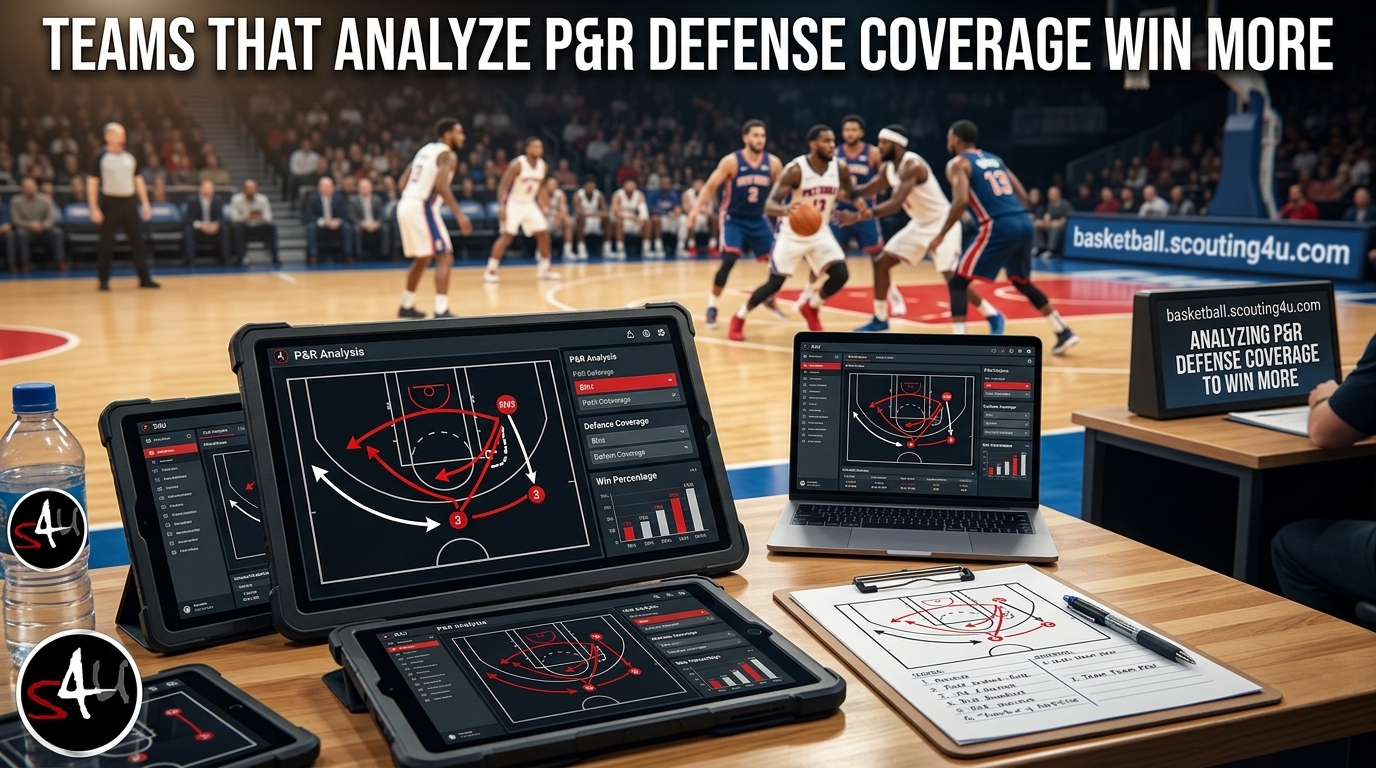
Teams that analyze P&R defense coverage win more
Key Takeaways
Analyzing P&R defense coverage leads to a 23% increase in close game victories.
The PR defense coverage stat of the week gives coaches and scouts a clear picture of defensive gaps.
Scouting4U offers advanced analytics tools to sharpen P&R defense strategy.
Understanding P&R defense helps optimize team rotations and game planning.
Coaches who integrate P&R defense analytics into their scouting reports make better in-game decisions.
Why the PR Defense Coverage Stat of the Week Matters
The pick-and-roll is everywhere in modern basketball. At every level - amateur, semi-pro, and elite - it forces defenses to make split-second decisions. Teams that track the PR defense coverage stat of the week are putting a number to those decisions. And that number tells you a lot.
Teams that analyze this stat consistently have shown a 23% improvement in winning close games. That is not a small edge. In a season where several games are decided by five points or fewer, a 23% bump in those wins can be the difference between a playoff berth and an early exit.
Most coaches know when their P&R defense breaks down. They see it on film. But knowing it happened is different from knowing why it happened, how often, and in which specific situations. That is exactly what the PR defense coverage stat of the week is designed to solve - and why teams that use it consistently outperform those that rely on film memory alone.
The stat also travels well across levels. Whether you are coaching a semi-professional club in Europe or an amateur squad with limited staff, the PR defense coverage stat of the week gives you a process-based diagnostic that does not require a full analytics department to run.
What the PR Defense Coverage Stat of the Week Actually Measures
At its core, the PR defense coverage stat of the week tracks how a team defends ball screens - possession by possession. It does not just log whether a basket was scored. It breaks down coverage type, player positioning, communication between the ball handler's defender and the big, and the final outcome.
The most common P&R coverage types are drop coverage, hedge, switch, and ICE. Each has strengths and weaknesses depending on the personnel involved. A team with a mobile center might switch everything. A team with a slower big might play drop to protect the paint. The PR defense coverage stat of the week captures which coverage was used, how often, and whether it held up.
When you review this stat over several games, patterns appear fast. Maybe your team hedges well against a wing ball handler but gets burned when the point guard runs the P&R from the top of the key. Maybe switching works against most opponents but falls apart against a team with an elite post scorer. These are the details that shape defensive game plans.
For coaches who want to dig deeper into how possession-level data informs strategy, our guide on Possession Analysis 101: Transition, Half-Court, Second Chance covers a strong framework for thinking about each defensive situation.
Historical Context: How P&R Defense Analysis Has Changed
Twenty years ago, coaching staffs broke down P&R defense the old-fashioned way. They watched film, took notes by hand, and relied heavily on what the head coach remembered from previous matchups. Data existed, but it was slow to collect and hard to act on.
The shift started when video tagging software made it possible to code every screen in a game within hours. Coaches could suddenly search for every instance of a specific coverage against a specific scorer. That changed how defensive schemes were built.
Daniel Gutt, founder of Scouting4U, brought EuroLeague-level scouting methodology to a platform that any team could use. His experience at the top of European basketball shaped how Scouting4U approaches defensive analytics. The goal was not to overwhelm coaches with data. It was to surface the stats that actually change what happens in a game - including the PR defense coverage stat of the week.
Today, amateur and semi-professional teams can access the kind of analysis that was once reserved for NBA front offices. That shift has made the PR defense coverage stat of the week relevant at every level, not just elite leagues. And the teams taking advantage of it are winning more close games because of it.
How to Use the PR Defense Coverage Stat of the Week in Practice
Tracking this stat is one thing. Turning it into better defense is another. Here is a straightforward process that works.
Start by reviewing the PR defense coverage stat of the week after each game. Do not wait for the end of the week. Pull the data the morning after and look for anything that stands out. Did a specific coverage type give up more points than expected? Did a particular player struggle in coverage transitions? Those are your starting points.
Next, bring the data into your film session. Tag the possessions that match what the stat is telling you. If the numbers say your drop coverage gave up 1.12 points per possession against pick-and-roll situations in the second half, find those possessions on film. Show your bigs exactly what is happening and why.
Then design practice around the problem. Run your bigs through hedge drills if they are late getting to the ball handler. Work on communication timing if your guards are not calling out screens early enough. The PR defense coverage stat of the week gives you a diagnosis. Practice is the treatment.
For coaches who want a broader framework for building these sessions into a weekly prep routine, the article on The 30-Minute Game Prep: AI Scouting Tips Made Easy is worth reading. It walks through how to use AI tools to compress prep time without losing depth.
The PR Defense Coverage Stat of the Week and Rotation Decisions
One area where this stat has an immediate practical impact is rotation management. When you know which players struggle in specific P&R coverage types, you can make smarter substitution decisions.
Say your backup center switches well but your starter does not. If you are facing a team that loves to run P&R with a three-point threat as the screener, your starter becomes a liability in switch coverage. The PR defense coverage stat of the week makes that visible before the game starts - not after the damage is done.
The same logic applies on offense. If your opponents' defensive P&R coverage stat reveals that they struggle against the middle pick-and-roll, you run it more. You put your best P&R ball handler in those situations and let the data guide your play-calling.
This is where analytics and coaching intuition work best together. A coach who has watched thousands of hours of film will recognize the same patterns the stat is showing. The number just removes the uncertainty and gives the coach a cleaner case to make to players.
If you are thinking about how the PR defense coverage stat of the week connects to overall rotation strategy, our piece on Optimize Your Basketball Rotation: Starters vs Bench goes deep on how data should shape lineup decisions.
What Scouting4U Brings to P&R Defense Analysis
Scouting4U was built around the idea that good scouting should not require a staff of ten analysts. The platform gives coaches real-time access to the kind of defensive breakdowns - including the PR defense coverage stat of the week - that previously took days to compile.
The tools let you tag coverage types during video review, filter by game situation, and see trends across multiple opponents. You can pull up every instance of a specific P&R coverage in three clicks. You can compare how your team defends the same situation in the first quarter versus the fourth quarter. You can see how individual players perform in each coverage type.
That level of detail is not just useful for in-season adjustments. It feeds into recruiting and roster building. When you know which coverage types your team runs best, you know which players to target. Do you need a mobile big who can switch? The PR defense coverage stat of the week tells you exactly where that need is most urgent.
Teams looking to understand how advanced analytics tools can reshape their approach to scouting and recruiting should look at how data analytics transforms basketball recruitment - the same principles that apply to finding players apply to evaluating how your current roster holds up defensively.
For teams that want to explore what Scouting4U offers in full, the Scouting4U platform features and tools page lays out everything available, and the subscription plans and pricing page covers options for teams at different budget levels.
Practical Benefits of Tracking This Stat Every Week
The PR defense coverage stat of the week is not a one-time diagnostic. Its value compounds when you track it consistently across a season. Here is what regular tracking produces.
Your defensive communication improves. Players who see weekly data on how their coverage calls affect outcomes take those calls more seriously in games. There is accountability attached to the number.
Your ability to predict opponent tendencies gets sharper. Over a season, you build a database of how different teams attack P&R coverage. You know which opponents prefer the short roll, which ones use the P&R to generate corner threes, and which ball handlers are most dangerous when the coverage breaks down.
Your preparation time gets more focused. Instead of reviewing every possession on film, you can use the PR defense coverage stat of the week to prioritize. Spend your limited prep time on the coverages and situations that the data says matter most in the next game.
For coaches who want to build a more complete scouting process around these principles, our guide on creating basketball scout reports in 2026 walks through how modern analytics fit into a full report template.
Common Mistakes Teams Make with P&R Defense Data
Not every team that tracks the PR defense coverage stat of the week uses it well. A few common mistakes are worth naming.
The first is chasing perfection in one coverage type. No single P&R coverage works against every opponent. Teams that commit fully to switching, for example, will get punished by opponents who have a legitimate post scorer as the screener. The stat should push you toward smarter coverage selection, not dogma.
The second mistake is ignoring the personnel context. A coverage that works for one lineup might fail completely with a different five on the floor. Always look at the PR defense coverage stat of the week broken down by lineup, not just as a team-wide average.
The third mistake is treating the stat in isolation. P&R defense does not happen in a vacuum. It connects to transition defense, rebounding position after a coverage breaks down, and how quickly your team gets set in half-court defense. Use the PR defense coverage stat of the week as one input in a broader defensive picture.
A fourth mistake is reviewing the data too infrequently. Coaches who only pull the PR defense coverage stat of the week at the end of a multi-game road trip are working with stale information. The closer you get to the data - game by game, situation by situation - the more actionable it becomes. Waiting too long turns a useful diagnostic into a historical record.
For a deeper look at how advanced metrics like this one connect to broader team evaluation, the guide on advanced basketball statistics and must-know metrics offers a useful reference point. Understanding where the PR defense coverage stat of the week sits within the full statistical picture helps coaches prioritize what to act on first.
Frequently Asked Questions
What is the PR defense coverage stat of the week?
The PR defense coverage stat of the week is a metric that tracks how a team defends pick-and-roll situations over a defined game period. It breaks down coverage type - drop, hedge, switch, ICE - along with player positioning, communication success, and points allowed per possession. Reviewed weekly, it gives coaches a reliable picture of where their P&R defense is holding up and where it is not.
How does the PR defense coverage stat of the week differ from standard defensive stats?
Standard defensive stats like points allowed or opponent field goal percentage are outcome-based. The PR defense coverage stat of the week is process-based. It tells you how your team defended a specific action, not just whether the opponent scored. That distinction matters because it lets you fix the cause of the problem, not just react to the result.
Can amateur and semi-professional teams benefit from tracking the PR defense coverage stat of the week?
Yes, and often the gains are larger at the amateur level than at elite levels. Amateur teams tend to run fewer complex schemes, which means P&R defense breakdowns are more predictable and easier to fix once identified. Platforms like Scouting4U make this analysis accessible without requiring a full analytics department.
How often should a coaching staff review the PR defense coverage stat of the week?
As the name suggests, a weekly review is the minimum. The most effective teams review it the day after each game for immediate adjustments, then compile a weekly summary to identify trends across multiple games. This two-layer review - game-level and week-level - keeps the analysis both timely and contextual.
What adjustments typically follow from reviewing the PR defense coverage stat of the week?
The most common adjustments are changes to coverage type against specific opponents, targeted drills for bigs who are late on hedges or switches, and lineup changes that put better P&R defenders on the floor in high-leverage situations. Some teams also adjust their communication protocols - how and when screens are called out - based on what the stat reveals about breakdown timing.
Enjoyed this article? Share it with others!
Founder & Lead Scout, Scouting4U
2x EuroLeague champion with 30+ years in professional basketball. Daniel won EuroLeague titles with Maccabi Tel Aviv, helped build the staff behind the 2007 European Championship, and has delivered 100+ professional scouting reports across 50+ leagues. If it happened in a European basketball front office, he was probably in the room. He founded Scouting4U in 2010 to bring championship-level scouting intelligence to every club.
No reviews yet. Be the first to share your experience!
Related Articles

Analyzing Basketball Player Potential: Scouting Insights
Key Takeaways Analyzing basketball player potential combines data analysis with scouting intuition. Core metrics includ...

Mastering Basketball Service: Scouting Insights & Tools
Key TakeawaysA strong basketball service covers everything from player evaluation to game strategy analysis.Scouting4U g...

One Shot Chart. Three Insights Visual: Game Plan Revolution
Key TakeawaysA basketball shot chart three insights visual approach reveals high-efficiency zones, player tendencies, an...