
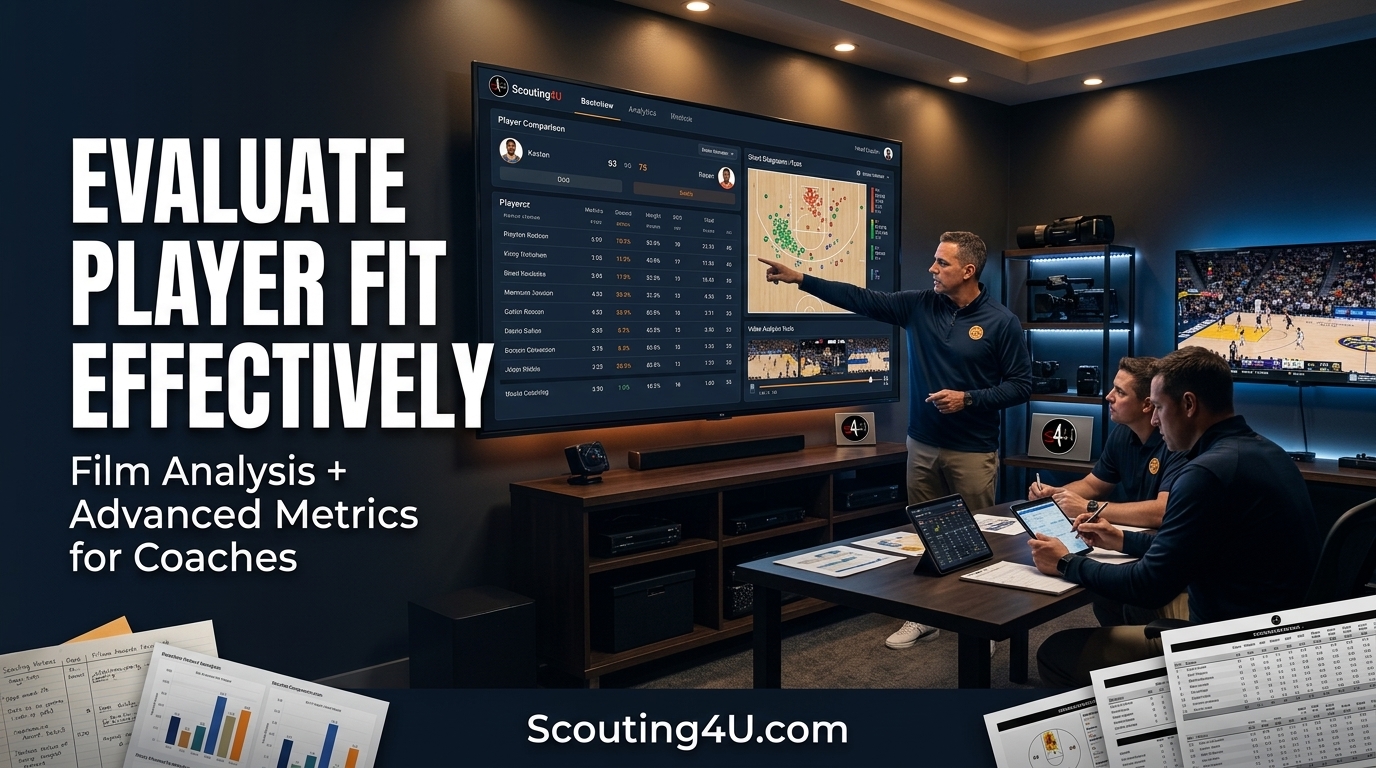
How to Evaluate Basketball Player Fit Effectively
Key Takeaways
Learning to evaluate basketball player fit is the foundation of smart roster construction.
Data-driven metrics give you objective evidence, not gut feelings.
The right tools let you compare players against your roster before you commit.
Team dynamics matter as much as individual stats.
History shows that cohesion beats raw talent - every time.
Why You Need to Evaluate Basketball Player Fit Before Every Signing
Every coach and GM has watched a talented player fail on a new team. The talent was real. The fit was wrong. That gap - between individual ability and team compatibility - is exactly why you need to evaluate basketball player fit with the same rigor you apply to box scores. When teams skip this step, they end up with unbalanced rosters, locker room friction, and wasted cap space. When they do it well, they find players who make everyone around them better.
This guide walks through how to evaluate basketball player fit at every level - from the metrics you track to the lineup scenarios you model before making a move. Whether you coach at the youth level or scout professionally, the process is the same. The tools just get more powerful.
What Player Fit Actually Means
Player fit is not just about skill level. A player can be highly skilled and still be a poor fit. Fit means the player's tendencies, habits, and role preferences align with what your team actually needs.
There are three layers to consider when you evaluate basketball player fit:
Role fit - Does the player's preferred role match what your team has available? A ball-dominant scorer who needs 20 touches a game will struggle on a team that already has one.
Style fit - Does the player's game translate to your system? A half-court specialist joining a transition-heavy offense will take time to adjust - and may never fully adapt.
Personality and culture fit - This one is harder to measure, but it matters. A player who thrives in high-autonomy systems may struggle under rigid structure, and vice versa.
When you evaluate basketball player fit properly, you are looking at all three layers at once - not just the stats on the page.
The Metrics That Matter Most
Numbers give you a starting point. They don't give you the full picture, but they narrow the field fast. Here are the metrics that do the most work when you evaluate basketball player fit:
Usage Rate (USG%) - This tells you how often a player is involved in offensive plays when on the floor. A player with a 28% usage rate coming into a team where the top player already uses 30% of possessions will compete for shots, not complement them.
Assist-to-Turnover Ratio - A high ratio indicates a player who makes smart decisions with the ball. This matters in systems that rely on ball movement.
Offensive and Defensive Rating (ORTG/DRTG) - These per-100-possession numbers show how the team performs with a player on the floor. They are far more useful than raw points or rebounds.
True Shooting Percentage (TS%) - More accurate than field goal percentage alone, this accounts for three-pointers and free throws. It tells you how efficiently a player actually scores.
Player Efficiency Rating (PER) - A single number that summarizes overall performance. Useful for quick comparisons, though it needs context to mean anything.
None of these metrics work in isolation. A player can have a high PER but a usage rate that clashes with your existing rotation. That's why you need a comparison tool that lets you model players side by side, against your actual roster - not just against league averages. The Scouting4U platform features are built around exactly this kind of layered analysis.
How to Evaluate Basketball Player Fit Using Video
Stats tell you what happened. Video tells you why. When you evaluate basketball player fit, video analysis closes the gap between numbers and reality.
Watch for these things specifically:
How does the player move without the ball? Players who make smart off-ball cuts and hold proper spacing are immediately easier to integrate than those who stand around waiting for the ball.
How do they defend in a team system? Individual defensive stats can look fine while a player consistently breaks scheme, fails to rotate, or gambles for steals. One player doing this can collapse a defensive structure.
How do they respond after mistakes? Body language under pressure reveals a lot about culture fit. A player who immediately starts pointing fingers or checking out mentally after a bad possession is a different kind of challenge than one who resets and competes.
Video paired with stats gives you the full picture. If you're serious about how you evaluate basketball player fit, you need both. Read more about the video and data workflow in our guide on basketball defensive scouting and identifying weaknesses.
Roster Construction: Building Around Fit, Not Just Talent
The 2004 Detroit Pistons remain one of the most cited examples in basketball roster history - not because they had the most talent, but because they had the best fit. No player on that team tried to do more than his role required. Every piece complemented the others. They beat a Lakers team with four future Hall of Famers.
That example is not an anomaly. Teams that evaluate basketball player fit before assembling rosters consistently outperform those that chase talent alone. The Golden State Warriors dynasty was built on spacing, passing, and defensive versatility - not just individual star power.
Roster construction means asking different questions than traditional scouting asks. Instead of "Is this player good?" the question becomes "Does this player make our team better?" Those are not the same thing.
For a deeper look at how to build with fit in mind, see our article on basketball roster construction and building a winning team.
How to Evaluate Basketball Player Fit in Youth and Amateur Settings
Most of what's written about player evaluation assumes NBA-level data. But the same principles apply at every level - you just work with what you have.
At the youth and amateur level, you evaluate basketball player fit by watching how players respond to their teammates' mistakes, how they communicate on defense, whether they play within the flow of the offense or force the action. Stats matter less. Behavior matters more.
Ask these questions during tryouts and early practices:
Does this player make the right pass even when it isn't the flashy one? Do they talk on defense? Do they celebrate teammates' good plays or only their own? Do they accept coaching or resist it?
These behaviors predict fit better than any drill at the youth level. As players develop, you add metrics. But the behavioral foundation comes first.
Using Data Analytics to Find Undervalued Fits
Analytics don't just measure superstars. They often do their best work identifying players who won't show up on anyone else's radar. A player who shoots 42% from three on catch-and-shoot attempts, switches reliably on defense, and has a low usage rate may not generate highlight clips - but they might be exactly what your roster needs.
When you evaluate basketball player fit with advanced tools, you can search specifically for players whose profiles match your gaps. If your team lacks a reliable secondary playmaker, you filter for assist rate, turnover percentage, and on/off court splits. You find names you wouldn't have found through traditional scouting.
This approach is covered in detail in our post on how data analytics reveals undervalued basketball players. The short version: the players who fit your system best are often not the ones everyone else is chasing.
Integrating a New Player Into Your Lineup
Finding the right fit is step one. Getting the player to actually fit is step two, and it takes deliberate work.
Start by modeling lineup combinations before the player steps on the floor. Which existing players does the new addition complement? Which matchups does the new player create or solve? Run those scenarios in practice before relying on them in games.
Communication matters here. A player joining a new system needs clear expectations about their role. Ambiguity leads to players defaulting to old habits - which may not match what you need from them.
Track on/off court splits in the early weeks. If the team performs significantly better when the new player sits, something is wrong with the integration. That's data you can act on before it becomes a season-long problem.
For practical guidance on building lineups that work, read our breakdown of basketball lineup analysis and optimizing your starting five.
How Scouting4U Helps You Evaluate Basketball Player Fit
The challenge with evaluating fit is that it requires multiple data streams at once - individual stats, team metrics, video, historical comparisons. Doing that manually is slow and easy to get wrong.
Scouting4U pulls those streams together in one place. You can compare a recruit's metrics directly against your roster, model lineup combinations, review video clips tied to specific plays, and track how similar player profiles have performed in comparable systems.
The goal is to make it faster and more accurate to evaluate basketball player fit - so you spend less time on spreadsheets and more time on decisions. See the full breakdown of what's available on the platform features page, or check out subscription plans and pricing if you're ready to get started.
The Process: A Practical Framework to Evaluate Basketball Player Fit
If you want a repeatable process, here it is. Use this framework every time you evaluate basketball player fit, regardless of the level you coach or scout at.
Step 1: Define your roster needs. Before evaluating any player, know what you're looking for. What role is open? What style gaps exist? What does your team struggle to do?
Step 2: Filter by role and style metrics. Use usage rate, assist percentage, defensive rating, and shooting profile to narrow the candidate pool to players whose numbers suggest a match.
Step 3: Watch video on the finalists. Look for the behavioral markers described above - off-ball movement, defensive habits, communication, competitive response.
Step 4: Model the lineup. Before making a decision, run the numbers on how the player would affect your existing combinations. Look at on/off splits from their previous team.
Step 5: Check culture indicators. Talk to coaches and teammates from the player's previous teams. Stats won't tell you everything.
Step 6: Monitor integration actively. Once the player joins, track early performance data weekly. Adjust the role if the numbers suggest misalignment.
When you evaluate basketball player fit using this framework consistently, you make fewer costly mistakes - and you find players others miss. Teams that skip steps in this process are the ones that end up rebuilding a year later.
Common Situations Where Fit Analysis Changes the Decision
It's worth looking at a few specific scenarios where taking time to evaluate basketball player fit changed what looked like an obvious call.
A team needs a shooter. They find a player who averaged 18 points per game last season. On the surface, it looks like a clear upgrade. But the player's usage rate was 29% - and your team already has a 27% usage player at the same position. The overlap creates a problem before the first practice. A deeper look reveals a different candidate: 14 points per game, 19% usage, 44% from three on off-ball screens. That player fits. The first one doesn't.
Another common scenario: a team needs defensive depth. You're watching two players with similar steal and block numbers. One defends well in man-to-man but struggles in zone. Your system uses both. The second player switches comfortably and communicates loudly on every possession. You evaluate basketball player fit by asking which player fits your defensive scheme - not just which player produces the better raw defensive numbers.
These are the decisions that separate good front offices from struggling ones. The talent difference between the two options is often small. The fit difference is large. For more on how tendencies shape these decisions, see our article on basketball tendency analysis and decoding opponent patterns.
Frequently Asked Questions
What is the best way to evaluate basketball player fit for a specific system?
Start by defining what your system requires - spacing, ball movement, defensive switching ability, pace, and so on. Then filter candidates by the metrics that reflect those requirements. Usage rate, assist-to-turnover ratio, and defensive rating are good starting points. Follow up with video to confirm the numbers translate to actual behavior on the floor.
Which stats matter most when you evaluate basketball player fit?
Usage percentage, true shooting percentage, offensive and defensive rating, and assist-to-turnover ratio give you the most useful signal. On/off court splits - how the team performs with and without the player - are often more revealing than individual counting stats like points or rebounds.
Can you evaluate basketball player fit without advanced analytics?
Yes. At youth and amateur levels, behavioral observation is often more predictive than stats. Watch how a player communicates, defends in scheme, moves without the ball, and responds under pressure. Those indicators reveal fit even when data is limited.
How early in the recruitment process should you evaluate basketball player fit?
As early as possible. Many teams waste time pursuing players who, on paper, seem talented but clearly do not fit the roster's needs. Running a quick role and style filter at the start of the search saves time and keeps evaluation focused on realistic options.
What mistakes do teams make when they try to evaluate basketball player fit?
The most common mistake is prioritizing individual talent over role compatibility. A player who is objectively skilled but needs a role your team cannot offer will underperform regardless of their ability. Teams also underweight culture fit - how a player responds to coaching, handles adversity, and interacts with teammates - because it's harder to measure. Both errors lead to the same result: a talented player who doesn't make the team better.
Enjoyed this article? Share it with others!
Founder & Lead Scout, Scouting4U
2x EuroLeague champion with 30+ years in professional basketball. Daniel won EuroLeague titles with Maccabi Tel Aviv, helped build the staff behind the 2007 European Championship, and has delivered 100+ professional scouting reports across 50+ leagues. If it happened in a European basketball front office, he was probably in the room. He founded Scouting4U in 2010 to bring championship-level scouting intelligence to every club.
No reviews yet. Be the first to share your experience!
Related Articles

Data-Driven Basketball Recruitment: A Front Office Guide
Key TakeawaysData-driven basketball recruitment improves roster decisions by replacing gut instinct with measurable evid...
Basketball Player Comparison Tool: Data-Driven Insights
What Is a Basketball Player Comparison Tool?A basketball player comparison tool is software that lets coaches, scouts, a...
Scouting Undervalued Basketball Players: Hidden Gems
Key TakeawaysUndervalued basketball players scouting is one of the most cost-effective ways to build a competitive roste...