
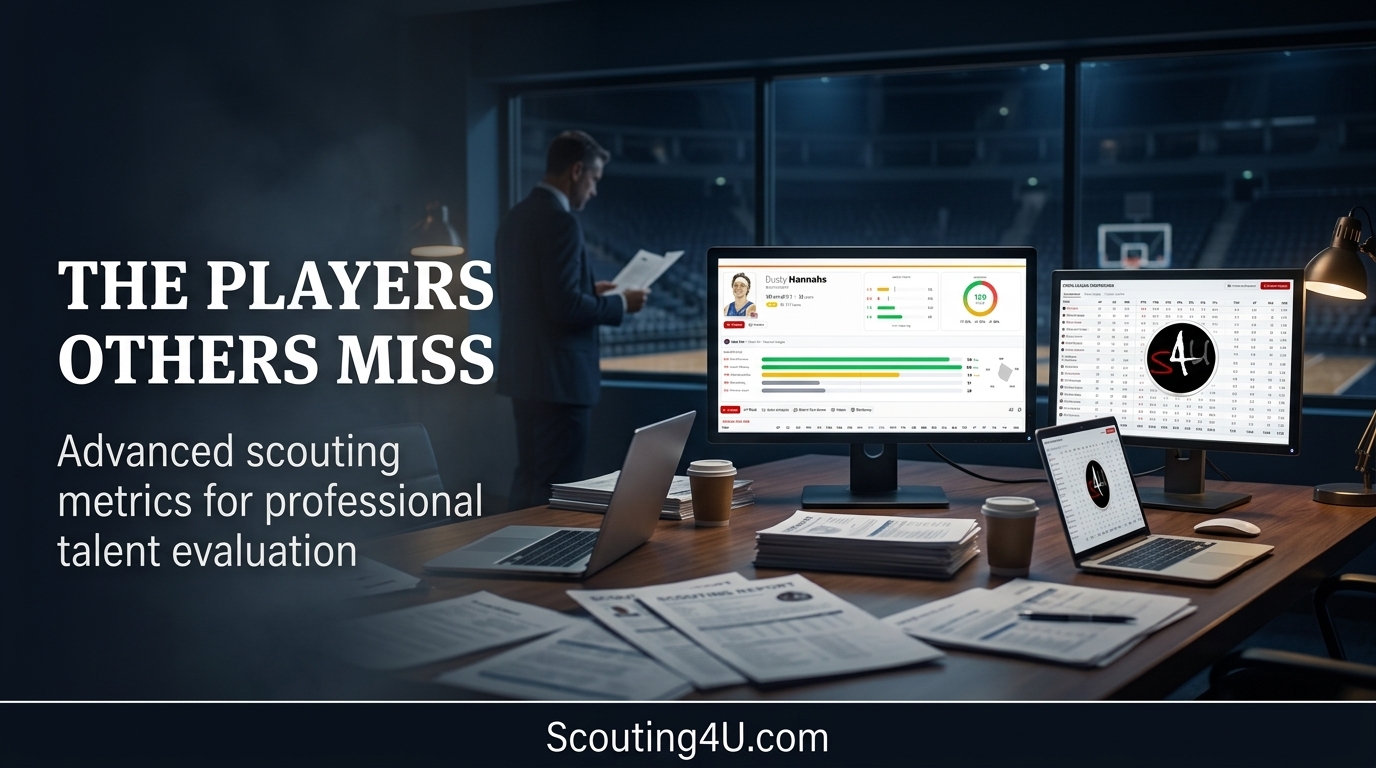
Scouting Undervalued Basketball Players: Hidden Gems
Key Takeaways
Undervalued basketball players scouting is one of the most cost-effective ways to build a competitive roster.
Data-driven recruitment surfaces hidden talent that traditional scouting routinely misses.
Advanced metrics - PER, TS%, USG% - give scouts a clearer, bias-free picture of player value.
Platforms like Scouting4U give coaches and scouts the tools to act on those numbers fast.
Why Undervalued Basketball Players Scouting Changes Everything
Most teams chase the same 20 players. They watch the same highlight reels, attend the same showcases, and end up bidding against each other for talent they could have found six months earlier. Undervalued basketball players scouting breaks that cycle. It means looking where others are not, reading numbers that others ignore, and signing players before their market price catches up to their actual value.
This is not a new idea. Moneyball made it famous in baseball. Basketball followed. The teams winning championships today are rarely the ones with the biggest payrolls alone - they are the ones with the sharpest eyes for undervalued talent. This guide covers exactly how to develop that edge.
What Makes a Basketball Player Undervalued?
Undervalued basketball players are not necessarily bad players. They are players whose value has not yet been recognized by the market. There are a few consistent reasons why this happens.
First, many players lack exposure. They play in lower-profile leagues, come from less-scouted regions, or simply have not had a platform to show what they can do. Second, traditional scouting often rewards athleticism and scoring above everything else. A player who sets hard screens, defends multiple positions, and moves the ball at the right moment rarely trends on social media - but coaches who run efficient systems want exactly that player.
Third, some players are late developers. Their peak production comes at 24 or 25, after most teams have already moved on. Undervalued basketball players scouting done well spots that development curve early. It asks not just "where is this player now?" but "where will they be in two seasons?"
Understanding these patterns is the starting point. Everything else builds from there.
The Role of Data in Undervalued Basketball Players Scouting
Data does not find players for you. But it does eliminate the noise that makes scouting unreliable. When you watch a game, you see 40 minutes of action filtered through your own biases, the game situation, and how tired the player happened to be that night. Data smooths all of that out.
Metrics like Player Efficiency Rating (PER) measure overall contribution across a full season. True Shooting Percentage (TS%) tells you how efficiently a player scores once you account for threes and free throws. Usage Rate (USG%) shows how often a player is involved in possessions. Together, these numbers paint a picture that is hard to fake over 30 or 40 games.
For undervalued basketball players scouting, the most useful approach is to filter by efficiency in context. A player averaging 8 points per game sounds modest. But if their TS% sits at 62%, they defend at a high level, and they play 22 minutes off the bench on a deep team, that is a player producing well above what their raw numbers suggest. That gap between perception and reality is exactly where hidden gems live.
For a deeper look at how analytics surfaces this kind of talent, see How Data Analytics Reveals Undervalued Basketball Players.
Historical Examples of Undervalued Talent Done Right
The San Antonio Spurs built their dynasty partly on this principle. Manu Ginobili was a second-round pick who became one of the most effective players of his era. The Spurs saw past his draft position and focused on what his game actually produced. Tony Parker was similarly overlooked coming out of France - too small, scouts said, too unproven in American basketball.
The Miami Heat's acquisition of Udonis Haslem followed the same logic. Haslem went undrafted. No team was willing to bet on him. Miami did, and he played a key role on three championship teams.
These are not flukes. They are the result of organized undervalued basketball players scouting - asking the right questions, using the right data, and being willing to act when the broader market has not yet caught on.
More recently, teams in Europe have applied similar methods with great success. The EuroLeague in particular has become a proving ground for players who later command serious attention from NBA front offices. Scouts who were watching those leagues early had a significant advantage.
Tools That Make Undervalued Basketball Players Scouting More Effective
Good scouting tools do three things. They centralize data so you are not jumping between spreadsheets and video clips. They allow for quick comparisons across players and leagues. And they surface patterns that would take a scout weeks to find manually.
Scouting4U was built with exactly this workflow in mind. The platform combines AI-driven scouting reports, video integration, and detailed statistical dashboards in one place. You can run a player comparison across two leagues, filter by position, and see efficiency metrics side by side. That kind of speed matters when you are trying to act before another team does.
The basketball player comparison tool on Scouting4U is particularly useful for undervalued basketball players scouting. It lets you benchmark a lesser-known player against established names, so you can make the case internally for why a prospect is worth pursuing. Numbers on a screen are more persuasive than a scout's gut feeling in most front-office meetings.
Explore the full range of Scouting4U platform features and tools to see what the platform offers at each level.
Evaluating Player Fit - Not Just Player Talent
Finding an undervalued player is only half the job. The other half is figuring out whether they fit your system. A player who thrives in a pace-and-space offense may struggle in a half-court, post-oriented system. A strong man-to-man defender may have no experience in a zone. These gaps are not always dealbreakers, but you need to know they exist before you sign.
Effective undervalued basketball players scouting accounts for fit from the beginning. When you build your target profile, you define what the team needs - not just in terms of position, but in terms of role. Do you need a pick-and-roll ball-handler who can also defend the perimeter? A forward who can switch and still hold their own in the post? Start with the role and then look for players who fill it at an undervalued price point.
For a structured approach to this process, the guide on How to Evaluate Basketball Player Fit Effectively walks through the key questions scouts should be asking at each stage of evaluation.
Roster construction also plays into this. You are not signing a player in isolation - you are adding a piece to an existing puzzle. The article on 5 Basketball Roster Building Strategies for Success covers how to think about the roster as a system and where undervalued players tend to add the most leverage.
Where to Find Undervalued Players Right Now
The best hunting grounds for undervalued basketball players scouting are the leagues that most scouts are not watching closely. That includes mid-tier European leagues, South American competitions, and second divisions in markets like Turkey, Israel, and Spain. Players in these leagues often have solid fundamentals and genuine game experience - but limited visibility beyond their immediate region.
The VTB United League and the Turkish BSL are two examples of competitions that produce NBA-caliber talent regularly. Scouts who build familiarity with these leagues gain a real edge. Most of their competitors are not watching until a player has already generated buzz.
Secondary markets within North America also matter. The G League, Canadian leagues, and NAIA programs all produce players who do not fit the traditional pipeline but perform well when given the right opportunity. Undervalued basketball players scouting in these environments requires consistency. You need to watch enough games to know what normal looks like before you can spot the outlier.
Age is another filter worth using. Players between 22 and 26 who have not had a full season of meaningful minutes are often priced below their actual ceiling. They are not teenagers anymore, so teams move on. But they also have not hit their peak. That window is one of the most productive places to look.
Building a Repeatable Scouting Process
One-off finds are luck. A repeatable undervalued basketball players scouting process is a competitive advantage that compounds over time. To build that, you need a few things in place.
Start with a clear target profile based on what your team needs. Without that, you end up watching players without a clear purpose. Then build a database of prospects you are tracking - not just players who are ready now, but players who could be ready in 12 to 18 months. Review that list regularly and update it as new data comes in.
Use video and stats together. Video tells you how a player moves, how they react, whether their body language holds up late in games. Stats tell you whether what you saw was representative or a fluke. Neither is sufficient alone. The best undervalued basketball players scouting combines both, and does so consistently across a full season - not just a single game or a weekend showcase.
Finally, act quickly when you find someone worth pursuing. By definition, undervalued players will not stay undervalued for long once they start producing. The whole point of undervalued basketball players scouting is to be early. If you wait for consensus, you have already missed the window.
How Scouting4U Supports This Process
Scouting4U was founded by EuroLeague expert Daniel Gutt, who spent decades working in professional basketball before building the platform. The goal from the start was to give scouts and coaches access to the kind of data infrastructure that previously only well-funded programs could afford.
The platform covers leagues across Europe, the Americas, and beyond. It provides AI-generated scouting reports, video tools, and stat dashboards that make undervalued basketball players scouting faster and more systematic. You can run player comparisons, filter by advanced metrics, and generate reports that are shareable with front offices and coaching staffs.
Subscription plans are available for individual scouts, coaching staffs, and league organizations. Each tier is designed to match the scale of the operation without requiring a large analytics department to make use of it. See the Scouting4U subscription plans and pricing page for current options.
If you want to see the platform in action before committing, the contact and demo request page lets you schedule a walkthrough with the team.
Conclusion
Undervalued basketball players scouting is not about finding players other teams missed through luck. It is a discipline - one that combines clear target-setting, consistent data use, and the willingness to look in places the market has not yet priced in. The teams that do this well do not just find one hidden gem. They build a pipeline that produces them year after year.
The tools to do this at a high level are more accessible than ever. Platforms like Scouting4U have removed many of the infrastructure barriers that once made data-driven undervalued basketball players scouting the exclusive domain of large front offices. If you have a clear process and the right resources, the edge is there to take.
Frequently Asked Questions
What does undervalued basketball players scouting actually mean in practice?
It means identifying players whose production and potential exceed their current market price or reputation. In practice, this involves filtering by efficiency metrics, watching lower-profile leagues, and targeting players who fill specific roster needs at a cost below what comparable production would normally command.
Which metrics matter most for undervalued basketball players scouting?
Player Efficiency Rating (PER), True Shooting Percentage (TS%), and Usage Rate (USG%) are strong starting points. Beyond those, on/off splits - how the team performs with and without the player on the floor - often reveal impact that box scores miss entirely. Defensive rating and screen assists are also worth tracking for players whose value shows up off the ball.
How can Scouting4U help with undervalued basketball players scouting?
Scouting4U provides a centralized platform combining AI-generated scouting reports, video tools, and advanced statistical dashboards. It covers multiple leagues and allows side-by-side player comparisons, which makes the process of identifying undervalued talent faster and easier to document for front-office presentations.
Why are some players consistently overlooked by traditional scouting?
Traditional scouting rewards what is easy to see - scoring, athleticism, height. Players who contribute through defense, spacing, or high-IQ play often do not register in highlight packages. Players from under-scouted leagues or regions face an additional visibility gap that has nothing to do with their actual ability.
Is undervalued basketball players scouting only relevant for professional teams?
No. College programs, semi-professional organizations, and even well-organized youth programs benefit from the same principles. The tools and methods scale down effectively. Knowing how to evaluate production relative to context is useful at any level of the game, and the earlier a program builds that habit, the greater the long-term advantage.
Enjoyed this article? Share it with others!
Founder & Lead Scout, Scouting4U
2x EuroLeague champion with 30+ years in professional basketball. Daniel won EuroLeague titles with Maccabi Tel Aviv, helped build the staff behind the 2007 European Championship, and has delivered 100+ professional scouting reports across 50+ leagues. If it happened in a European basketball front office, he was probably in the room. He founded Scouting4U in 2010 to bring championship-level scouting intelligence to every club.
No reviews yet. Be the first to share your experience!
Related Articles

Data-Driven Basketball Recruitment: A Front Office Guide
Key TakeawaysData-driven basketball recruitment improves roster decisions by replacing gut instinct with measurable evid...
Basketball Player Comparison Tool: Data-Driven Insights
What Is a Basketball Player Comparison Tool?A basketball player comparison tool is software that lets coaches, scouts, a...
5 Basketball Roster Building Strategies for Success
Basketball Roster Building Strategies: What Actually WorksBuilding a championship-caliber team requires more than assemb...