
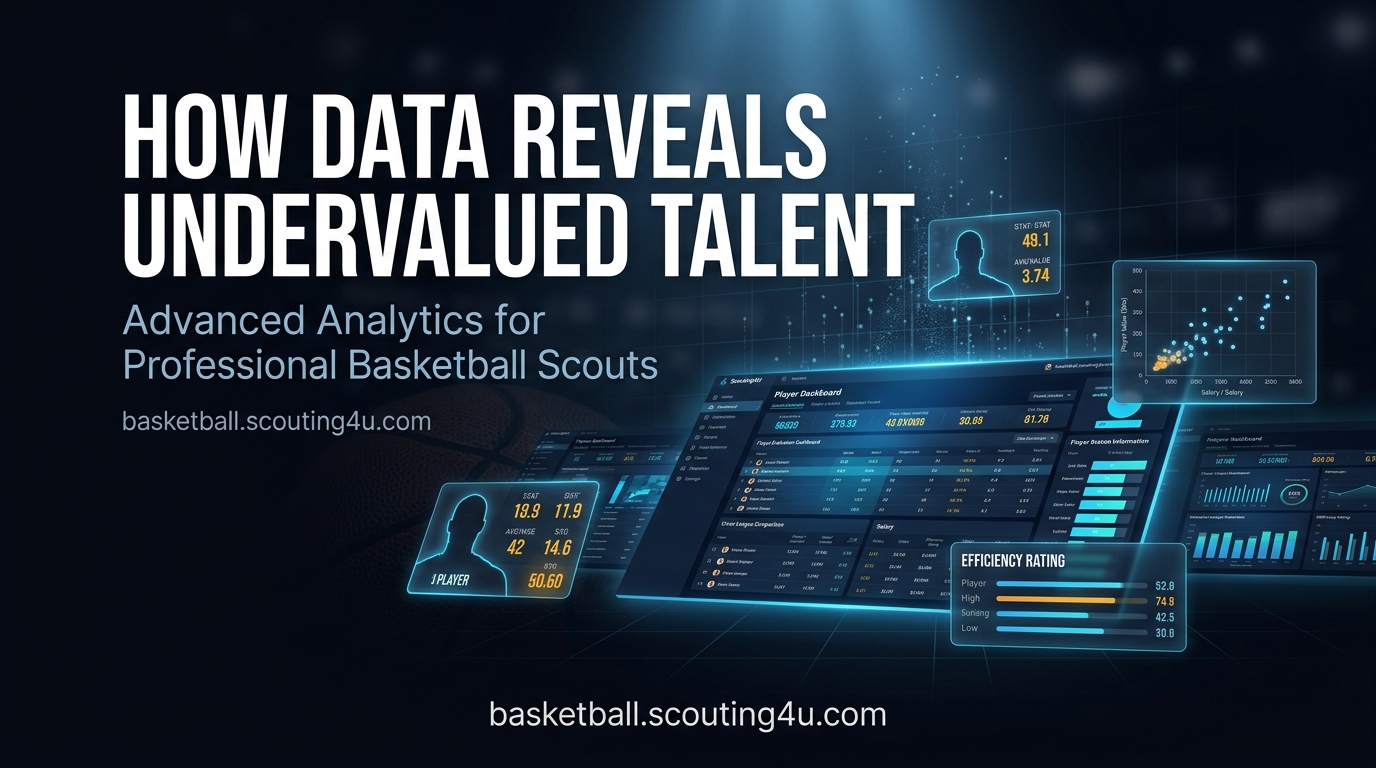
How Data Analytics Reveals Undervalued Basketball Players
Key Takeaways
Undervalued basketball players analytics data can uncover hidden gems often overlooked by traditional scouting.
Advanced metrics like PER, TS%, and USG% offer deeper insights into player efficiency and potential.
Scouting4U provides tools to analyze and identify undervalued talent using comprehensive analytics data.
Historical examples show how data-driven decisions lead to better roster building.
Introduction: Why Undervalued Basketball Players Analytics Data Matters
Basketball history is full of players who made a huge impact without becoming household names. Most were overlooked - not because they lacked ability, but because traditional scouting missed what the numbers would have shown. That gap is where undervalued basketball players analytics data does its best work. When you look past points per game and focus on efficiency and role-based production, an entirely different set of players comes into view.
Teams that use undervalued basketball players analytics data build smarter rosters. They find contributors others ignore. They sign players at below-market rates. Over time, that edge compounds. This article walks through how analytics uncovers hidden talent, which metrics matter most, and how platforms like Scouting4U make the process accessible to scouts at every level.
What Makes a Player "Undervalued" in Basketball Analytics
A player is undervalued when their actual contribution exceeds what their reputation suggests. That gap exists because conventional evaluation focuses on visible stats - points, assists, rebounds. These are easy to count, but they don't tell the full story.
Undervalued basketball players analytics data fills that gap. It captures what happens when a player is on the court but not touching the ball. It measures defensive impact, spacing, screen efficiency, and transition involvement. These contributions are real, but they rarely show up on a box score.
Some players are undervalued because they play in lower-profile leagues. Scouts rarely visit those leagues. Others are undervalued because their role suppresses their counting stats. A player asked to do less on offense might look ordinary by traditional measures, even though their efficiency is elite. Undervalued basketball players analytics data is the tool that separates those situations from genuine limitations.
The Core Metrics Behind Undervalued Basketball Players Analytics Data
You don't need dozens of statistics to start finding undervalued players. A focused set of advanced metrics gets you most of the way there.
Player Efficiency Rating (PER) adds up a player's per-minute contributions into one number. The league average sits around 15. A player posting 18+ PER in limited minutes is often more productive than their role suggests.
True Shooting Percentage (TS%) accounts for two-point attempts, three-point attempts, and free throws together. It gives a cleaner picture of shooting efficiency than field goal percentage alone. A TS% above 58% is strong by any standard.
Usage Percentage (USG%) measures how often a player is involved in offensive possessions while on the court. A player with low USG% but high efficiency may be doing more with fewer opportunities than their role allows. That's a signal worth following.
Box Plus/Minus (BPM) estimates a player's points-above-average contribution per 100 possessions. It works well for comparing players across different teams and systems.
Defensive metrics - including opponent field goal percentage at the rim, defensive rebound rate, and deflections per game - capture contributions that never appear in standard box scores. These are often where undervalued basketball players analytics data reveals the most overlooked players.
For a deeper look at which stats to track, the guide on 7 Basketball Stats Players Should Track for Success is worth reading alongside this article.
Historical Cases Where Analytics Found What Scouts Missed
Dennis Rodman is one of the clearest examples of undervalued basketball players analytics data in action - before the tools even existed in their current form. His scoring averages were modest. His defensive rebounding rate and defensive impact were extraordinary. Teams that understood what he actually contributed won championships. Teams that judged him by points per game underestimated him badly.
Dirk Nowitzki presented a different valuation problem. His skill set - a seven-foot player who could shoot off the dribble from anywhere - had no real precedent. Traditional scouts weren't sure how to weight it. His efficiency numbers were exceptional from early in his career. The analytics pointed toward a franchise player well before the broader market agreed.
More recently, the NBA has seen many players whose value came from data rather than reputation. Role players who set good screens, move without the ball, and defend multiple positions are consistently underpriced compared to their actual on-court impact. Undervalued basketball players analytics data surfaces these players reliably, provided you know which metrics to examine.
European leagues have a long history of producing undervalued talent. Analytics-focused teams have exploited that for years. The article on EuroLeague Scouting: Talent Discovery in Europe covers how data-driven discovery works in that context.
How Undervalued Basketball Players Analytics Data Changes Roster Construction
Finding undervalued players is only useful if you know how to build around them. Analytics doesn't just identify individuals - it maps how players fit together. That changes how smart teams think about roster construction.
A team might find two players with similar counting stats but very different efficiency profiles. The right analytical tools show which one fits better alongside the existing roster, based on positional spacing, defensive versatility, or pace of play. Undervalued basketball players analytics data makes that kind of decision concrete rather than speculative.
It also changes how teams allocate budget. If analytics shows that a player's defensive contribution is elite but invisible in box scores, that player is likely cheaper than they should be. Signing several such players - rather than one expensive star - can produce better outcomes at lower cost. This works especially well in leagues where analytics adoption is still limited and market gaps persist.
For practical guidance on building a roster this way, the piece on Basketball Roster Construction: Building a Winning Team goes into the details of how data shapes lineup decisions at every level.
Applying Undervalued Basketball Players Analytics Data in Practical Scouting
The gap between knowing which metrics matter and actually using them in a scouting workflow can be wide. Most scouts don't have time to build custom models. They need tools that surface the right information quickly.
This is where Scouting4U fits in. The platform pulls performance data across leagues, applies advanced metrics automatically, and generates reports that help scouts act on undervalued basketball players analytics data without needing a data science background. Video analysis and AI-generated scouting reports sit alongside statistical profiles. The numbers and the visual evidence reinforce each other.
That combination matters. Analytics tells you a player's efficiency is elite. Video shows you why and whether the context holds up. Scouts who use both together make better decisions than those who rely on either alone. Undervalued basketball players analytics data is most useful when it connects directly to game footage rather than sitting in a spreadsheet.
If you're evaluating what tools are available, the comparison at Best Basketball Analytics Software 2026: Complete Guide lays out the current options clearly.
Common Mistakes When Using Analytics to Find Undervalued Players
Analytics is useful, but it's not immune to misuse. Several recurring mistakes reduce its effectiveness when evaluating undervalued players.
The first mistake is treating box-score stats as advanced metrics. Points per game, assists, and rebounds are raw counting stats. They don't adjust for pace, context, or role. Teams that call this "using analytics" are often just doing traditional evaluation with extra steps.
The second mistake is ignoring sample size. A player who shoots 55% TS over 200 possessions has a much weaker signal than one who holds that mark over 1,500 possessions. Undervalued basketball players analytics data requires enough data to be meaningful. Small samples mislead.
The third mistake is evaluating players in isolation. A center who looks average on defensive rebounding might be playing alongside a guard who crashes the glass heavily, which suppresses the center's numbers. Context matters. Good analysts look at team-adjusted metrics, not just raw totals.
The fourth mistake is relying on a single metric. No one number captures everything. PER misses defensive value. BPM depends on the quality of the underlying data. Using undervalued basketball players analytics data well means checking multiple measures and then verifying them against film.
The Scouting4U Approach to Undervalued Basketball Players Analytics Data
Scouting4U was built around the problem of undervalued talent detection. The platform pulls data from leagues across Europe, the Americas, and beyond. It runs advanced metrics automatically and flags players whose efficiency significantly outpaces their reputation or market position.
Scouts using Scouting4U can filter by position, league, age, and specific metrics to narrow searches quickly. A scout looking for an undervalued point guard who plays at low usage but high efficiency can generate that list in minutes rather than days. The AI-generated reports attach context to the numbers and explain what the data shows in plain terms.
Undervalued basketball players analytics data sits at the center of how Scouting4U approaches player evaluation. The platform's design reflects the reality that most hidden value in basketball lives in metrics that traditional scouting skips. Finding it requires both the right data and the right tools to interpret it.
You can see the full range of platform capabilities at Scouting4U platform features and tools, and explore subscription options at Scouting4U subscription plans and pricing.
Why Context Separates Good Analytics from Bad Analytics
Raw numbers don't exist in a vacuum. A player's stats always reflect the system they play in, the teammates around them, and the opponents they face. Ignoring context is one of the fastest ways to misread undervalued basketball players analytics data.
Take pace of play. A player on a fast-paced team will naturally accumulate more counting stats than an equally skilled player on a slow-paced team. Pace-adjusted metrics correct for this. Without that adjustment, you're comparing apples to oranges.
Strength of schedule matters too. A player putting up strong efficiency numbers against weak competition is a different proposition than one doing it against top-tier defenses. Undervalued basketball players analytics data should always be filtered through the lens of competition quality.
Age and trajectory add another layer. A 22-year-old posting a BPM of +2.0 is likely to improve. A 33-year-old posting the same number is probably declining. The number is identical, but the outlook is completely different. Good analysts treat undervalued basketball players analytics data as one input among several - not a final verdict.
For a closer look at how possession-level context shapes player evaluation, the article on Possession Analysis: Transition, Regular, Second Chance breaks down how different play types produce very different statistical profiles.
Conclusion: Data Is How Hidden Talent Gets Found
The players most teams overlook are not invisible. They're just visible in the wrong places. Traditional scouting looks at reputation, athleticism, and counting stats. Undervalued basketball players analytics data looks at efficiency, contextual production, and role-adjusted contribution. Those two lenses often point at completely different players.
Teams that build undervalued basketball players analytics data into their standard scouting process find players others miss. That edge is especially strong in leagues where analytics adoption is still catching up to what the tools now make possible. The market gap is real and measurable.
Scouting4U gives scouts and front offices the specific tools to act on undervalued basketball players analytics data at scale - across leagues, positions, and age groups. The players are out there. The numbers show where to find them.
Frequently Asked Questions
What is undervalued basketball players analytics data?
Undervalued basketball players analytics data refers to advanced performance metrics that reveal a player's contribution beyond basic statistics. These metrics - including PER, TS%, BPM, and defensive indicators - identify players whose actual on-court impact exceeds what traditional scouting or box scores suggest.
Which advanced metrics are most useful for finding undervalued players?
True Shooting Percentage, Player Efficiency Rating, Usage Percentage, and Box Plus/Minus are the most widely applicable. Defensive metrics like opponent field goal percentage at the rim and deflections per game are especially useful for finding undervalued players whose contributions don't appear in standard statistics.
Can analytics replace traditional scouting entirely?
No. Undervalued basketball players analytics data works best when combined with video analysis and direct observation. Analytics narrows the search and identifies statistical signals. Film explains the context behind the numbers. Scouts who use both together make better decisions than those who rely on either alone.
How does Scouting4U help identify undervalued players?
Scouting4U aggregates data across multiple leagues, applies advanced metrics automatically, and generates AI-assisted reports that highlight players whose efficiency outpaces their reputation. Scouts can filter by position, age, league, and specific metrics to identify undervalued basketball players analytics data quickly without building custom tools from scratch.
Why do undervalued players tend to be concentrated in certain leagues?
Scouting coverage is uneven. Players competing in lower-profile European leagues generate strong undervalued basketball players analytics data but receive less attention because scouts visit those leagues less often. Platforms that aggregate cross-league data close that gap and make those players visible to teams willing to look.
Enjoyed this article? Share it with others!
Founder & Lead Scout, Scouting4U
2x EuroLeague champion with 30+ years in professional basketball. Daniel won EuroLeague titles with Maccabi Tel Aviv, helped build the staff behind the 2007 European Championship, and has delivered 100+ professional scouting reports across 50+ leagues. If it happened in a European basketball front office, he was probably in the room. He founded Scouting4U in 2010 to bring championship-level scouting intelligence to every club.
No reviews yet. Be the first to share your experience!
Related Articles
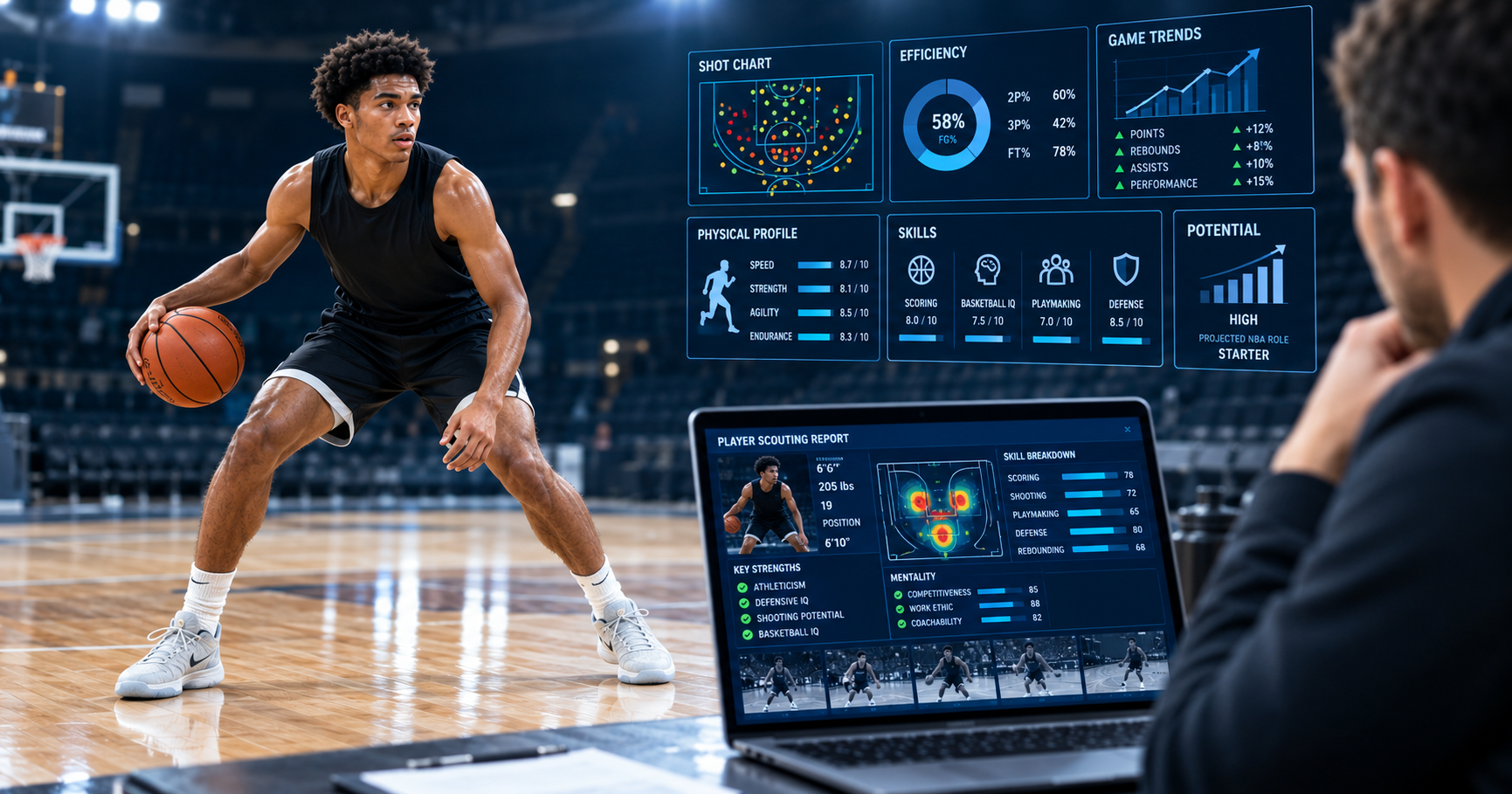
Analyzing Basketball Player Potential: Scouting Insights
Key Takeaways Analyzing basketball player potential combines data analysis with scouting intuition. Core metrics includ...

Mastering Basketball Service: Scouting Insights & Tools
Key TakeawaysA strong basketball service covers everything from player evaluation to game strategy analysis.Scouting4U g...

One Shot Chart. Three Insights Visual: Game Plan Revolution
Key TakeawaysA basketball shot chart three insights visual approach reveals high-efficiency zones, player tendencies, an...