
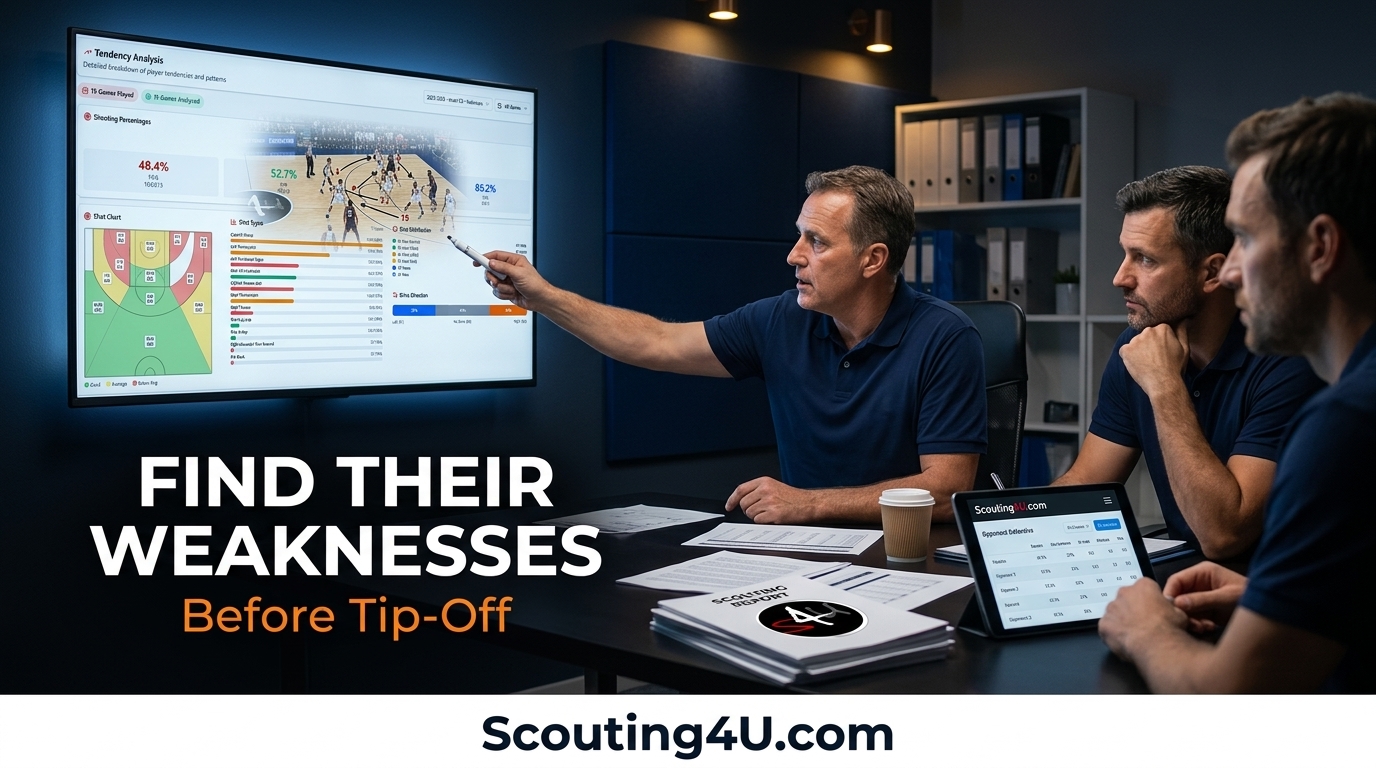
Basketball Defensive Scouting: Identify Weaknesses
Key Takeaways
Basketball defensive scouting helps coaches find and exploit opponent weaknesses before and during games.
Player tendency analysis tells you how individuals respond under pressure and in specific situations.
Lineup analysis helps you build optimal defensive matchups on a nightly basis.
Data metrics like Defensive Rating and Usage Percentage give you a numbers-based foundation for decisions.
Scouting4U provides tools that pull film, stats, and analytics into one workflow.
What Is Basketball Defensive Scouting?
Basketball defensive scouting is the process of studying an opponent before and during a game to find where their offense breaks down. Every team has patterns. Every player has habits. The job of a scout or coach is to find those patterns before the opening tip, then use them.
Done well, basketball defensive scouting gives your team a real competitive edge. Instead of reacting on the fly, you walk into the game with a plan. You know which ball-handler struggles going left. You know which shooter needs space to get hot. You know which pick-and-roll coverage shuts down their best action.
This guide breaks down exactly how to build that process - from film study to analytics to in-game adjustments.
Why Basketball Defensive Scouting Matters More Than Ever
The game has gotten faster. Offenses are more sophisticated. Teams use more motion, more switching, and more positionless lineups than they did ten years ago. That complexity makes basketball defensive scouting harder - but it also makes it more rewarding when you get it right.
Coaches who skip the scouting step often find themselves making halftime adjustments that should have been made before the game started. That costs you possessions. In close games, it can cost you the win.
At the highest levels, every program invests in basketball defensive scouting. But the tools and methods that used to be exclusive to pro staffs are now accessible to college programs, prep coaches, and even youth leagues. The barrier to entry has dropped. What separates teams now is how well they use the information.
Analyzing Opponent Tendencies Through Basketball Defensive Scouting
The first step in any basketball defensive scouting process is studying individual player tendencies. You want to know what players do when the game is on the line - not just what they do in general.
Watch how a ball-handler reacts when trapped in the corner. See how a shooter moves off the ball in the final two minutes of a close game. Notice whether a post player can finish equally well with both hands. These details separate surface-level scouting from preparation that actually changes outcomes.
Film study is the foundation. But film alone only shows you what happened. You need context - and that's where analytics come in. For a deeper look at how advanced metrics work in practice, see our guide on basketball opponent analysis insights and strategies.
What to Look for When Watching Film
When breaking down an opponent for basketball defensive scouting purposes, focus on a few specific areas rather than trying to catalog everything.
Ball screen coverage tendencies - do they go over, under, or switch?
Off-ball movement patterns for their best shooters
How they handle defensive pressure in the backcourt
Where their primary ball-handlers like to initiate offense
Their transition trigger - who pushes the ball and what lanes they prefer
Three or four games of film is usually enough to spot patterns. More than that, and you risk paralysis by analysis. Pick your spots and build a clear, simple report your players can actually absorb.
Building a Pre-Game Scouting Report
A pre-game report is where basketball defensive scouting turns from research into action. The report should be short enough to read in ten minutes and specific enough to change how your players guard an opponent.
Avoid the trap of writing everything you know. Prioritize. What are the two or three things your team must take away from this opponent? What's the one action you're going to live with them doing?
A strong basketball defensive scouting report covers individual player tendencies, their top offensive sets, their pick-and-roll preferences, and how they attack in transition. Add notes on who shoots well off movement versus off the dribble. That distinction alone changes how you guard them.
For a step-by-step walkthrough of the report-building process, read our full article on how to create a basketball pre-game scouting report.
Lineup Analysis in Basketball Defensive Scouting
Individual tendencies matter. But basketball defensive scouting also requires you to think at the lineup level. Which five-man units are your opponents using in crunch time? Which combinations hurt you the most, and which ones you can target on the other end?
Lineup data tells you things that individual stats can't. A player might look average on his own numbers, but his lineup might be outscoring opponents by twelve points per hundred possessions. That's a player you need to account for, even if his box score doesn't scream it.
On the defensive side, lineup analysis helps you decide which of your own combinations to deploy against their best units. Sometimes a smaller, quicker lineup disrupts their rhythm more than a bigger one does. Basketball defensive scouting at the lineup level gives you that clarity before the game starts, not during it.
Using Data Analytics to Sharpen Defensive Scouting
Modern basketball defensive scouting runs on numbers as much as film. A few metrics stand out as particularly useful when building a defensive game plan.
Defensive Rating (DRTG) measures how many points a team or player allows per 100 possessions. It's the cleanest single-number read on defensive efficiency.
Usage Percentage (USG%) tells you how often a player is involved in his team's offensive possessions. Target the high-usage players first in your basketball defensive scouting process. They're the ones who will make or break your opponent's offense.
Effective Field Goal Percentage (eFG%) accounts for the added value of three-pointers. When you're evaluating how a shooter performs in different zones, eFG% gives you a cleaner read than raw field goal percentage.
Points Per Possession (PPP) by play type breaks down exactly how an opponent scores - in transition, off isolations, off pick-and-rolls, from post-ups. This is where basketball defensive scouting gets surgical. You're not just defending a player; you're defending their most efficient actions.
Analytics won't replace watching film. But they tell you where to focus your attention before you sit down to watch. Learn more about how data shapes modern basketball preparation in our article on how data analytics reveals undervalued basketball players.
How Scouting4U Supports Basketball Defensive Scouting
Scouting4U brings film, statistics, and analytics into one platform. For coaches and scouts who are doing basketball defensive scouting work, that matters. You're not jumping between spreadsheets, video platforms, and stat databases. Everything lives in one place.
The platform lets you filter by game result, which is a genuinely useful feature for defensive work. You can isolate what an opponent does when they're trailing - their tendencies change, the plays they run change, and the players they trust change. That context is hard to get from raw stats alone.
You can also build lineup reports directly inside the platform, comparing how specific combinations perform against different defensive schemes. For coaches running multiple levels or managing large rosters, that efficiency is significant. Check out the full list of tools on the Scouting4U features page.
Making Live Adjustments Based on Your Scouting
Basketball defensive scouting doesn't stop at tip-off. The best coaches use their pre-game work as a reference point, then adapt as the game reveals new information.
Maybe your opponent is getting into their pick-and-roll sets faster than expected. Maybe their second unit is more aggressive than the film suggested. Your pre-game basketball defensive scouting gives you a baseline, but you have to stay flexible.
Build your game plan around two or three adjustable principles, not ten rigid rules. Teach your players the concepts behind why you're defending certain actions a certain way. When they understand the reasoning, they can adapt on the court without needing a timeout every possession.
Half-time is your second scouting session. Look at the numbers from the first half. What did they score on? What action did they run four times? Adjust your basketball defensive scouting notes based on what you actually saw, not just what you expected.
Common Mistakes in Basketball Defensive Scouting
Even experienced coaches make avoidable errors when scouting defensively. Here are a few worth watching for.
Over-scouting. When a report covers every player and every action in detail, nothing stands out. Prioritize ruthlessly. Give your players two or three things to remember, not twenty.
Ignoring the bench. Basketball defensive scouting often focuses on starters. But bench players can change games. Know which reserves get extended run and what they bring when they come in.
Using outdated film. A team's tendencies from six weeks ago may not reflect what they're doing now. Injuries, lineup changes, and coaching adjustments all shift patterns. Use recent film whenever possible.
Forgetting your own personnel. The best basketball defensive scouting accounts for your players' limitations, not just the opponent's strengths. Match your defensive assignments to what your roster can actually execute.
Basketball Defensive Scouting at Different Levels
The principles of basketball defensive scouting apply across levels, but the resources and depth change significantly.
At the pro level, staffs have dedicated scouts, video coordinators, and analysts. A game plan might include twenty pages of notes and four hours of edited film clips. The detail is extreme.
At the college level, resources are more limited, but the commitment to basketball defensive scouting is still serious. Most programs use three to five game films and build a ten-to-fifteen page report for major opponents.
At the high school and youth level, basketball defensive scouting is often informal - one or two games of film, a short meeting, and a few key talking points. That's fine. Simple scouting executed well beats complex scouting that confuses your players.
What matters at every level is that the information reaches your players in a form they can use. That's the real goal of basketball defensive scouting: turning research into performance on the court.
For coaches looking to build more systematic preparation routines, our article on basketball game preparation coaching essentials covers how to structure your overall process beyond just the defensive side.
Frequently Asked Questions
What is basketball defensive scouting?
Basketball defensive scouting is the process of studying an upcoming opponent to find weaknesses in their offense and tendencies in their play. Coaches and scouts use film, statistics, and analytics to build a game plan that puts their defense in the best position to succeed.
How many games of film should you watch when scouting a team defensively?
Three to five recent games gives you enough data to spot patterns without overwhelming your preparation. Focus on their most recent games first, since teams evolve throughout a season. If you're preparing for a playoff opponent you've already faced, add those head-to-head matchups to the mix.
What metrics are most useful in basketball defensive scouting?
Defensive Rating (DRTG), Usage Percentage (USG%), Effective Field Goal Percentage (eFG%), and Points Per Possession (PPP) by play type are the most practical starting points. Together they tell you who does the damage, how efficiently they do it, and which specific actions you need to take away.
How do you present scouting information to players without overloading them?
Keep the report focused on two or three priorities. Use short video clips to show exactly what you're describing. Avoid long written documents - most players absorb information better visually. Walk through the report as a team and leave time for questions so players understand the concepts, not just the rules.
Can basketball defensive scouting work at the youth level?
Yes, even basic scouting helps at younger levels. You don't need advanced analytics or hours of film. Watching one or two games and identifying two or three tendencies - like a team that always runs the same out-of-bounds play or a dominant player who only goes right - gives youth coaches a real planning advantage.
Enjoyed this article? Share it with others!
Founder & Lead Scout, Scouting4U
2x EuroLeague champion with 30+ years in professional basketball. Daniel won EuroLeague titles with Maccabi Tel Aviv, helped build the staff behind the 2007 European Championship, and has delivered 100+ professional scouting reports across 50+ leagues. If it happened in a European basketball front office, he was probably in the room. He founded Scouting4U in 2010 to bring championship-level scouting intelligence to every club.
No reviews yet. Be the first to share your experience!
Related Articles

Data-Driven Basketball Recruitment: A Front Office Guide
Key TakeawaysData-driven basketball recruitment improves roster decisions by replacing gut instinct with measurable evid...

Basketball Player Comparison Tool: Data-Driven Insights
What Is a Basketball Player Comparison Tool?A basketball player comparison tool is software that lets coaches, scouts, a...

Scouting Undervalued Basketball Players: Hidden Gems
Key TakeawaysUndervalued basketball players scouting is one of the most cost-effective ways to build a competitive roste...