

Data-Driven Basketball Recruitment: A Front Office Guide
Key Takeaways
Data-driven basketball recruitment improves roster decisions by replacing gut instinct with measurable evidence.
Metrics like PER, TS%, and DRTG help front offices find undervalued players before rivals do.
Scouting4U gives teams tools for player comparison, fit evaluation, and performance dashboards.
Advanced analytics cut the risk of expensive roster mistakes.
Historical results from teams like the Spurs confirm what the numbers already suggested.
Why Data-Driven Basketball Recruitment Changes Everything
Data-driven basketball recruitment has reshaped how front offices build rosters. Not long ago, a scout's eye and a GM's instinct drove most decisions. Those methods still matter, but they are no longer enough. The teams winning now combine traditional scouting with hard numbers - and do it faster than their competition.
Data-driven basketball recruitment works because it forces specificity. Instead of saying a player "has good motor," you measure his defensive rating over 500 possessions. Instead of guessing whether two players fit together, you model their on/off splits. The result is a sharper, faster decision-making process at every stage of team building.
This guide is for front offices, coaches, and scouts who want a practical framework for data-driven basketball recruitment. We will cover which metrics matter, how to evaluate player fit, where analytics falls short, and how platforms like Scouting4U support the whole process.
The Core Metrics Behind Data-Driven Basketball Recruitment
Not all stats are equally useful. Some numbers look impressive on paper and mean very little in practice. The following metrics consistently show up in effective data-driven basketball recruitment processes because they measure real impact, not just activity.
Player Efficiency Rating (PER)
PER compresses a player's entire statistical contribution into one number. It accounts for positive actions - points, rebounds, assists, steals, blocks - and subtracts for turnovers and missed shots. The league average sits at 15. Any player above 20 is performing at an All-Star level. PER is not a complete picture, but it gives you a fast comparison across players from different leagues and contexts. In data-driven basketball recruitment, it serves as a reliable first filter.
True Shooting Percentage (TS%)
Basic field goal percentage ignores the value of three-pointers and free throws. TS% fixes that. It tells you how efficiently a player scores per shooting attempt, regardless of shot type. A player hitting 38% from three on high volume can look inefficient by FG% but excellent by TS%. In data-driven basketball recruitment, ignoring TS% means misjudging offensive value on a regular basis.
Defensive Rating (DRTG)
DRTG measures how many points a team allows per 100 possessions when a specific player is on the floor. Defensive impact is notoriously hard to capture in simple stats. DRTG does not solve that problem completely, but it points you in the right direction. Pair it with film review and you get a far clearer picture than blocks and steals alone. Data-driven basketball recruitment depends on metrics like this to evaluate the defensive side of the ball objectively.
Box Plus/Minus and VORP
Box Plus/Minus estimates a player's point contribution per 100 possessions relative to a league-average player. Value Over Replacement Player (VORP) extends that calculation across total minutes. Both metrics are especially useful in data-driven basketball recruitment when comparing players across different team contexts - a player on a bad team with a high VORP is worth a second look.
Building a Winning Roster with Data-Driven Basketball Recruitment
Metrics only help if you use them inside a clear roster-building philosophy. A team that values pace and spacing needs different players than one that grinds in the half court. Data-driven basketball recruitment starts with defining what your system demands, then finding the players whose numbers fit those demands.
There are a few practical steps that work well in any data-driven basketball recruitment process:
Set positional benchmarks. Define the minimum TS%, DRTG, and assist-to-turnover ratio you expect at each position. This filters the market quickly.
Run fit projections. Before pursuing a player, model how their on-ball usage interacts with your current roster. Two ball-dominant guards rarely share the floor well, regardless of their individual numbers.
Weight recent data more heavily. A player's performance from three seasons ago tells you less than last season's numbers. Injury history, age curves, and role changes all affect how you interpret historical data.
For a deeper look at how teams approach this process, the article on basketball roster building strategies breaks down five proven methods that front offices use at every level.
Data-driven basketball recruitment also benefits from a clear view of basketball roster construction principles - specifically how to balance stars, role players, and depth without breaking your salary structure or sacrificing team chemistry.
Evaluating Player Fit: Where Data-Driven Basketball Recruitment Gets Difficult
Player fit is one of the harder problems in data-driven basketball recruitment. A player can post great individual numbers and still hurt your team. The reason is usually role conflict. When two players need the same touches, the same space, or the same defensive assignment covered for them, neither performs at their ceiling.
The right approach is to evaluate fit on multiple levels at once. Data-driven basketball recruitment that only looks at individual metrics misses the interaction effects that determine whether a roster actually works together.
Offensive Role Fit
Look at usage rate alongside assist percentage. A player with a 30% usage rate on his current team will not perform the same way as a third option on yours. Data-driven basketball recruitment means projecting how numbers will shift when roles change - not just importing last year's stats and assuming they will hold.
Defensive Assignment Fit
What does your system ask of each defensive position? If your scheme switches aggressively on screens, adding a slow-footed big with great defensive rebounding is a bad fit, even if his individual DRTG looks fine. The article on how to evaluate basketball player fit goes into more detail on how to structure this analysis within a data-driven basketball recruitment workflow.
Chemistry and Minutes Distribution
Analytics cannot fully measure locker room dynamics, but they can flag minutes distribution problems. If your current roster already logs 80% of its minutes in a crowded frontcourt, adding another forward creates friction regardless of that player's talent level. Data-driven basketball recruitment helps you spot those conflicts before you sign anyone.
Scouting Undervalued Talent Through Data-Driven Basketball Recruitment
One of the clearest wins in data-driven basketball recruitment is finding players that traditional scouting misses. The market for obvious stars is efficient - everyone knows who they are and prices reflect that. The edge comes from identifying players whose numbers outpace their reputation.
Dirk Nowitzki is the textbook example. At the 1998 draft, many scouts were skeptical of a 20-year-old German forward with limited American exposure. The Mavericks used film combined with early analytical thinking to see past the skepticism. Nowitzki became one of the best players in NBA history. The lesson is not that data replaces scouting. It is that data-driven basketball recruitment keeps you from talking yourself out of a good player because he does not fit a familiar profile.
More recent examples include second-round picks who outperform their draft position because someone in the front office tracked their efficiency numbers in European leagues. Data-driven basketball recruitment makes this kind of discovery repeatable, not lucky. It turns a scout's hunch into a process anyone on the staff can follow.
For more on this, see the guide on scouting undervalued basketball players - it covers specific methods for filtering through data to find players other teams overlook. You can also look at how data analytics reveals undervalued basketball players for a deeper breakdown of the statistical approaches involved.
Where Data-Driven Basketball Recruitment Falls Short
Data-driven basketball recruitment is not a perfect system. Knowing the limits matters as much as knowing the strengths.
The biggest blind spot is context. Stats describe what happened, not why. A player with a declining PER might be adjusting to a new role, coming back from injury, or playing behind a teammate who takes his best opportunities. Raw numbers do not tell you which of those is true. That is why data-driven basketball recruitment always requires a human layer on top of the data.
Small sample sizes are another problem. A player who performed well in 12 games after a mid-season trade looks great statistically, but 12 games is not enough to draw strong conclusions. Data-driven basketball recruitment requires knowing when to weight the numbers heavily and when to wait for more evidence.
Finally, some of what makes a player good is genuinely hard to quantify. Defensive positioning, communication, willingness to take a charge, ability to steady teammates during a rough stretch - these show up in winning percentages eventually, but they do not appear cleanly in any individual metric. The best front offices use data-driven basketball recruitment to narrow the field, then rely on scouts and coaches to answer the questions numbers cannot.
How Scouting4U Supports Data-Driven Basketball Recruitment
Scouting4U is built for the kind of work described in this guide. The platform gives front offices and coaches a set of tools that make data-driven basketball recruitment practical - not just theoretically sound.
The player comparison tool lets you set your own benchmarks and see how candidates stack up across the metrics that matter to your system. Instead of pulling data from multiple sources and reconciling it manually, everything is in one place. You can filter by league, age, role, and efficiency metrics to generate a shortlist fast. That alone cuts hours off the early stages of data-driven basketball recruitment. For a detailed breakdown of how these comparison tools work in practice, see the guide on basketball player comparison tools and data-driven insights.
The AI-powered scouting reports layer statistical analysis on top of video, so you are not making decisions from numbers alone. You see the context - how a player moves off the ball, how he responds in late-game situations, where his defensive lapses tend to occur. That combination of data and film is where data-driven basketball recruitment produces the best results. For more on how this technology works, see how AI basketball scouting reports transform the evaluation process.
Dashboards on the platform visualize team-level metrics alongside individual player data. You can model how a prospective signing changes your projected defensive rating or offensive efficiency before you make an offer. That kind of pre-decision modeling reduces the risk of expensive mistakes and keeps your data-driven basketball recruitment process grounded in real numbers rather than optimistic assumptions.
To see the full range of what is available, the Scouting4U platform features page covers every tool in detail. If you are ready to explore options for your organization, the subscription plans and pricing page has straightforward tier information.
Historical Success Stories in Data-Driven Basketball Recruitment
The San Antonio Spurs have used analytical thinking in roster construction for two decades. Their ability to find productive international players - Manu Ginobili in the second round, Tony Parker at 28th overall - reflects a front office that trusted data on players the rest of the league undervalued. Five championships across multiple roster configurations is the outcome of sustained, disciplined data-driven basketball recruitment.
The Houston Rockets under Daryl Morey became the most discussed example of analytics-first roster building in the NBA. Their aggressive use of TS% and spacing metrics led to lineups that maximized three-point attempts and rim attempts while minimizing mid-range shots. Their regular season records during those years were among the best in the league. Data-driven basketball recruitment was not incidental to that success - it was the strategy itself.
At the college level, smaller programs have used data-driven basketball recruitment to sign players overlooked by major conferences. By identifying efficiency metrics that predict college performance better than high school rankings, they brought in players who outperformed their recruiting star ratings consistently. Data-driven basketball recruitment levels the playing field for organizations without massive budgets or nationally recognized brand names.
European clubs have followed a similar path. Front offices tracking efficiency numbers across secondary leagues have signed players for modest fees who went on to perform at the top tier. The differences between European basketball and the NBA make direct statistical comparisons tricky, but teams with strong data-driven basketball recruitment processes know how to adjust for those differences.
Applying Data-Driven Basketball Recruitment Across Different League Contexts
One area where data-driven basketball recruitment gets genuinely complicated is cross-league comparison. A player averaging 18 points per game in a mid-tier European league is not the same as one averaging 18 in the NBA. The competition level, pace, officiating, and roster quality all differ. A front office that treats raw stats from different leagues as interchangeable will make expensive errors.
The solution is to use adjusted metrics. Many analytical platforms now offer league-adjusted efficiency numbers that normalize performance across competitions. These adjustments are not perfect, but they are far more reliable than raw stats when your data-driven basketball recruitment process spans multiple leagues and countries.
For example, a player posting a high TS% in the EuroLeague is almost certainly a legitimate offensive threat. The same TS% in a lower-tier domestic league carries less weight without context. Data-driven basketball recruitment requires you to know which leagues those adjustments apply to and how much weight to give them. Tools like Scouting4U include league context data precisely because this is such a common need in modern front office work.
Understanding league-specific factors is also important when evaluating players from competitions like the Turkish Basketball League or the Spanish ACB League. Both produce NBA-caliber talent regularly, but the statistical baselines differ enough that raw comparisons mislead more often than they help. Data-driven basketball recruitment done right accounts for those differences from the start.
Getting Started with Data-Driven Basketball Recruitment
If your front office or coaching staff is new to this approach, the barrier to entry is lower than it used to be. You do not need a dedicated analytics department to benefit from data-driven basketball recruitment. You need clear questions, reliable data, and tools that make the analysis manageable.
Start by defining the three or four metrics that matter most for your system. Run your current roster through those metrics and identify where the gaps are. Then search for players who address those gaps, filtering by age, contract status, and league context. Data-driven basketball recruitment at this stage is less about sophisticated modeling and more about asking the right questions consistently.
Use the numbers to build a shortlist. Use scouts and coaches to evaluate the shortlist. Make decisions that combine both. That is data-driven basketball recruitment in practice - not replacing human judgment, but making it sharper and more consistent over time.
For teams preparing for specific opponents or evaluating players in game contexts, the guide on basketball game preparation coaching essentials offers a practical complement to recruitment-focused analytics. And if you want to understand what scouts are actually measuring when they watch players in person, what scouts measure at basketball combines is worth reading alongside any data-driven basketball recruitment framework.
Conclusion
Data-driven basketball recruitment is not a trend. It is the standard operating procedure for well-run organizations at every level of the game. The front offices that treat it as optional are leaving real advantages on the table.
The metrics exist. The tools exist. The historical evidence is clear. What varies is how well teams integrate data-driven basketball recruitment into their actual decision-making process - not just as a backup check, but as a primary input from the start of every evaluation.
Scouting4U gives you the infrastructure to do that without building it from scratch. The player comparison tools, AI scouting reports, and performance dashboards are designed for front offices that want data-driven basketball recruitment to be practical, not just possible. Start with your biggest roster question and work backward from there. The numbers will tell you where to look next.
Frequently Asked Questions
What is data-driven basketball recruitment?
Data-driven basketball recruitment is the process of using analytics, performance metrics, and statistical models to guide player acquisition and roster construction decisions. It combines numbers like PER, TS%, and DRTG with traditional scouting to give front offices a more complete picture of each player's value.
Which metrics matter most in data-driven basketball recruitment?
The most consistently useful metrics are Player Efficiency Rating (PER), True Shooting Percentage (TS%), Defensive Rating (DRTG), Box Plus/Minus, and Value Over Replacement Player (VORP). No single metric tells the whole story. The most accurate evaluations use several metrics together, interpreted in the context of a player's role and team system.
How does data-driven basketball recruitment help find undervalued players?
Analytics surface players whose efficiency numbers outpace their market reputation. A player in a secondary league with strong TS% and VORP numbers may be underpriced because traditional scouts have limited exposure to that league. Data-driven basketball recruitment makes those discoveries systematic rather than accidental.
Can smaller organizations use data-driven basketball recruitment effectively?
Yes. Platforms like Scouting4U make analytical tools accessible without requiring a dedicated data science team. Smaller organizations can define a few key metrics, use the platform's filters and comparison tools to identify candidates, and then apply traditional scouting to evaluate the shortlist. The process scales to the size of your organization.
Where does data-driven basketball recruitment have clear limitations?
Analytics struggle with context, small sample sizes, and intangibles. A player's numbers can shift dramatically based on role, teammates, and system. Stats also do not capture leadership, defensive communication, or a player's ability to handle pressure situations. Data-driven basketball recruitment works best when numbers narrow the field and experienced scouts evaluate what is left.
Enjoyed this article? Share it with others!
Founder & Lead Scout, Scouting4U
2x EuroLeague champion with 30+ years in professional basketball. Daniel won EuroLeague titles with Maccabi Tel Aviv, helped build the staff behind the 2007 European Championship, and has delivered 100+ professional scouting reports across 50+ leagues. If it happened in a European basketball front office, he was probably in the room. He founded Scouting4U in 2010 to bring championship-level scouting intelligence to every club.
No reviews yet. Be the first to share your experience!
Related Articles
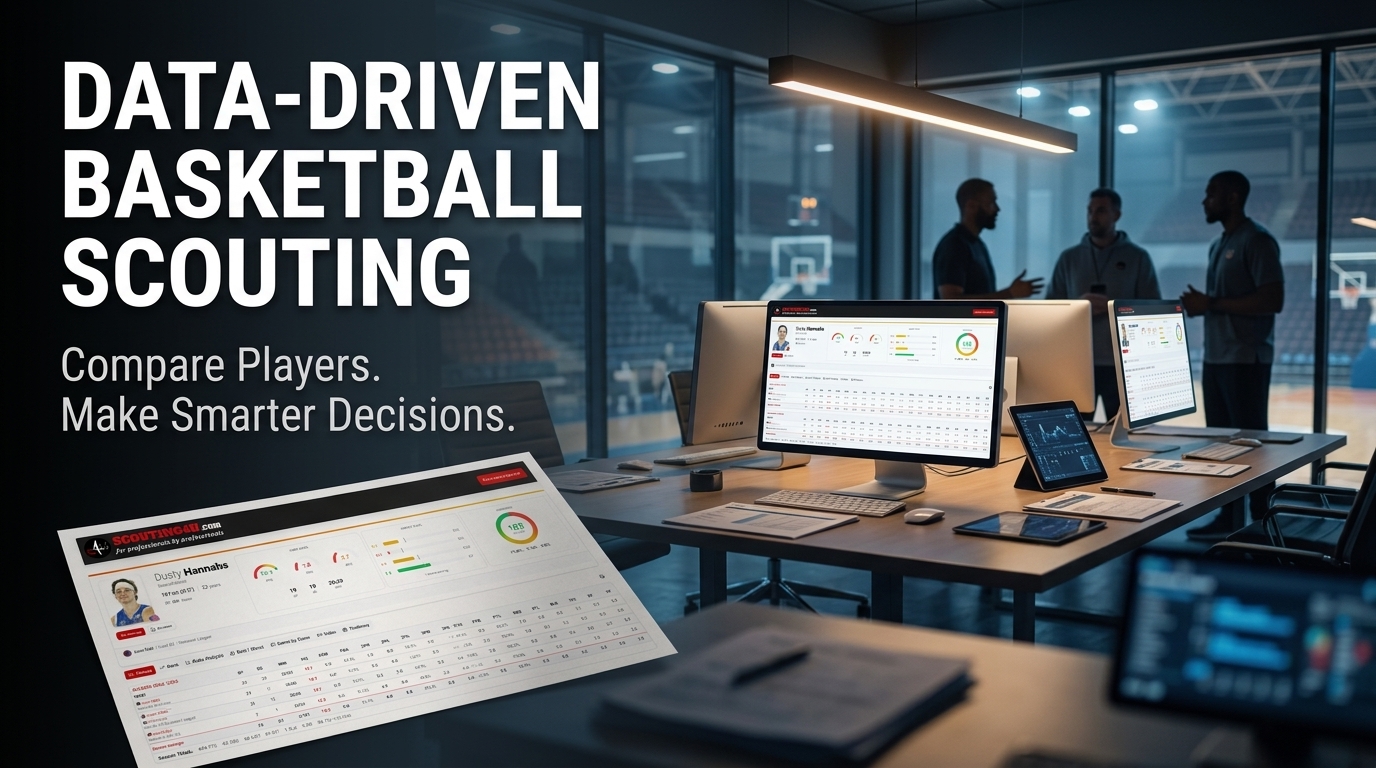
Basketball Player Comparison Tool: Data-Driven Insights
What Is a Basketball Player Comparison Tool?A basketball player comparison tool is software that lets coaches, scouts, a...
Scouting Undervalued Basketball Players: Hidden Gems
Key TakeawaysUndervalued basketball players scouting is one of the most cost-effective ways to build a competitive roste...
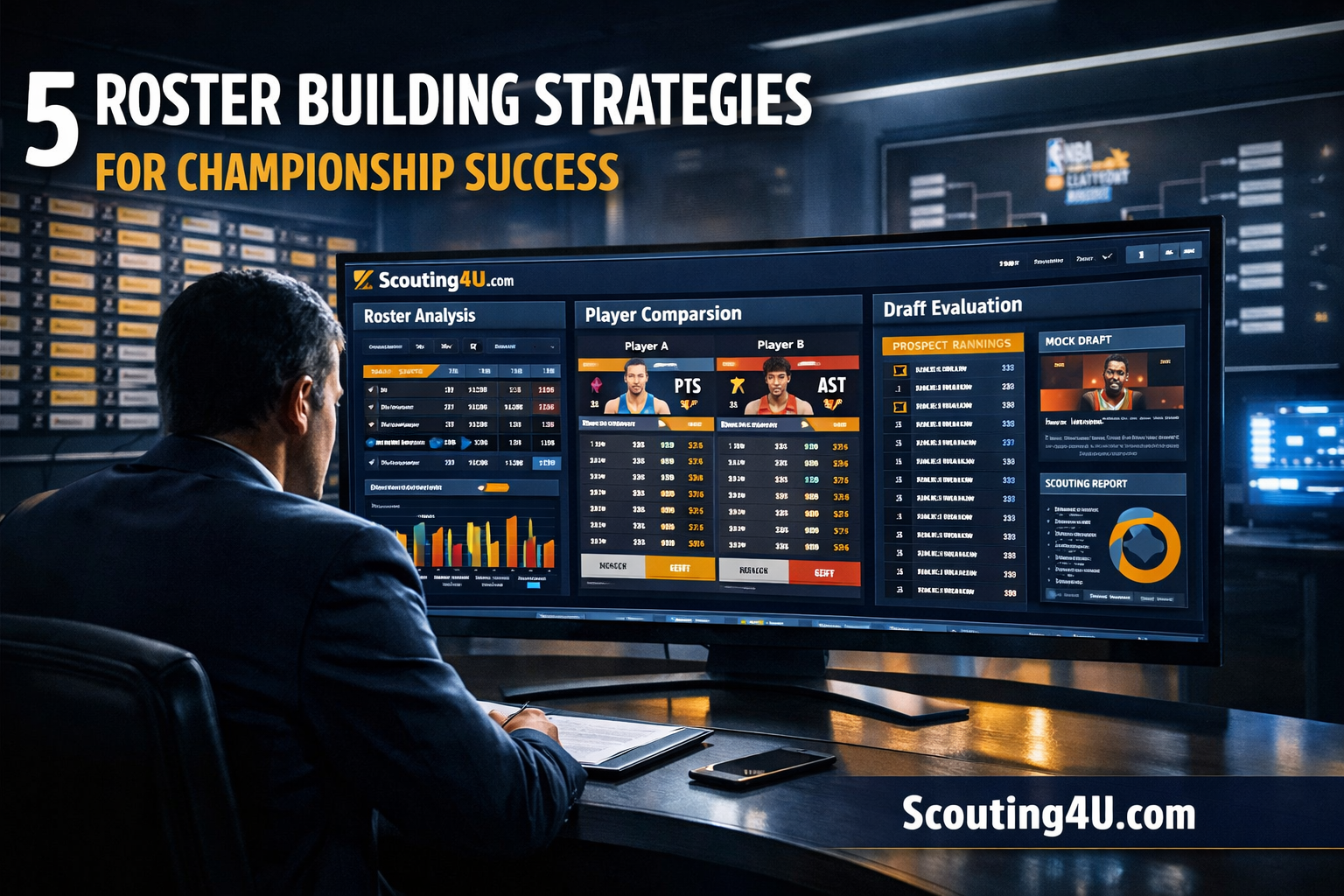
5 Basketball Roster Building Strategies for Success
Basketball Roster Building Strategies: What Actually WorksBuilding a championship-caliber team requires more than assemb...