
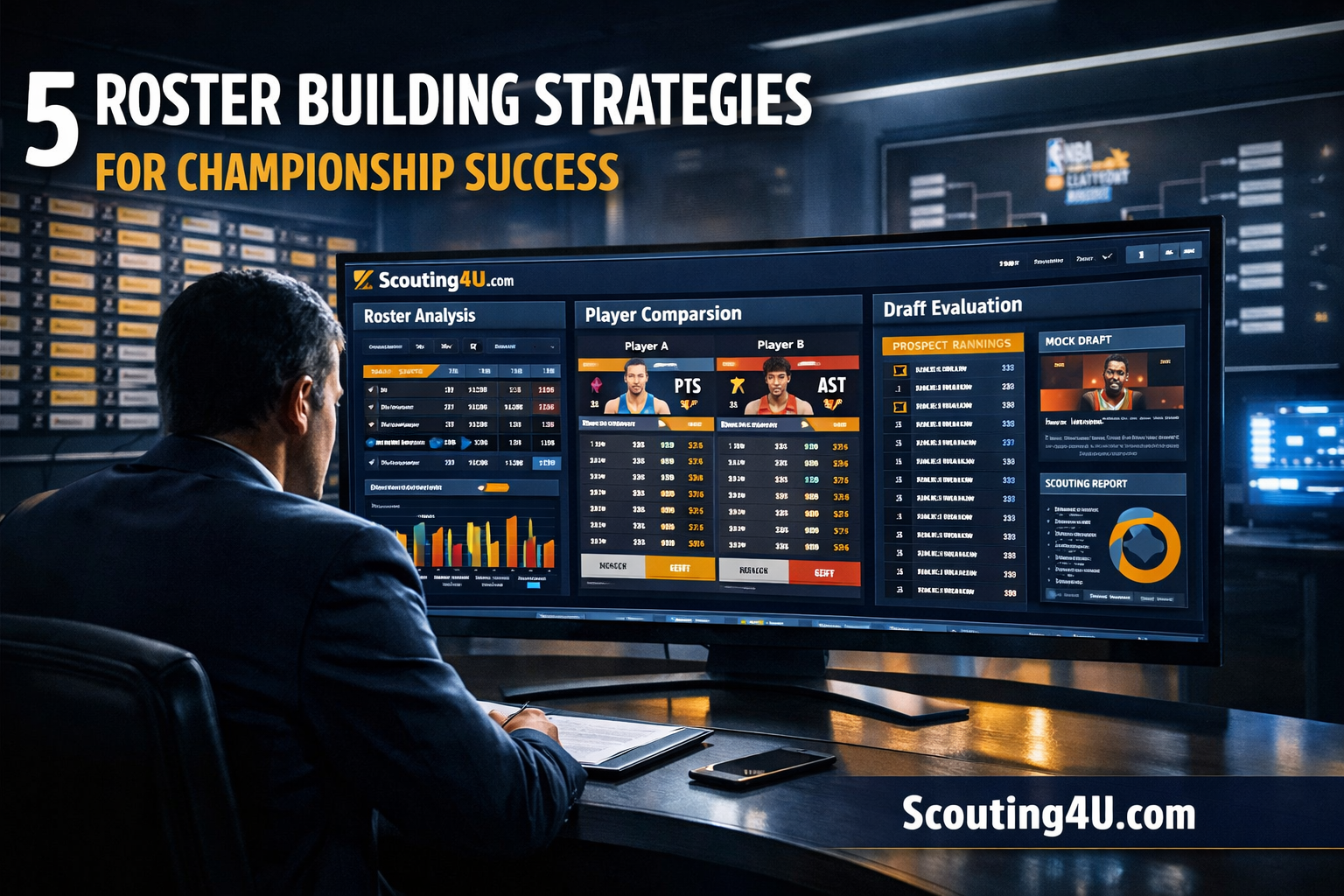
5 Basketball Roster Building Strategies for Success
Basketball Roster Building Strategies: What Actually Works
Building a championship-caliber team requires more than assembling talented players. Effective basketball roster building strategies are what separate organizations that consistently compete from those that rebuild year after year. This guide covers five proven basketball roster building strategies that front office personnel, coaches, and managers can apply right now - from player fit evaluation to adapting your roster around shifting game trends. Whether you are a professional front office executive or a college coach, these basketball roster building strategies give you a repeatable framework for making better decisions.
Key Takeaways
Player fit and team chemistry are the foundation of every successful roster.
Data-driven recruitment gives teams an edge when evaluating undervalued talent.
Balancing star players with the right role players is what wins titles.
Advanced scouting tools save time and reveal patterns that human observation alone misses.
Roster construction must evolve as the game itself evolves.
Why Basketball Roster Building Strategies Matter More Than Ever
The modern game moves fast. Rosters turn over quickly. Teams at every level face pressure to make good decisions with limited time and limited budgets. That is why having a clear set of basketball roster building strategies - not just gut instincts - matters so much right now. Organizations that rely on defined processes outperform those that react to circumstances. The five basketball roster building strategies below are not abstract theory. They are actionable steps you can start applying today.
1. Prioritize Player Fit Over Raw Talent
The first rule of basketball roster building strategies is this: the best player available is not always the right player for your team. Fit matters more than individual ceiling. A roster full of high-scoring wings who all need the ball in their hands will underperform a balanced group built around complementary skill sets.
Player fit covers several dimensions. First, there is the skill dimension - does this player do things the team currently lacks? Second, there is the role dimension - can this player accept a defined role and execute within it? Third, there is the personality dimension - how does this player respond to adversity, to coaching, and to sharing the spotlight?
Teams that have historically struggled to get past the first round often have fit problems, not talent problems. They have too many players competing for the same touches, or defensive liabilities at positions where the opponent attacks most. Before signing anyone, map out what the roster actually needs. Then find players who fill those needs.
This is one of the most underrated basketball roster building strategies at every level. Coaches who get this right consistently punch above their roster's perceived talent level. Those who ignore it tend to wonder why their team underachieves despite having individually impressive players.
Our guide on how to evaluate basketball player fit effectively goes deeper on the specific metrics and qualitative signals coaches should use when assessing whether a player belongs on a given roster.
2. Use Data Analytics to Find Players Others Miss
Modern basketball roster building strategies rely heavily on data. The reason is simple: the human eye misses things, and bias creeps into evaluations more than most scouts want to admit. Analytics remove some of that noise.
Teams that use player efficiency metrics, on/off split data, and tracking stats can identify players who create advantages that don't show up in traditional box scores. A player who averages 8 points per game might be far more valuable than one averaging 18 if his presence improves his teammates' shooting by 4 percentage points and he never turns the ball over in critical moments.
This is how smaller-budget teams stay competitive. They find value where others aren't looking. The data doesn't care about reputation or highlight reels - it just shows what actually happened on the court.
Data-driven basketball roster building strategies also help you avoid expensive mistakes. When you rely solely on reputation or recent highlights, you overvalue players who had one good stretch and undervalue consistent contributors who do their work quietly. Analytics give you a more accurate read on both.
For a detailed breakdown of how this works in practice, read our article on how data analytics reveals undervalued basketball players. It covers specific metrics and real examples of players who were overlooked until the numbers told a different story.
Scouting4U's platform gives teams access to exactly this kind of analysis. You can filter by performance in specific game contexts, compare players across different leagues, and build a clearer picture of who fits before making a roster decision. Check out the full breakdown of tools at Scouting4U platform features.
3. Balance Star Power With the Right Supporting Cast
Every winning roster in basketball history has had this in common: the stars were surrounded by role players who knew their jobs and did them well. Basketball roster building strategies that ignore this principle tend to produce entertaining teams that lose in the playoffs.
Think about the 1990s Chicago Bulls. Michael Jordan was the best player on the planet, but without Dennis Rodman on the boards and Steve Kerr knocking down open threes, those six championships don't happen. Rodman didn't need to score. Kerr didn't need to create his own shot. They each understood their role and executed it at a high level every night.
The same pattern holds across different eras. The San Antonio Spurs dynasty under Gregg Popovich was built on role clarity. Every player knew exactly what was expected of them, and the roster was constructed specifically to support the team's style of play rather than around the preferences of any single player.
When building out your supporting cast, look for players who provide specific things: floor spacing, switchable defense, reliable free throw shooting, or physical interior presence. Avoid the temptation to sign players who are "good all-around" but don't excel at anything specific. A roster needs specialists who do their thing at a high level, not a collection of average contributors.
This balance between stars and role players is at the heart of effective basketball roster building strategies. Get it right and your best player becomes even better. Get it wrong and you end up with a roster where everyone is competing for the same resources.
Lineup analysis helps here. Understanding which combinations work and which ones create problems allows you to build a rotation with intention. Our basketball lineup analysis guide walks through how to evaluate your starting five and bench rotation together as a system.
4. Build a Scouting Process That Scales
Good basketball roster building strategies don't just happen in the front office. They depend on having a scouting infrastructure that consistently brings in reliable information. Many organizations treat scouting as an afterthought - something done reactively when a roster spot opens up. That approach produces reactive, rushed decisions.
A better model is continuous scouting. Your staff should always be tracking players across multiple leagues, building profiles, and flagging targets before you need them. When a roster spot opens, you already have three or four candidates evaluated and ready to present. You're not starting from scratch under pressure.
Advanced scouting today means going beyond watching game film. It means using tendency analysis to understand how a player behaves in specific situations - whether they drive left in pick-and-roll coverage, whether they switch or go under screens, whether their efficiency drops in the fourth quarter. This kind of depth is what separates good scouting from great scouting.
Pre-game scouting reports are another piece of this. If your roster decisions are informed by detailed, consistent opponent analysis, you'll understand what your team lacks against specific styles of play - and build accordingly. Our guide on how to create a basketball pre-game scouting report covers the structure and content that makes these reports actually useful.
The teams that apply these basketball roster building strategies most effectively treat scouting as an ongoing operation, not an occasional project. They build databases of player profiles over time. They compare players across leagues. They track development arcs rather than just current production. That continuity is what allows them to move decisively when an opportunity opens up.
AI-powered tools have made this process significantly more efficient. Instead of spending hours manually tagging film, coaches and scouts can get structured analysis in a fraction of the time. That means more coverage, more players evaluated, and better decisions at every stage of the roster-building process.
5. Adapt Your Basketball Roster Building Strategies to How the Game Is Changing
Basketball isn't static. The game in 2025 looks different from the game in 2015, which looked different from the game in 2005. Effective basketball roster building strategies must account for how the sport is evolving - not just where it is now, but where it's going.
Three-point shooting has reshaped roster construction at every level. Teams that build rosters without floor spacing pay a real penalty. Even big men need to demonstrate some perimeter threat or at least the ability to set legal, effective screens that create corner three opportunities for teammates. The days of carrying an immobile center who scores 12 points per game in the post are largely gone at the top levels of the game.
Defensive versatility is the other major trend. Positionless basketball requires players who can guard multiple positions. A shooting guard who can only guard shooting guards becomes a liability when the opponent goes small and forces switches. Teams that build with switchability in mind are harder to attack and require fewer rotational adjustments in-game.
Pace of play also matters. Rosters built for a slow, half-court style will struggle against teams that push in transition. If your personnel can't run, your opponent will exploit that. Conversely, if you build for pace, you need players with the conditioning and decision-making to maintain it over 40 minutes.
Basketball roster building strategies that account for these trends give teams a structural advantage before the ball is even tipped. Use analytics to track how the game is shifting in your specific competition level - what works in the NBA filters down, but the timeline varies by league and age group. Staying ahead of these shifts is what separates forward-thinking programs from those that are always playing catch-up.
Roster Construction Is an Ongoing Process
The work doesn't stop when the roster is set. Basketball roster building strategies need to be revisited regularly - after the first month of the season, at the trade deadline, and again in the offseason. Rosters that looked right in October can have obvious gaps by January. The organizations that recognize and address those gaps early are the ones that compete deep into the postseason.
Consistent use of performance data, ongoing scouting, and an honest evaluation of what the team actually needs versus what it currently has - that cycle is what sustains winning programs over time. Individual decisions matter, but the process is what produces results year after year.
Applying these basketball roster building strategies consistently is not easy. It requires organizational discipline, trust in data alongside human judgment, and a willingness to make unpopular decisions when the evidence calls for it. But teams that commit to this approach get better at it over time. The process compounds.
If you want to see how Scouting4U can support your basketball roster building strategies from evaluation through ongoing analysis, visit our contact page to request a demo.
Frequently Asked Questions
What are the most important basketball roster building strategies for smaller-budget teams?
Focus on data-driven identification of undervalued players. Smaller budgets mean you can't compete for the most coveted free agents, but you can find players whose contributions don't show up prominently in traditional stats. Efficiency metrics, on/off data, and tendency analysis help surface players who create real value at a price that fits your budget. Role clarity and fit also matter more when you have less margin for error on every roster spot. Basketball roster building strategies that center on process rather than prestige give budget-constrained teams the best chance to compete.
How does player fit affect team performance in practice?
Poor fit creates redundancies - too many players needing the same things from a possession - and leaves gaps that opponents can exploit. Good fit means every player on the court at the same time complements the others. Offensively, that means spacing, movement, and ball-sharing. Defensively, it means coverage responsibilities that don't create mismatches. Teams with high fit tend to perform better in late-game situations where execution under pressure matters most.
How often should basketball roster building strategies be reassessed during a season?
At minimum, after the first 10-15 games of the season and again at any roster transaction deadline. Early-season data gives you a real-world test of your preseason assumptions. Some fits that looked good on paper don't translate. Some players outperform expectations. Reassessing with actual performance data rather than projections helps you make better mid-season adjustments. The best basketball roster building strategies build this reassessment cycle into the process from the start.
What role does scouting technology play in modern basketball roster building strategies?
Scouting technology reduces the time required to evaluate players and increases the depth of that evaluation. AI-assisted analysis can process game film and generate tendency reports in a fraction of the time it takes manually. This means scouts can cover more players, coaches can spend less time on film preparation, and front office staff can make decisions with more complete information. The best platforms integrate video, statistics, and analytical tools in one place - which is exactly what effective basketball roster building strategies require at scale.
How do basketball roster building strategies differ between professional and amateur levels?
At the professional level, the emphasis is on acquiring and retaining talent within salary constraints, which requires precise valuation of player contributions. At the amateur and college level, basketball roster building strategies focus more on player development potential and cultural fit within a program. Youth and high school programs should prioritize player development plans and position versatility over immediate production. The analytical tools available now work across all these levels - the specific metrics and weights just need to reflect the context.
Enjoyed this article? Share it with others!
Founder & Lead Scout, Scouting4U
2x EuroLeague champion with 30+ years in professional basketball. Daniel won EuroLeague titles with Maccabi Tel Aviv, helped build the staff behind the 2007 European Championship, and has delivered 100+ professional scouting reports across 50+ leagues. If it happened in a European basketball front office, he was probably in the room. He founded Scouting4U in 2010 to bring championship-level scouting intelligence to every club.
No reviews yet. Be the first to share your experience!
Related Articles

Data-Driven Basketball Recruitment: A Front Office Guide
Key TakeawaysData-driven basketball recruitment improves roster decisions by replacing gut instinct with measurable evid...
Basketball Player Comparison Tool: Data-Driven Insights
What Is a Basketball Player Comparison Tool?A basketball player comparison tool is software that lets coaches, scouts, a...
Scouting Undervalued Basketball Players: Hidden Gems
Key TakeawaysUndervalued basketball players scouting is one of the most cost-effective ways to build a competitive roste...