
Basketball Player Comparison Tool: Data-Driven Insights
What Is a Basketball Player Comparison Tool?
A basketball player comparison tool is software that lets coaches, scouts, and front office staff measure players against each other using real performance data. Instead of relying on gut feeling or highlight reels, you get numbers that tell the actual story. Points per game is just the start. Modern tools pull in shooting efficiency, defensive impact, usage rates, and dozens of other metrics - all in one place.
Using a basketball player comparison tool has become standard practice at every level of the game. College programs use it in recruiting. Professional teams use it to scout opponents. General managers use it to decide who to sign. The reason is simple: it cuts through noise and surfaces facts.
This article walks through how these tools work, which metrics matter most, and how to get real value from a basketball player comparison tool in your own scouting or roster-building process.
Why a Basketball Player Comparison Tool Changes Recruitment
Traditional scouting has always depended on watching film and trusting experienced eyes. That still matters. But a basketball player comparison tool adds a layer that human observation alone cannot provide: consistency at scale.
A scout watching ten games might miss a pattern. A good basketball player comparison tool will catch it every time. It processes hundreds of possessions, dozens of games, and multiple seasons without fatigue or bias. When you are trying to decide between two players who look similar on paper, that consistency becomes the deciding factor.
Data-driven recruitment also helps teams find players other programs overlooked. If a player posts strong numbers in a mid-major conference, the tool surfaces that. If a European prospect has elite defensive metrics but limited exposure, the tool finds him. That is how front offices build competitive rosters without overspending - they use a basketball player comparison tool to find value before the market catches up.
If you want a deeper look at how data reveals overlooked talent, read how data analytics reveals undervalued basketball players.
Key Metrics Inside Any Serious Basketball Player Comparison Tool
Not all stats are equal. A basketball player comparison tool is only as good as the metrics it tracks. Here are the ones that actually move the needle.
Player Efficiency Rating (PER) gives you a single number that summarizes a player's contributions per minute. It accounts for positive actions like points, assists, and rebounds, and penalizes turnovers and missed shots. It is imperfect - no single number captures everything - but it is a useful starting point when comparing players across different roles.
True Shooting Percentage (TS%) measures scoring efficiency across all shot types. It weighs two-pointers, three-pointers, and free throws. A player who scores 20 points by going 8-for-25 from the field is very different from one who scores 20 points on 8-for-14. TS% captures that difference clearly.
Usage Rate (USG%) tells you how much of a team's offense runs through a specific player when he is on the court. A high USG% player carries a heavy load. A low USG% player may be an efficient specialist. When you compare two players using a basketball player comparison tool, USG% gives context to everything else.
Assist Percentage (AST%) and Defensive Rating (DRTG) round out the picture. AST% shows how often a player creates for teammates. DRTG measures how many points the team allows per 100 possessions when a player is on the floor. These two metrics together tell you whether a player helps on both ends or just one.
A good basketball player comparison tool lets you filter and sort by all of these, then compare two or more players side by side.
How to Use a Basketball Player Comparison Tool to Evaluate Player Fit
Finding a talented player is one thing. Finding a player who fits your system is another. This is where a basketball player comparison tool does some of its best work.
Start by defining what your team needs. If your offense runs through a dominant post player, you need shooters around him. A basketball player comparison tool lets you filter for players with high three-point rates, low USG%, and strong off-ball movement data. You narrow a large pool down to realistic targets fast.
If you run a pace-and-space system, you want players with high TS%, strong catch-and-shoot numbers, and the defensive activity to survive in a switching scheme. The tool surfaces those players. Without it, you are sorting through spreadsheets manually - or relying on word of mouth.
For more on this process, the guide on how to evaluate basketball player fit effectively covers the full framework.
Lineup data adds another dimension. A basketball player comparison tool that includes lineup analysis shows how specific five-man units perform together. You might find that a player who looks average in isolation becomes a net positive in a specific lineup combination. That is not information you get from watching film alone.
Uncovering Undervalued Players With a Basketball Player Comparison Tool
Some of the best moves in basketball history came from finding players others ignored. A basketball player comparison tool is the most reliable way to do that systematically.
Undervalued players often have one of two profiles. The first is a player in a low-visibility league who produces at a high level but has never been tested at a higher level. The second is a player in a high-profile role who looks average on basic stats but grades out well on advanced metrics - often because he is doing work that does not show in the box score.
A basketball player comparison tool catches both types. It lets you search across leagues, adjust for competition level, and identify statistical outliers. When you find a player who ranks in the 90th percentile for a key metric but is not on anyone's radar, that is the opening.
This approach connects directly to roster construction strategy. Read more about that in 5 basketball roster building strategies for success.
The Evolution of Analytics and the Basketball Player Comparison Tool
Twenty years ago, basketball analytics barely existed. Teams tracked points, rebounds, and assists. Box scores were the whole picture. Then two things happened: computing power got cheap, and tracking technology got good.
Optical tracking systems now record every player's position on the court multiple times per second. That data feeds into player tracking metrics like distance covered, speed, defensive closeout rates, and shot quality allowed. A modern basketball player comparison tool draws on all of this.
The shift mirrors what happened in baseball with statistical analysis in the early 2000s. Coaches who resisted the change fell behind. Coaches who adopted it found edges others missed. Basketball is in that same place now - the gap between teams using a basketball player comparison tool seriously and teams that are not is measurable.
The tools also got more accessible. What once required a full analytics department is now available through platforms built specifically for scouts and coaches at all levels. A college assistant can run the same type of comparison that an NBA front office runs.
Integrating a Basketball Player Comparison Tool Into Your Scouting Workflow
Having access to a basketball player comparison tool is not enough. You need a process for using it.
Start with a clear question. Who are we trying to replace? What position group are we thin at? What specific skill do we need? The tool gives you better answers when you ask better questions.
Build a shortlist using filters. Use the metrics that matter most for the role you are filling. Run side-by-side comparisons on your top candidates. Look at trends over multiple seasons, not just single-year numbers. A player whose metrics are improving is often more valuable than one whose numbers are flat.
Then watch film on your shortlist. The basketball player comparison tool narrows the field. Film confirms or challenges what the numbers suggest. The two work together - neither replaces the other.
Document your findings in a structured scouting report. The numbers go in, the film observations go in, and the final recommendation is clear. That process repeats every time. Over a season, you build a database of evaluations you can return to.
Understanding how AI is accelerating this process is worth your time - see how AI basketball scouting reports technology transforms scouting for a full breakdown.
What to Look for in a Basketball Player Comparison Tool Platform
Not every basketball player comparison tool is built the same way. Some are better for professional scouting. Others are designed for college recruiting. A few work well at the youth and developmental level.
When evaluating a platform, ask these questions. Does it cover the leagues you scout? International leagues, mid-majors, and developmental leagues are often underrepresented. Does it update in near real-time or with a significant lag? Does it allow custom filters and side-by-side player views? Can you export data for your own analysis?
The best platforms combine a basketball player comparison tool with broader scouting features - video integration, report generation, roster management, and collaboration tools. That integration saves time and reduces the chance that good data gets lost between departments.
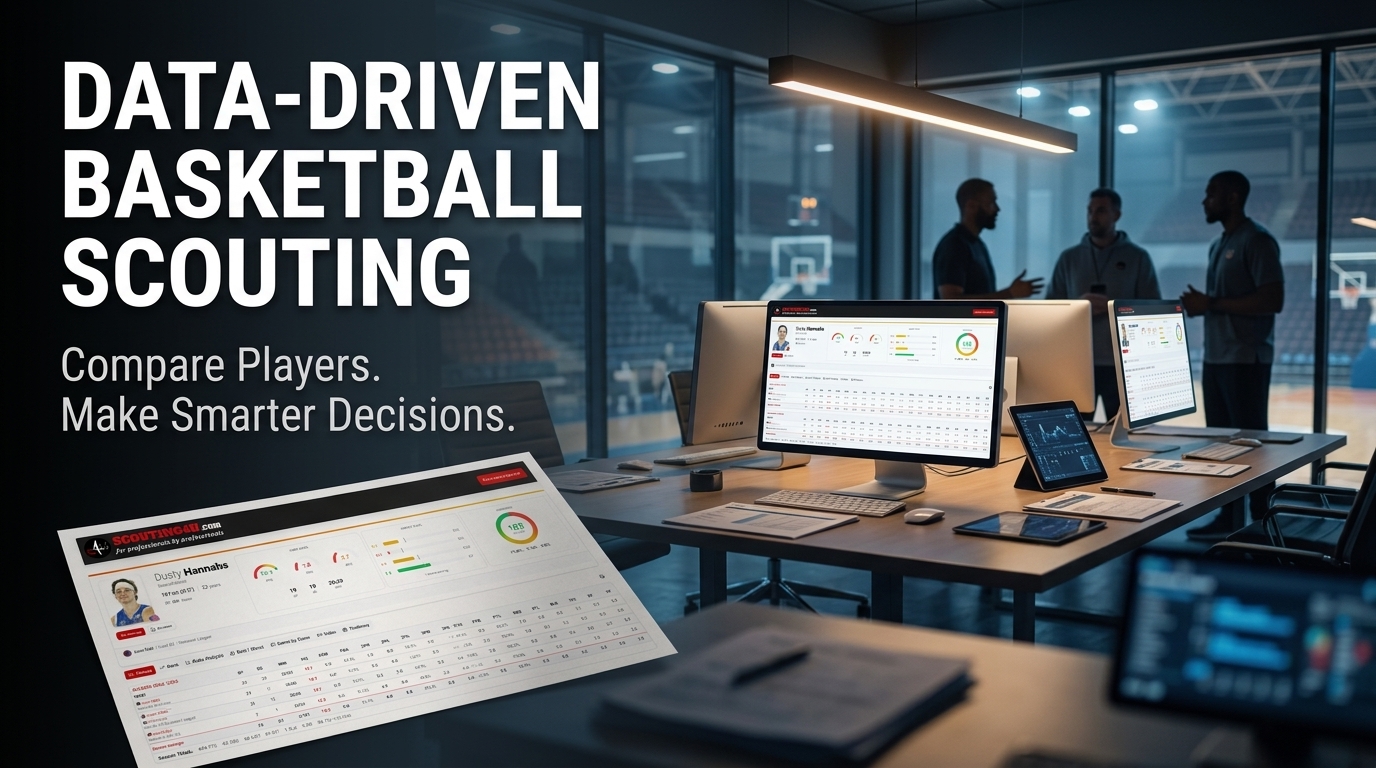
Scouting4U is built around exactly this approach. The platform gives scouts and coaches a basketball player comparison tool alongside team metrics dashboards, player profiles, and reporting features. It covers European leagues in depth - an area where many American-focused tools fall short. You can explore the full feature set at Scouting4U platform features and tools.
Building a Smarter Roster With a Basketball Player Comparison Tool
Roster construction is the sum of many individual decisions. Each signing, each draft pick, each trade shapes what your team looks like. A basketball player comparison tool makes each of those decisions more defensible.
You are not guessing. You are comparing specific players on specific metrics, in context, over meaningful sample sizes. When a decision goes wrong - and some will - you have a clear record of what the data showed and why you made the call. That accountability improves the process over time.
Teams that use a basketball player comparison tool consistently also get better at it. They learn which metrics predict success in their specific system. They learn which red flags actually matter and which ones are noise. That institutional knowledge compounds. Over three or four seasons, a team with a strong analytics culture simply makes better personnel decisions than one without it.
The basketball player comparison tool is not a replacement for experience or judgment. It is a sharper set of tools for coaches and scouts who already have both. Used well, it turns good decision-makers into great ones.
Conclusion
The basketball player comparison tool has moved from a novelty to a necessity. Every program serious about winning uses one. The question now is not whether to adopt analytics but how to use them well. Start with the right metrics, ask specific questions, combine data with film, and build a repeatable process. A basketball player comparison tool gives you the infrastructure. The rest depends on how well you use it.
Scouting4U offers one of the most complete basketball player comparison tool platforms available, with deep coverage of European leagues, advanced metrics, and features built specifically for working scouts and coaches. If you want to see what it can do for your program, visit the contact and demo requests page to schedule a walkthrough.
Frequently Asked Questions
What is a basketball player comparison tool?
A basketball player comparison tool is a software platform that measures players against each other using performance data. It pulls metrics like shooting efficiency, usage rate, defensive rating, and assist percentage into one interface so scouts and coaches can make direct comparisons across players, positions, and leagues.
Which metrics should I prioritize when using a basketball player comparison tool?
It depends on the role you are filling, but Player Efficiency Rating (PER), True Shooting Percentage (TS%), Usage Rate (USG%), and Defensive Rating (DRTG) are solid starting points. For playmakers, add Assist Percentage. For role players, look at off-ball movement data and catch-and-shoot efficiency. A good basketball player comparison tool lets you filter by any of these.
Can a basketball player comparison tool help find undervalued players?
Yes. A basketball player comparison tool is one of the most reliable ways to find players other programs have overlooked. By searching across leagues and filtering on advanced metrics, you can surface players who grade out well statistically but have not attracted attention yet - often because they play in low-visibility leagues or in supporting roles that do not produce flashy box score numbers.
How does a basketball player comparison tool improve roster construction?
It makes individual decisions more precise and the overall process more consistent. Instead of evaluating players in isolation, you compare them against clear benchmarks and against each other on the specific metrics that matter for your system. Over time, this builds institutional knowledge about what actually predicts success in your program.
Is a basketball player comparison tool useful for college and youth basketball, or just professional teams?
It is useful at every level. College programs use a basketball player comparison tool in recruiting to identify fits early. High school and youth coaches use it to track player development over time. Professional teams use it in scouting and trades. The core value - comparing players on real data instead of impressions - applies regardless of level.
Enjoyed this article? Share it with others!
Founder & Lead Scout, Scouting4U
2x EuroLeague champion with 30+ years in professional basketball. Daniel won EuroLeague titles with Maccabi Tel Aviv, helped build the staff behind the 2007 European Championship, and has delivered 100+ professional scouting reports across 50+ leagues. If it happened in a European basketball front office, he was probably in the room. He founded Scouting4U in 2010 to bring championship-level scouting intelligence to every club.
No reviews yet. Be the first to share your experience!
Related Articles

Data-Driven Basketball Recruitment: A Front Office Guide
Key TakeawaysData-driven basketball recruitment improves roster decisions by replacing gut instinct with measurable evid...

Scouting Undervalued Basketball Players: Hidden Gems
Key TakeawaysUndervalued basketball players scouting is one of the most cost-effective ways to build a competitive roste...

5 Basketball Roster Building Strategies for Success
Basketball Roster Building Strategies: What Actually WorksBuilding a championship-caliber team requires more than assemb...