
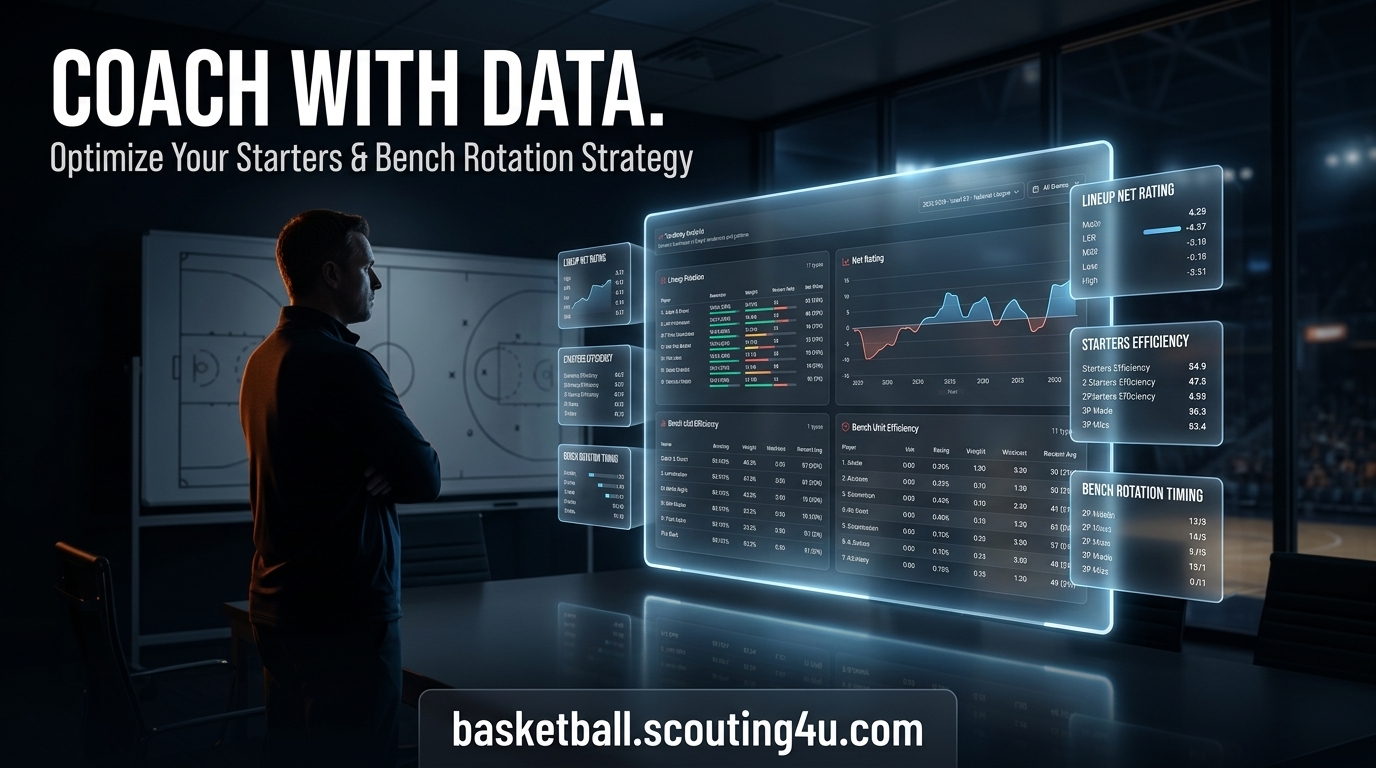
Basketball Starters Bench Rotation Data Tip: Optimize Strategy
Key Takeaways
Every basketball starters bench rotation data tip starts with knowing which lineups actually win minutes - not just which players look good in isolation.
Metrics like PER, ORTG, and DRTG tell you far more than gut instinct ever will.
Analytics platforms like Scouting4U make rotation analysis accessible for coaches at every level.
Balancing starters and bench roles requires fresh data, not last season's assumptions.
International rotation patterns offer real lessons you can apply right now.
Why Every Basketball Starters Bench Rotation Data Tip Matters More Than You Think
Coaches lose games they should win because of rotation decisions made on feel rather than fact. That's the honest truth. A basketball starters bench rotation data tip is not just a neat analytical exercise - it's the difference between a bench that steals momentum and one that gives it away. When your second unit outscores the opponent's bench by 12 points yet your team still loses by 8, something is wrong with how you're deploying your starters. Data shows you exactly where the breakdown happened.
Modern basketball has moved well past basic box scores. Teams at every level now track lineup combinations, on/off splits, and net rating changes in real time. The coaches who use this information win more close games. The ones who ignore it keep making the same rotation mistakes over and over. This guide breaks down how to read rotation data, which metrics matter most, and how to turn raw numbers into smarter lineup decisions. Every basketball starters bench rotation data tip covered here is built around that same goal: better decisions, fewer wasted minutes, more wins.
Understanding Rotation Data: The Basics Every Coach Should Know
Rotation data is simply the record of which players shared the court, for how many minutes, and what happened during those minutes. It sounds simple. In practice, it's one of the most informative datasets in the sport. A solid basketball starters bench rotation data tip always begins here - with clean, organized time-on-court records.
The core numbers to track are net rating (points scored minus points allowed per 100 possessions), pace, and turnover rate for each lineup combination. When you see a five-man unit with a net rating of +9.4 over 40 minutes, that unit is doing something right. When another unit posts -6.1, you need to know why before you play them together again.
On/off splits are just as useful. Compare a player's team performance when he's on the floor versus when he sits. Sometimes a starter looks fine in isolation but the team actually plays better without him in certain matchups. That's the kind of basketball starters bench rotation data tip that changes your rotation by game three of a playoff series. It's also the kind of insight that's easy to miss if you're only watching film and skipping the numbers.
Start simple. Track your five most-used lineup combinations. Record their net rating for each game. After ten games, patterns emerge that no amount of film watching alone will reveal as clearly. That's the core value of any basketball starters bench rotation data tip approach: patterns become visible faster.
Key Metrics for Analyzing Starters vs. Bench Performance
Not all stats are equal when it comes to rotation decisions. Here are the ones worth your time.
Player Efficiency Rating (PER) gives you a single number that accounts for positive and negative contributions. It's not perfect, but it's a fast way to compare players across different roles. A starter averaging a PER of 14 and a bench player sitting at 17 is a rotation conversation waiting to happen.
True Shooting Percentage (TS%) adjusts for three-pointers and free throws, so you get an accurate read on who's actually scoring efficiently. This matters most when evaluating your bench offense. A backup who shoots 58% TS% is a weapon. One shooting 42% is a liability your opponents will target.
Offensive Rating (ORTG) and Defensive Rating (DRTG) measure how many points a lineup scores and allows per 100 possessions. These are the clearest indicators of lineup quality. Any basketball starters bench rotation data tip worth taking seriously will point you toward net rating - ORTG minus DRTG - as your primary rotation filter. This single number tells you more about lineup effectiveness than points per game ever will.
Usage Rate tells you how often a player is involved in possessions. A bench player with high usage and low efficiency is hurting your offense. Pair him with a playmaker or reduce his role. A starter with low usage might have more to give if you run more sets through him. The basketball starters bench rotation data tip here is to cross-reference usage with efficiency before drawing conclusions about any player's value.
For a deeper look at tracking these numbers in your own workflow, check out this guide on how to track basketball stats like a pro.
How to Apply a Basketball Starters Bench Rotation Data Tip in Live Game Situations
Pre-game analysis matters. In-game decisions are where it gets hard. The best coaches use rotation data before tip-off to set a plan, then adjust based on what the live numbers show.
Start by identifying your two or three most reliable lineup combinations from practice data and recent games. Know which bench units hold leads and which ones give them back. This is your baseline basketball starters bench rotation data tip for game night: go in with data-backed combinations ready, not just a rotation written on a whiteboard.
During the game, watch your net rating shifts. If your starting unit is getting outscored in a stretch, don't wait five possessions too long to make a change. Coaches who track live lineup data make substitutions 30 to 60 seconds earlier than those going on instinct alone. Over a full season, those early adjustments add up to a meaningful number of possessions - and possessions are points.
Also track opponent bench performance separately. If their second unit is on a 10-2 run, that's not the time to send out your weakest defensive lineup. Match your most disruptive bench defender against their best bench scorer. That's a practical basketball starters bench rotation data tip you can apply in any game at any level. It doesn't require advanced software - just attention to the right numbers at the right moment.
A good basketball starters bench rotation data tip for in-game management: flag two "trigger points" in your pre-game notes. Define in advance what data threshold will prompt a lineup change. When the number hits, you act. That removes hesitation and keeps decisions grounded in your pre-game analysis rather than emotion.
Using Scouting4U to Get Deeper Rotation Insights
Pulling all this data manually takes hours. Most coaching staffs don't have that time. This is where an analytics platform earns its value. Scouting4U gives coaches access to lineup combination breakdowns, advanced metrics, and opponent tendency reports - all in one place.
The platform lets you filter by lineup, time period, score situation, and opponent type. You can see exactly how your bench performs when protecting a five-point lead in the fourth quarter versus when trailing by ten. That level of detail changes how you plan rotations. Each basketball starters bench rotation data tip you pull from the platform is grounded in actual game events, not estimates.
Scouting4U also makes it easier to build individual player profiles tied to lineup performance. If a specific bench player consistently lifts the team's ORTG when paired with a particular starter, the data makes that combination visible. Without a tool like this, you might never notice the pattern. See what's available at the Scouting4U features page and check subscription plans and pricing to find the right tier for your program.
The platform is built for coaches who want a basketball starters bench rotation data tip backed by real numbers rather than guesswork. It works for programs without a dedicated analytics staff. One coach with thirty minutes and the right filters can pull actionable rotation intelligence before the next game.
Balancing Playing Time: The Rotation Data Tip Coaches Overlook
Minutes distribution is one of the most debated topics in coaching. Too many coaches default to playing their best five players heavy minutes and treating the bench as an afterthought. Rotation data argues against that approach regularly.
Fatigue is real. A starter logging 38 minutes in game two of a back-to-back is often less effective than a rested bench player. DRTG numbers tend to drop in the fourth quarter for starters who played heavy minutes in the first half. A good basketball starters bench rotation data tip here: track fourth-quarter performance separately and compare it against first-half numbers. The drop-off tells you who needs fewer early minutes.
Foul management is another rotation driver that data handles well. If your starting center picks up two fouls in the first six minutes, your bench data needs to tell you whether your backup can hold ground until halftime. If the numbers say he can, sit the starter confidently. If his defensive rating in foul-trouble situations is poor, you need a different plan before the next game. A basketball starters bench rotation data tip that coaches rarely write down: document your backup's performance in foul-trouble stretches specifically, not just his overall numbers. That context makes the decision much easier in the moment.
For broader player development thinking that connects to these decisions, the complete guide to basketball player development is worth reading alongside your rotation analysis work.
What International Basketball Teaches Us About Rotations
European basketball has always approached rotation differently than the NBA. Most EuroLeague coaches play tighter rotations - eight or nine players rather than ten or eleven - and they trust their bench units with specific tactical roles rather than just "filling minutes."
This approach works because European programs track lineup data carefully and build rotations around specific matchups. A bench unit in the Spanish ACB or VTB United League is often designed to shift defensive schemes, not just rest starters. Each player in the rotation has a defined role tied to data on what that unit does well. That's not an accident. It's the result of applying a basketball starters bench rotation data tip framework systematically over an entire season.
The takeaway for any coach is this: a basketball starters bench rotation data tip from European practice is to assign each bench unit a purpose before the game starts. Don't just rotate for rest. Rotate to change pace, apply pressure, or exploit a specific matchup you've identified in pre-game data. That's a discipline the best European programs have used for decades.
For more on how these systems compare, see the breakdown of European basketball vs NBA key differences and the EuroLeague scouting guide.
Building a Rotation Review Process After Every Game
Post-game review is where the best basketball starters bench rotation data tip work actually happens. Most coaches review film. Fewer coaches pull lineup data alongside it. The ones who do get smarter faster.
After each game, run through these four questions using your rotation data. First, which lineup combinations had the best and worst net ratings? Second, did your bench scoring unit hold or lose ground against their counterpart? Third, were there minutes in the game where your rotation left a defensive mismatch unaddressed for too long? Fourth, did fatigue show up in your starters' efficiency in the fourth quarter?
These four questions make every post-game review more concrete. You're not just watching what happened - you're building a rotation database that makes your next game better. Over a 30-game season, that compound improvement is significant. This is the long-term value of applying every basketball starters bench rotation data tip you can gather: the data tells a story that gut instinct simply can't.
Add a fifth question if you want to go deeper: did any bench player's performance suggest a role change is warranted? This is where a basketball starters bench rotation data tip turns into roster strategy. If a backup posts three consecutive games with a positive net rating in starter-adjacent minutes, the data is telling you something worth acting on.
If you're also working on how analytics connects to scouting and recruiting, this piece on data-driven basketball analytics covers the full picture well.
Common Rotation Mistakes and What the Data Says
Even experienced coaches make predictable rotation errors. Data tends to expose them quickly.
Playing starters too many minutes because of trust rather than performance is the most common one. The second is burying bench players with good efficiency numbers because they're not "proven" starters. Both mistakes show up clearly in net rating data. A basketball starters bench rotation data tip that solves both: let a player's lineup net rating earn him minutes, regardless of title.
Another mistake is ignoring score-state context. A lineup that works when trailing by six may collapse when protecting a lead. Segment your data by score state. You'll find that some players who look average overall are excellent in specific game situations. That information changes how you use them. This is a basketball starters bench rotation data tip that most coaches don't implement until they've already lost a game because of it.
Scouting errors in rotation planning also cost teams. If you're not tracking opponent bench tendencies alongside your own rotation data, you're missing half the picture. Good rotation strategy is always a two-sided exercise. Check out scouting mistakes that cost games for more on how data catches errors before they become losses.
Putting It All Together: A Practical Basketball Starters Bench Rotation Data Tip Framework
Here's how to turn all of this into a repeatable system. Before each game, pull your last five-game lineup net ratings and identify your two best bench combinations. Set a minutes plan based on fatigue data from recent games. Flag any foul-risk starters who need a short early leash.
During the game, track score-state changes by lineup. Make substitutions based on your pre-game combinations, not panic. After the game, run through the four post-game questions outlined above and update your lineup database.
Do this for ten consecutive games and your rotation instincts will sharpen dramatically - because they'll be backed by real numbers. Every basketball starters bench rotation data tip in this guide points toward the same conclusion: the coaches who track this information win more games than those who don't. The margin is not small. In competitive basketball, one extra win per month often separates playoff teams from also-rans.
Apply one basketball starters bench rotation data tip at a time if the full system feels like too much at once. Start with net rating. Then add on/off splits. Then score-state segmentation. Build the habit in layers and it sticks. That incremental approach is more practical than trying to overhaul everything before your next game.
If you want to see what a full analytics workflow looks like in practice, the guide to basketball game statistics software walks through it step by step.
Frequently Asked Questions
What exactly is a basketball starters bench rotation data tip?
It's any data-backed insight that helps a coach decide which players to use, when to use them, and in which combinations. A basketball starters bench rotation data tip can come from net rating splits, on/off data, fatigue tracking, or score-state analysis. The common thread is that the decision is driven by numbers, not just habit or preference.
How often should coaches review rotation data during a season?
After every game, ideally. A quick 15-minute post-game review of lineup net ratings and bench performance takes less time than most coaches expect. Over a full season, that habit builds a detailed picture of which combinations work and which don't - information that becomes especially useful in late-season and playoff situations. Applying a consistent basketball starters bench rotation data tip process after each game is how good rotation instincts actually develop.
Which metrics matter most for rotation decisions?
Net rating (ORTG minus DRTG) is the single most useful number. After that, focus on on/off splits, TS% for individual players, and fourth-quarter efficiency for starters carrying heavy minutes. PER gives a quick player comparison when you need to make a fast call. Use all of them together rather than relying on any one metric alone. Every solid basketball starters bench rotation data tip traces back to at least one of these numbers.
Can smaller programs without analytics staff use rotation data effectively?
Yes. Platforms like Scouting4U are built to make this accessible without a dedicated analytics team. A head coach or assistant can pull lineup data and run basic net rating comparisons without advanced technical knowledge. The tools do the heavy lifting. You just need to ask the right questions of the data you have. The basketball starters bench rotation data tip framework described in this guide works at the high school level just as well as it does professionally.
How does international rotation strategy differ from the NBA approach?
European coaches typically use tighter rotations with more defined roles for each bench unit. NBA rotations tend to be deeper and more fluid, adjusting more frequently to matchups within games. The basketball starters bench rotation data tip from international basketball is to give bench units a tactical purpose - not just rest time - which requires pre-game data work that many programs at every level can adopt immediately.
Enjoyed this article? Share it with others!
Founder & Lead Scout, Scouting4U
2x EuroLeague champion with 30+ years in professional basketball. Daniel won EuroLeague titles with Maccabi Tel Aviv, helped build the staff behind the 2007 European Championship, and has delivered 100+ professional scouting reports across 50+ leagues. If it happened in a European basketball front office, he was probably in the room. He founded Scouting4U in 2010 to bring championship-level scouting intelligence to every club.
No reviews yet. Be the first to share your experience!
Related Articles

Analyzing Basketball Player Potential: Scouting Insights
Key Takeaways Analyzing basketball player potential combines data analysis with scouting intuition. Core metrics includ...

Mastering Basketball Service: Scouting Insights & Tools
Key TakeawaysA strong basketball service covers everything from player evaluation to game strategy analysis.Scouting4U g...

One Shot Chart. Three Insights Visual: Game Plan Revolution
Key TakeawaysA basketball shot chart three insights visual approach reveals high-efficiency zones, player tendencies, an...