
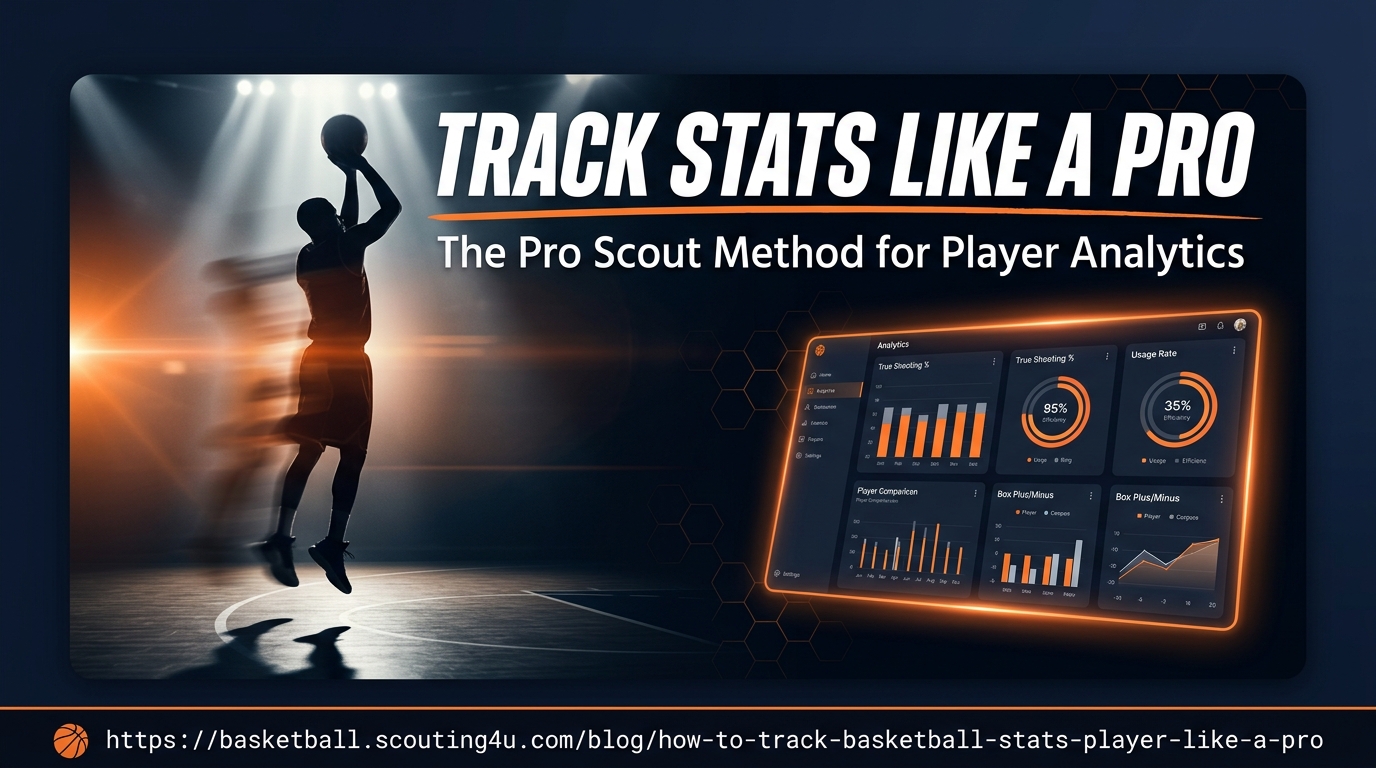
How to Track Basketball Stats Player Like a Pro
Key Takeaways
You must track basketball stats player data consistently to accelerate development and attract scouts.
Advanced metrics like PER, TS%, and USG% give a fuller picture than basic box scores alone.
Scouting4U offers powerful tools to help every player track basketball stats player performance over time.
A structured tracking plan helps create a compelling player profile for recruiters and coaches.
Historical data comparisons reveal trends that guide smarter, more targeted training decisions.
Why You Need to Track Basketball Stats Player Data
Every serious player and coach needs to track basketball stats player performance with precision. Raw talent alone will not open doors at the next level. Data does. When you track basketball stats player numbers regularly, you gain clear insight into what is working and what needs fixing. You can spot patterns across games, measure growth over a season, and communicate your value to scouts in a language they trust. Without stats, development is guesswork. With stats, it becomes a science.
The basketball landscape has changed dramatically. Scouts and coaches at every level — from high school to professional leagues — now expect players to arrive with documented performance data. If you cannot track basketball stats player metrics in a structured way, you risk being overlooked in favor of players who can. The good news is that modern platforms make it easier than ever to gather, store, and interpret this data.
Whether you are a young athlete building your first player profile or a coach managing an entire roster, the decision to consistently track basketball stats player results is one of the highest-value investments you can make. Let's break down exactly how to do it right.
Core Metrics Every Player Should Track
To track basketball stats player performance effectively, you need to know which numbers matter most. Basic stats like points, rebounds, and assists are a starting point. But advanced metrics tell a much richer story. They measure efficiency, decision-making, and overall impact on the team. Here are the most important ones to monitor.
Player Efficiency Rating (PER)
PER condenses a player's entire statistical output into one number. It accounts for positive contributions — scoring, assists, rebounds, steals, blocks — and subtracts negative ones like turnovers and missed shots. A PER of 15 is considered average at the professional level. When you track basketball stats player PER across a season, you can see whether overall efficiency is trending upward or declining. It is especially useful for comparing performance across different roles and team systems.
True Shooting Percentage (TS%)
Standard field goal percentage misses a lot of nuance. TS% corrects this by weighting two-point shots, three-point shots, and free throws according to their actual point value. A player who scores heavily from the three-point line and the free throw line will show a higher TS% than their raw shooting percentage suggests. When you track basketball stats player shooting data with TS%, you get an honest measure of scoring efficiency that scouts and analysts rely on heavily.
Usage Rate (USG%)
USG% measures the share of a team's offensive possessions a player uses while on the floor. It includes field goal attempts, free throw attempts, and turnovers. A high USG% means the team runs a lot of plays through that player. Context matters here. A high USG% with a low TS% signals inefficiency. A high USG% paired with a high TS% identifies a go-to scorer who performs under pressure. Always track basketball stats player usage alongside efficiency for the full picture.
Assist-to-Turnover Ratio
This simple ratio reveals how well a player creates for teammates while protecting the ball. A ratio above 2:1 is generally strong. Guards and playmakers should pay particular attention to this metric. When you track basketball stats player assist and turnover numbers together, you can evaluate decision-making quality far better than either number alone would allow.
Defensive Rating and Stocks
Defense is often the hardest side of the ball to quantify. Defensive Rating measures how many points a team allows per 100 possessions with a player on the court. "Stocks" — the combined total of steals and blocks — offer a simpler defensive indicator. Track basketball stats player defensive numbers alongside offensive metrics to build a balanced profile that reflects total contribution.
How to Track Basketball Stats Player Performance Step by Step
Knowing which metrics matter is only half the battle. You also need a reliable system to collect and store data consistently. Here is a practical process you can start using today.
Step 1 — Choose Your Tracking Method
You can track basketball stats player data manually using spreadsheets, or you can use dedicated analytics software. Manual tracking works for basic stats but becomes cumbersome with advanced metrics. Software platforms automate data entry, calculate advanced stats instantly, and store everything in one accessible place. For serious players and teams, software is the clear choice.
Step 2 — Define Your Baseline
Before you can measure improvement, you need a starting point. Collect stats from your most recent games to establish baseline numbers. Record PER, TS%, USG%, assist-to-turnover ratio, and defensive metrics. This baseline becomes the reference point for every review going forward when you track basketball stats player progress.
Step 3 — Set Specific Improvement Targets
Vague goals produce vague results. Instead of "get better at shooting," set a target like "raise TS% from 52% to 57% within 10 weeks." Tie each target to a specific metric you already track basketball stats player data for. This makes progress measurable and keeps training focused.
Step 4 — Review Data Weekly
Consistency separates great trackers from average ones. Schedule a weekly data review session. Compare your numbers to the previous week. Look for trends — is your USG% rising while your TS% holds steady? That is a positive sign. Is your assist-to-turnover ratio dropping? That signals a problem worth addressing in practice. The more often you track basketball stats player results, the faster you can course-correct.
Step 5 — Combine Stats with Video
Numbers tell you what happened. Video tells you why. Pair every statistical review with a film session. If your defensive rating spiked this week, watch the plays that led to those numbers. You will understand the cause immediately and can adjust accordingly. For a deeper dive into this approach, read our complete guide to basketball video analysis and game film.
Tools to Track Basketball Stats Player Data Efficiently
The right tools make it dramatically easier to track basketball stats player performance at scale. Manual methods simply cannot keep up with the volume and complexity of modern analytics. Investing in the right platform pays dividends in time saved and insight gained.
Dedicated Analytics Platforms
Platforms like Scouting4U are purpose-built to track basketball stats player data at both individual and team levels. They calculate advanced metrics automatically, generate visual reports, and allow you to store data across multiple seasons. This makes year-over-year comparisons straightforward. Explore the full range of capabilities on the Scouting4U features page to see how the platform can support your development goals.
Video Analysis Software
Video analysis tools let you tag specific plays, create highlight clips, and annotate footage with statistical context. When integrated with stat tracking, video platforms provide a complete picture of performance. Scouts increasingly expect both data and video evidence when evaluating players. Tools that connect these two streams make your profile far more compelling.
Game Statistics Software
Standalone game statistics software is another valuable option, particularly for teams managing large rosters. These tools simplify live data entry during games and sync automatically to your analytics dashboard afterward. For guidance on choosing and using the right solution, check out our guide to mastering basketball game statistics software.
Wearable and Sensor Technology
GPS trackers, accelerometers, and smart insoles now capture physical performance data that traditional stats miss entirely. Sprint distances, jump heights, and workload metrics complement statistical tracking by connecting physical output to on-court performance. As these tools become more affordable, integrating physical data with performance stats will become standard practice at all levels.
Building a Player Profile That Scouts Trust
The ultimate goal when you track basketball stats player numbers is to build a profile that communicates your value clearly and credibly to scouts and coaches. A well-constructed profile does the selling for you before you ever step on the court for a tryout.
Your profile should include season averages for all key advanced metrics, game-by-game breakdowns for recent performances, year-over-year comparisons that demonstrate growth, and curated video clips aligned to the stats. Scouts want to see consistency. They want to see an upward trajectory. And they want to see that a player understands their own game well enough to present data intelligently.
Platforms like Scouting4U streamline this process. They format your tracked data into professional-grade reports you can share directly with scouts, agents, and coaches. For a broader understanding of what scouts look for and how to position yourself effectively, read our player development guide on how to get scouted in basketball.
Using Historical Data to Accelerate Development
One of the most underused advantages of tracking stats consistently is the historical data you accumulate over time. Most players focus only on recent games. The players who develop fastest look at long-term trends across full seasons and multiple years.
When you track basketball stats player data historically, patterns emerge that short-term snapshots hide. You might notice your shooting efficiency drops significantly in the fourth quarter of close games — a sign of conditioning or mental focus that needs addressing. You might discover your assist numbers rise when you play with certain teammates, revealing lineup combinations worth exploiting. You might find that your PER spikes in games where you record five or more offensive rebounds, pointing to a specific style of play that suits your strengths.
These insights are only visible when you have accumulated enough data over time. This is why starting now — regardless of your current level — matters so much. Every game you track basketball stats player results today becomes valuable historical context tomorrow.
Developing a Youth Basketball Tracking Plan
Young players benefit enormously from learning to track basketball stats player data early. Building this habit at the youth level creates self-awareness, goal-setting discipline, and a statistical foundation that grows richer every year.
For youth players, start with simplified metrics: points, rebounds, assists, steals, and field goal percentage. As players mature and their understanding of the game deepens, introduce advanced metrics like TS%, USG%, and defensive ratings. By the time a player reaches high school or college recruiting age, they will have years of tracked data demonstrating consistent growth — a powerful advantage in competitive recruitment environments.
Coaches and parents can support this process by making weekly stat reviews a regular part of player routines. Frame it positively: tracking stats is not about criticism, it is about awareness and empowerment. Players who understand their own data make smarter decisions on and off the court.
Connecting Stats to Scouting and Recruitment
When you track basketball stats player data with recruitment in mind, the entire exercise takes on greater strategic value. Scouts operate in a competitive environment. They evaluate dozens or hundreds of players for limited roster spots. Players who arrive with clean, comprehensive, well-presented statistical profiles stand out immediately.
Advanced metrics demonstrate basketball IQ as much as raw talent. A player who tracks their own PER, monitors their TS%, and speaks fluently about their USG% communicates seriousness and self-awareness. These qualities matter to professional scouts just as much as the numbers themselves. For more on what modern scouting looks like at the highest levels, explore our definitive guide to basketball scouting for modern scouts.
If you are ready to take your tracking to the next level with professional-grade tools, visit the Scouting4U pricing page to find a plan that fits your needs and budget.
Common Mistakes When You Track Basketball Stats Player Data
Even motivated players make avoidable errors in their tracking approach. Knowing these pitfalls in advance saves wasted effort and keeps your data reliable.
Tracking only offensive stats. Defense wins championships, and scouts know it. Always include defensive metrics in your tracking routine to present a complete picture.
Ignoring sample size. One great game means little statistically. You need at least 10-15 games of data before drawing meaningful conclusions from advanced metrics. Stay patient and keep collecting.
Failing to contextualize stats. A 15% USG% for a point guard and a 15% USG% for a center mean very different things. Always interpret stats within the context of position, role, and team system.
Not reviewing the data regularly. Collecting stats without reviewing them defeats the purpose. Schedule time weekly to analyze what you track basketball stats player data shows and act on the findings.
Using inconsistent tracking methods. Mixing manual spreadsheets with multiple apps creates data gaps and inconsistencies. Choose one primary platform and stick with it for continuity.
Frequently Asked Questions
What stats should I prioritize when I track basketball stats player performance?
Start with the core advanced metrics: Player Efficiency Rating (PER), True Shooting Percentage (TS%), and Usage Rate (USG%). Add assist-to-turnover ratio and defensive rating for a complete picture. These metrics reveal efficiency, decision-making, and total impact far better than points and rebounds alone. As you build your tracking habit, expand into more granular data like on/off splits and shot location breakdowns.
How often should I track basketball stats player data?
Track every game, without exception. Even in informal pickup games, recording basic stats maintains the habit and builds your historical database. Conduct a full advanced metrics review weekly. Schedule a deeper month-by-month trend analysis at least once per month. The more consistently you track basketball stats player results, the more useful and reliable your data becomes over time.
Can youth players benefit from learning to track basketball stats player metrics?
Absolutely. Young players who learn to track basketball stats player data early develop self-awareness and goal-setting skills that compound over their entire career. Start with simple metrics — points, rebounds, assists, and shooting percentage — and introduce advanced stats as their basketball understanding grows. By the time they enter recruiting age, they will have a rich multi-year statistical record that gives them a major advantage over peers who started tracking late.
What tools work best to track basketball stats player information at the team level?
Dedicated analytics platforms like Scouting4U are the most efficient solution for teams. They automate advanced metric calculations, store data across full seasons, generate shareable reports, and integrate with video analysis tools. Spreadsheets can work for small teams with limited budgets, but they become unwieldy quickly. For teams serious about development and recruitment, purpose-built software is the clear choice. Visit the Scouting4U features page to explore what professional-grade tracking looks like in practice.
How does tracking stats help with getting recruited?
When you consistently track basketball stats player metrics, you build a documented evidence trail of your development and performance. Scouts trust data. A player who arrives at a tryout with a clean statistical profile — showing growth across multiple seasons, strong advanced metrics, and video to back it up — stands out immediately. Data tells your story more credibly than highlights alone. Pair your stats with a strong profile on a recognized platform and you dramatically increase your visibility to coaches and recruiters at every level.
Enjoyed this article? Share it with others!
Founder & Lead Scout, Scouting4U
2x EuroLeague champion with 30+ years in professional basketball. Daniel won EuroLeague titles with Maccabi Tel Aviv, helped build the staff behind the 2007 European Championship, and has delivered 100+ professional scouting reports across 50+ leagues. If it happened in a European basketball front office, he was probably in the room. He founded Scouting4U in 2010 to bring championship-level scouting intelligence to every club.
No reviews yet. Be the first to share your experience!
Related Articles
Basketball Combine Preparation: What Scouts Measure
What Is Basketball Combine Preparation?Basketball combine preparation is the structured process of getting ready to perf...
Creating a Youth Basketball Development Plan That Works
Key TakeawaysA youth basketball development plan is crucial for player growth and scouting readiness.Tracking basketball...

How to Build a Basketball Player Profile for Scouts
Key TakeawaysCreating a strong basketball player profile for scouts is crucial for getting noticed.Track essential baske...