
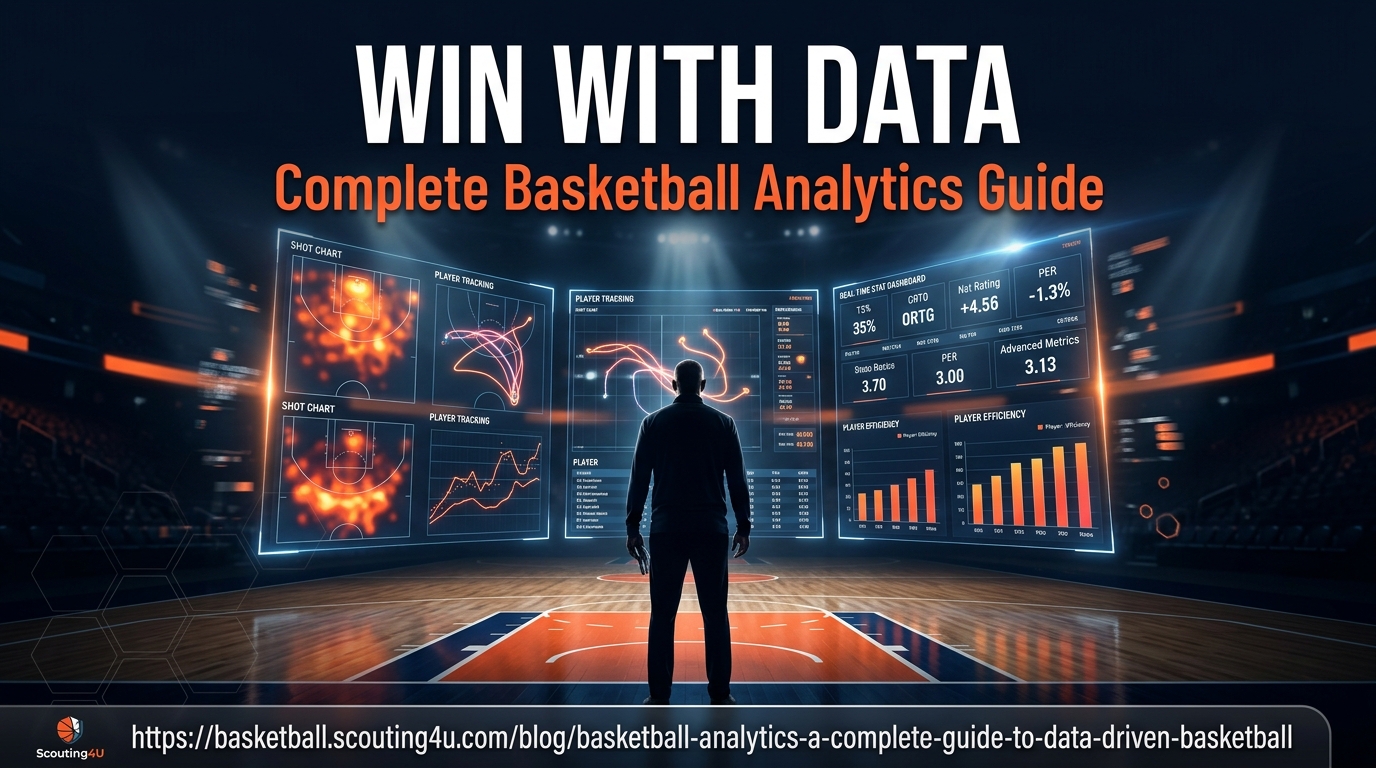
Basketball Analytics: A Complete Guide to Data-Driven Basketball
Key Takeaways
Data-driven methods revolutionize player evaluation and team strategies.
Key metrics include PER, TS%, ORTG, and DRTG.
Platforms like Scouting4U enhance recruitment and player development.
Advanced tools provide insights into shot selection and game strategy.
Modern scouting and coaching decisions depend on objective data analysis.
Introduction to Basketball Analytics
Basketball analytics has transformed how teams and coaches approach the game. By using data, teams make smarter decisions that improve performance and recruitment. This guide covers the core components of basketball analytics, its history, and the tools that now shape modern basketball. Whether you are a coach, scout, or fan, understanding data analysis gives you a real edge. The rise of advanced statistics has changed everything from roster construction to in-game adjustments.
The Historical Evolution of Basketball Analytics
The field started with simple stats like points, rebounds, and assists. As the game grew more competitive, teams needed deeper insights. Advanced metrics like PER and TS% emerged to fill that gap. These numbers reveal what traditional stats often miss. Over time, data became central to how front offices build rosters and how coaches design game plans. Today, nearly every professional team uses some form of data-driven analysis to stay competitive.
The NBA led this shift in the early 2000s. Teams began hiring analysts and statisticians alongside traditional scouts. The "Moneyball" effect, which started in baseball, inspired basketball leaders to rethink how they valued players. As a result, basketball analytics grew from a niche interest into a core business function for elite clubs worldwide. The transformation happened quickly once front offices saw the results.
Understanding Key Basketball Metrics
To use basketball analytics well, you need to understand the metrics behind it. Each stat tells a different story. Some measure scoring. Others measure defense or overall impact. Let's break down the most important ones.
Player Efficiency Rating (PER)
PER is a single number that captures a player's total contributions. It accounts for positive actions like scoring and assists, and negative ones like turnovers and fouls. PER is standardized across all players, so you can compare a point guard to a center fairly. Scouts and analysts use PER to quickly assess a player's overall value. A league-average PER is typically 15. Anything above 20 signals an elite performer.
True Shooting Percentage (TS%)
TS% measures shooting efficiency more accurately than field goal percentage alone. It includes free throws and three-pointers, giving a full picture of how well a player scores. A high TS% means a player gets the most out of every shot attempt. This metric is especially useful for comparing players who score in very different ways. For a deeper look at how TS% connects to game performance, read our guide on Mastering Basketball Analytics: PER and True Shooting.
Offensive and Defensive Ratings
ORTG (Offensive Rating) measures how many points a player or team scores per 100 possessions. DRTG (Defensive Rating) does the same on the defensive end. These ratings help coaches understand impact beyond raw scoring. A player can have a modest point total but still boost the team's ORTG by making smart plays. Likewise, a strong DRTG indicates a player who limits opponents effectively.
Box Plus/Minus and Win Shares
Box Plus/Minus (BPM) estimates a player's contribution compared to a league-average player. Win Shares (WS) translate a player's performance into the number of wins they help produce. Both metrics are widely used in data-driven scouting to evaluate contract value and roster construction. They help front offices decide which players are worth investing in long-term.
Advanced Tools and Software for Data Analysis
Modern basketball analytics relies on powerful software platforms. These tools collect, organize, and visualize data so coaches and scouts can act on it quickly. Platforms like Scouting4U provide detailed data insights covering performance, strategy, and recruitment. The right software turns raw numbers into actionable game plans.
When choosing a platform, teams often compare options side by side. Understanding what each tool offers helps teams select the best fit for their needs.
Beyond professional teams, college programs and European clubs are also adopting analytics software. The barrier to entry has dropped significantly. Even smaller organizations can now access the same level of data analysis that once required a full data science team.
Shot Chart Analysis and Scoring Efficiency
Shot charts are one of the most visual and intuitive tools in modern data analysis. They show where on the court a player attempts and makes shots. Coaches use this data to design plays that get players into their favorite spots. Defenders use it to cut off high-percentage areas.
Shot chart analysis also reveals inefficiencies. If a player takes many mid-range shots with a low conversion rate, data tools can flag that. The team can then adjust to generate better looks. This approach to scoring efficiency is explored in detail in our guide on Mastering Shot Selection: The Complete Guide to Scoring Efficiency in Basketball.
At the team level, shot chart data informs offensive system design. Teams that emphasize three-pointers and shots at the rim tend to score more efficiently. The evidence from game data across multiple seasons supports this clearly.
How Basketball Analytics Improves Recruitment
Recruitment is one of the areas where basketball analytics adds the most value. Traditional scouting relies on watching games and trusting instincts. Analytics adds an objective layer to that process. Scouts can now filter hundreds of players using data before ever watching a single game clip.
Metrics like PER, TS%, and defensive rating help scouts identify undervalued players. These are athletes who may not have a big reputation but whose numbers show elite-level production. This kind of insight levels the playing field, especially for teams with smaller scouting budgets.
Scouting4U was built with this use case in mind. The platform offers tools that streamline the recruitment workflow. To understand how scouting connects with player careers, read our guide on Basketball Scouting: The Definitive Guide for Modern Scouts. It covers how modern scouts use data to make better decisions at every stage of the process.
Integrating Video Analysis with Data
Data alone does not always tell the full story. Video analysis adds context to what the numbers show. When a player has a low assist rate, video can reveal whether that is due to poor decision-making or a system that limits their opportunities. Combining video with statistical data gives coaches and scouts a complete picture.
Platforms like Scouting4U integrate both tools in one place. You can pull up a player's stats and then watch the clips that generated those numbers. This makes the review process faster and more accurate. It also reduces the risk of misreading data without the visual context to support it.
For a full breakdown of how video and data work together, see our article on Basketball Video Analysis: The Complete Guide to Game Film. It explains the workflow that top analysts use to get the most from both data and film.
Basketball Analytics in Player Development
Player development is another area where basketball analytics delivers real results. Coaches can track a player's progress over time using objective metrics. If a player's TS% is improving, the training is working. If their DRTG is declining, there may be a defensive issue to address.
Analytics also helps players set realistic goals. A young player can compare their numbers to established pros at the same age. This gives them a concrete benchmark to work toward. Structured development programs built around data tend to produce better long-term results than those relying on intuition alone.
Scouting4U supports development programs by tracking player performance across seasons. Coaches can identify trends and adjust training plans accordingly. This data-driven approach to growth is part of what makes objective performance analysis so valuable at every level of the game. To explore development frameworks further, see The Complete Guide to Basketball Player Development.
Opponent Analysis and Game Strategy
Before any big game, coaching staffs use basketball analytics to study their opponents. They examine tendencies, preferred play types, and individual player weaknesses. This preparation helps teams design targeted defensive schemes and offensive attacks.
Opponent analysis tools can identify patterns that the human eye might miss. For example, a team might always run a pick-and-roll from the right side in the fourth quarter. Data analysis can surface that trend so the defense can prepare. Every small edge adds up over a long season.
Scouting4U offers dedicated opponent analysis features. These tools are especially useful for coaches who want to go beyond surface-level preparation. The platform gives teams a systematic way to break down opponents using real data. You can learn more in The Complete Guide to Basketball Opponent Analysis Using Scouting4U.
The Global Growth of Basketball Analytics
Basketball analytics is no longer just an NBA phenomenon. European leagues, college programs, and even youth organizations are adopting data-driven approaches. The global spread of the game has created demand for tools that work across different leagues and playing styles.
European basketball has its own unique characteristics. Teams play a different style, and the metrics that matter may vary slightly. Understanding those differences is key to using data effectively in international scouting. Our guide on European vs American Basketball Analytics: Scouting Differences breaks down what scouts need to know when crossing between markets.
As more leagues embrace data, the talent pool of analysts and data scientists in basketball grows. This creates new career paths and drives further innovation. The future of data-driven basketball looks very promising at every level of the sport.
Scouting4U: A Leader in Basketball Analytics
Scouting4U stands out as a premier platform in the basketball analytics space. It was founded by EuroLeague expert Daniel Gutt and built specifically for scouts, coaches, and analysts. The platform offers comprehensive solutions covering player development, recruitment, and strategic planning.
What sets Scouting4U apart is its combination of data depth and usability. Users can access advanced metrics, video clips, and scouting reports all in one place. The platform is designed to save time while improving the quality of decisions. Teams using Scouting4U consistently report better outcomes in recruitment and game preparation.
To learn more about what the platform offers, visit the Scouting4U platform features and tools page. You can also explore Scouting4U subscription plans and pricing to find the right option for your organization.
Conclusion
Basketball analytics has become an essential part of the modern game. It helps coaches make smarter decisions, scouts find hidden talent, and teams build winning rosters. The metrics and tools available today are more powerful than ever. Teams that embrace data-driven methods gain a clear edge over those that rely on guesswork alone. Whether you are just starting out or looking to go deeper, the data is there to guide you. Platforms like Scouting4U make it easier than ever to put basketball analytics to work at every level of the sport.
Frequently Asked Questions
What is basketball analytics?
Basketball analytics involves analyzing statistical data to understand player performance and team strategies. It helps coaches and scouts make better decisions using objective information rather than relying solely on observation.
Why is PER important in basketball analytics?
PER (Player Efficiency Rating) gives a single number that captures a player's total contributions on both ends of the floor. It allows scouts and coaches to compare players fairly, regardless of position or playing style.
How does basketball analytics improve recruitment?
Data analysis helps scouts filter large pools of players using objective metrics. This uncovers undervalued talent that traditional scouting might miss and makes the overall recruitment process faster and more accurate.
What tools are used in basketball analytics?
Common tools include advanced metrics software, video analysis platforms, and integrated scouting systems like Scouting4U. These platforms combine data and video to give coaches and scouts a full picture of player and team performance.
Is basketball analytics only used in professional leagues?
No. Data-driven analysis is now used at the college, European, and even youth levels. As the tools become more accessible, more organizations at every level are adopting these approaches to coaching, scouting, and player development.
Enjoyed this article? Share it with others!
Founder & Lead Scout, Scouting4U
2x EuroLeague champion with 30+ years in professional basketball. Daniel won EuroLeague titles with Maccabi Tel Aviv, helped build the staff behind the 2007 European Championship, and has delivered 100+ professional scouting reports across 50+ leagues. If it happened in a European basketball front office, he was probably in the room. He founded Scouting4U in 2010 to bring championship-level scouting intelligence to every club.
No reviews yet. Be the first to share your experience!
Related Articles

Basketball Analysis: Elevate Game Insights with Video
Key TakeawaysSystematic video breakdown improves decision-making at every level of the game.Video tagging software makes...

Mastering Basketball Video Analysis for Coaches
Key TakeawaysBasketball video analysis helps coaches evaluate players and teams more accurately.Scouting4U offers advanc...
True Shooting Percentage Basketball: Calculation & Insights
Key TakeawaysTrue shooting percentage basketball offers a comprehensive efficiency metric that goes beyond simple field ...