
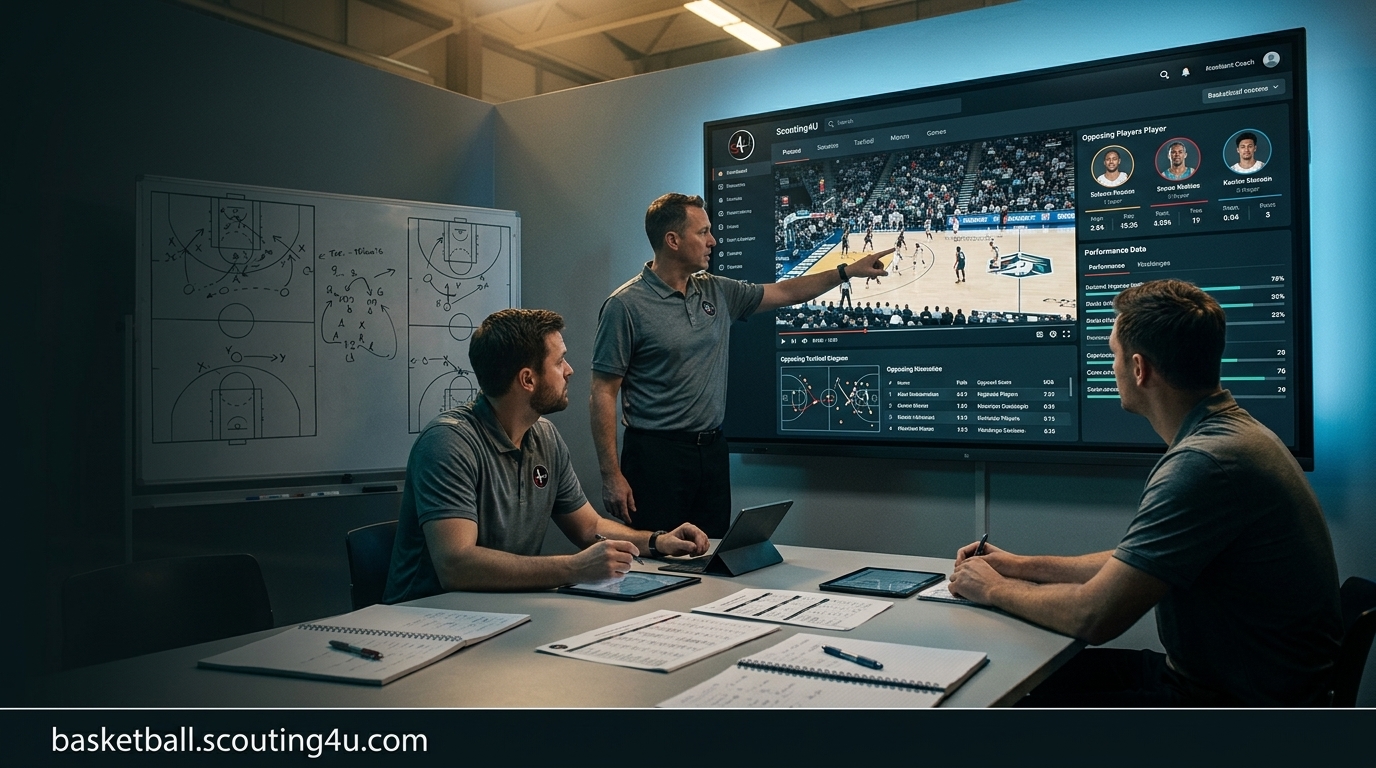
How to Create a Basketball Pre-Game Scouting Report
Key Takeaways
A basketball pregame scouting report is the foundation of smart game preparation.
Opponent tendencies and lineup data directly shape your defensive and offensive adjustments.
Analytics platforms like Scouting4U cut the time spent building each basketball pregame scouting report.
Data-driven decisions, not gut instinct alone, separate prepared teams from reactive ones.
What Is a Basketball Pregame Scouting Report?
A basketball pregame scouting report is a structured document coaches use to prepare for a specific opponent. It pulls together film review, statistical trends, and lineup data into one actionable plan. Think of it as a game plan backed by evidence rather than assumptions.
Every serious coaching staff - from youth programs to professional leagues - relies on some version of a basketball pregame scouting report before tip-off. The format may differ, but the goal is the same: know your opponent before they know themselves.
Done well, a basketball pregame scouting report answers three questions. Where does this team want to score? How do they defend? And which players drive their results? Answer those questions with real data, and your preparation becomes a genuine competitive advantage.
Why the Basketball Pregame Scouting Report Matters More Than Ever
Coaching staffs at every level now have access to more data than they can manually process. That is a problem if you lack a system. A basketball pregame scouting report gives that data structure and purpose.
Without a report, coaches rely on memory and general impressions. That leads to missed tendencies and poor matchup decisions. With a report, every assistant coach, player, and analyst works from the same page. There is no confusion about the game plan before tip-off.
The other factor is time. A well-built basketball pregame scouting report can be prepared faster with the right tools. Platforms built for scouting - like Scouting4U, founded on Daniel Gutt's EuroLeague experience - automate much of the data gathering. That leaves coaches more time to coach.
For more on how technology changes this process, read how AI basketball scouting reports technology transforms scouting.
How to Build a Basketball Pregame Scouting Report Step by Step
There is no single template that works for every team or league. But the best basketball pregame scouting reports share a common structure. Here is how to build one that actually gets used.
Step 1: Pull the Opponent's Recent Game Data
Start with the last 8-10 games. Look at offensive rating, defensive rating, pace, and turnover rate. These numbers give you a baseline before you watch a single minute of film.
Pay attention to trends. A team that has won four straight may be playing differently than their season averages suggest. Context matters as much as raw numbers.
Step 2: Map the Offensive Tendencies
Where does this team score? Shot charts reveal a lot. Some teams live at the rim. Others rely on mid-range pull-ups or corner threes. Your basketball pregame scouting report should show your defenders exactly where the opponent wants to operate.
Go deeper than just shot location. Look at how they generate those shots. Do they run pick-and-roll heavily? Do they use off-ball screens to free shooters? Do they push in transition after defensive rebounds? Each of these tendencies requires a specific defensive response.
For a deeper breakdown of how to read pick-and-roll sets, see how to analyze pick-and-roll defense coverage.
Step 3: Break Down the Defensive Setup
Understanding how the opponent defends is just as important as knowing how they score. Does this team switch everything on ball screens? Do they zone up in the fourth quarter? Do they trap on the baseline?
Your basketball pregame scouting report should identify these patterns so your offense can attack them. If they hedge hard on ball screens, your ball handler can turn the corner. If they go under, your point guard should be shooting off the dribble.
Step 4: Identify the Key Players
Not every player on the opposing roster needs equal attention. Your basketball pregame scouting report should flag the players who create the most problems - and the ones who can be targeted defensively.
Use usage rate (USG%) to find who handles the ball most in key moments. Use Player Efficiency Rating (PER) to measure overall impact. Look at plus-minus data to find which lineups the opponent runs when they pull away - or fall apart.
Step 5: Build the Lineup Analysis
Modern basketball is won and lost in lineup matchups. Your basketball pregame scouting report needs a section on which five-man units the opponent uses most, and which ones are actually effective.
Some teams have a dominant starting lineup but a weak bench unit. Others go 10 deep without a dropoff. Knowing this shapes your substitution strategy. If their backup point guard is a liability, pressure him early. If their second unit outscores opponents, shorten your bench rotation that game.
For more on managing rotations with data, see basketball starters bench rotation data tip: optimize strategy.
Step 6: Add Situational Notes
The best basketball pregame scouting report goes beyond averages. It looks at how the opponent performs in specific situations. What do they do after timeouts? How do they execute their press break? What is their late-game offensive set when the score is close?
These situational details are often the difference in tight games. A team that has studied these moments beats a team that hasn't - even if the talent gap is small.
Basketball Defensive Scouting: Going Deeper
Defensive scouting deserves its own focus within your basketball pregame scouting report. It is not enough to say "they play man defense." You need to show your players exactly how that defense behaves in different situations.
Start with help defense positioning. Does the weak-side defender tag the roll man or stay home on the corner three? Does the center drop or show on the ball screen? These decisions tell you where the gaps are.
Then look at transition defense. Some teams sprint back and pack the paint. Others give up the fast break corner three. Your basketball pregame scouting report should tell your guards whether to push the pace or set up your half-court offense.
Shooting percentages by zone matter here too. If the opponent allows 38% from the left corner but only 28% from the right wing, your offensive sets should reflect that. Details like this make a basketball pregame scouting report genuinely useful rather than decorative.
Tendency Analysis: Reading Patterns Before They Happen
Tendency analysis is the part of your basketball pregame scouting report that separates average preparation from elite preparation. Tendencies are habits. And habits under pressure are predictable.
Look at shot selection in the fourth quarter versus the first quarter. Some players who are disciplined early in the game start forcing shots late. Others become passive. Your defenders need to know which is which.
Passing tendencies matter too. Where does the point guard look first in the pick-and-roll? Does the center always look for the short roll pass or the skip to the weak side? These patterns show up in every game. Your basketball pregame scouting report should document them clearly.
Rebounding tendencies belong here as well. Does the opponent send two or three to the offensive glass? Do they trigger an early outlet pass after a defensive rebound? Transition offense starts with knowing where the ball goes after a missed shot.
To see how possession analysis connects to all of this, read possession analysis: transition, regular, second chance.
Using Technology to Build Better Reports Faster
Manual scouting takes hours. You watch film, pull stats from multiple sources, cross-reference lineup data, and then organize everything into a format your staff can actually use. That process works - but it is slow.
Platforms like Scouting4U are built to speed up this workflow. They centralize game data, shot charts, lineup stats, and tendency reports in one place. A basketball pregame scouting report that once took six hours can now take two - with more depth and fewer gaps.
Scouting4U was built on EuroLeague-level scouting methodology. That means the data structure behind each report reflects how professional scouting staffs actually think about opponents. You are not just getting numbers. You are getting numbers organized around the questions that matter.
To understand what the platform offers in full, visit Scouting4U platform features and tools. If you are ready to see pricing, explore Scouting4U subscription plans.
Common Mistakes Coaches Make With Scouting Reports
Even experienced coaching staffs make the same errors when building a basketball pregame scouting report. Here are the ones worth avoiding.
The first mistake is including too much information. A 40-page report does not get read. It gets filed. Keep your basketball pregame scouting report tight. Focus on what players can actually remember and execute.
The second mistake is relying only on season-long averages. A team's habits from October may not reflect how they play in March. Weight recent games more heavily, and note any lineup changes or scheme adjustments.
The third mistake is skipping the player-specific detail. Team tendencies matter, but basketball games are decided by individual matchups. Your basketball pregame scouting report should call out each key opponent by name and describe exactly how to defend or attack them.
The fourth mistake is not sharing the report in the right format. Coaches often build reports for themselves rather than for their players. Younger players need shorter, visual summaries. Film sessions work better than text-heavy documents. Build your basketball pregame scouting report with the end user in mind.
Putting the Report Into Practice on Game Day
A basketball pregame scouting report only has value if it changes how your team plays. That means integrating it into your walkthrough, your film session, and your pregame talk.
Run through three to five specific scenarios the report identified. If the opponent's point guard always goes right on the pick-and-roll, practice forcing him left. If their best shooter cuts baseline off the post, show your defenders that cut in film and walk through the rotation.
The goal is not to overload players with information. It is to give them two or three things they can actually focus on in the flow of a real game. A great basketball pregame scouting report simplifies complexity - it does not add to it.
For more on connecting scouting work to overall game preparation, read basketball game preparation: coaching essentials.
Conclusion
A basketball pregame scouting report is one of the most practical tools a coaching staff has. It turns raw data into a specific game plan. It replaces guesswork with documented patterns. And when done well, it gives players confidence because they know exactly what is coming.
Building a good basketball pregame scouting report takes discipline and the right tools. Start with opponent data, map offensive and defensive tendencies, dig into lineup matchups, and keep the final document focused. Then use platforms like Scouting4U to do more of that work in less time.
The teams that win consistently are usually the teams that prepare best. A thorough basketball pregame scouting report is where that preparation starts.
Frequently Asked Questions
What should be included in a basketball pregame scouting report?
A basketball pregame scouting report should cover offensive tendencies, defensive schemes, key player breakdowns, lineup efficiency data, and situational notes. The goal is to answer where the opponent scores, how they defend, and which players drive their results - all in a format your staff can act on.
How long should a basketball pregame scouting report be?
Length depends on your level of play and how your staff uses the report. For most teams, a focused basketball pregame scouting report of 5-10 pages works better than a 40-page document. Players and assistants need information they can retain and apply in real time, not a research paper.
How often should coaches update their basketball pregame scouting report process?
Review your basketball pregame scouting report format at least once per season. As opponents evolve their schemes and rosters change, your report structure should adapt. Platforms like Scouting4U make it easier to refresh reports quickly without starting from scratch each time.
What metrics matter most in a basketball pregame scouting report?
Focus on offensive rating (ORTG), defensive rating (DRTG), usage rate (USG%), Player Efficiency Rating (PER), shot zone percentages, and lineup plus-minus. These metrics give you the clearest picture of how an opponent generates advantages - and where they can be exposed.
Can smaller programs or youth teams benefit from a basketball pregame scouting report?
Yes. A basketball pregame scouting report does not require a professional staff or expensive software to be useful. Even a one-page summary of an opponent's top plays, key scorers, and defensive tendencies helps youth players prepare with more confidence and focus.
Enjoyed this article? Share it with others!
Founder & Lead Scout, Scouting4U
2x EuroLeague champion with 30+ years in professional basketball. Daniel won EuroLeague titles with Maccabi Tel Aviv, helped build the staff behind the 2007 European Championship, and has delivered 100+ professional scouting reports across 50+ leagues. If it happened in a European basketball front office, he was probably in the room. He founded Scouting4U in 2010 to bring championship-level scouting intelligence to every club.
No reviews yet. Be the first to share your experience!
Related Articles

Data-Driven Basketball Recruitment: A Front Office Guide
Key TakeawaysData-driven basketball recruitment improves roster decisions by replacing gut instinct with measurable evid...

Basketball Player Comparison Tool: Data-Driven Insights
What Is a Basketball Player Comparison Tool?A basketball player comparison tool is software that lets coaches, scouts, a...

Scouting Undervalued Basketball Players: Hidden Gems
Key TakeawaysUndervalued basketball players scouting is one of the most cost-effective ways to build a competitive roste...