
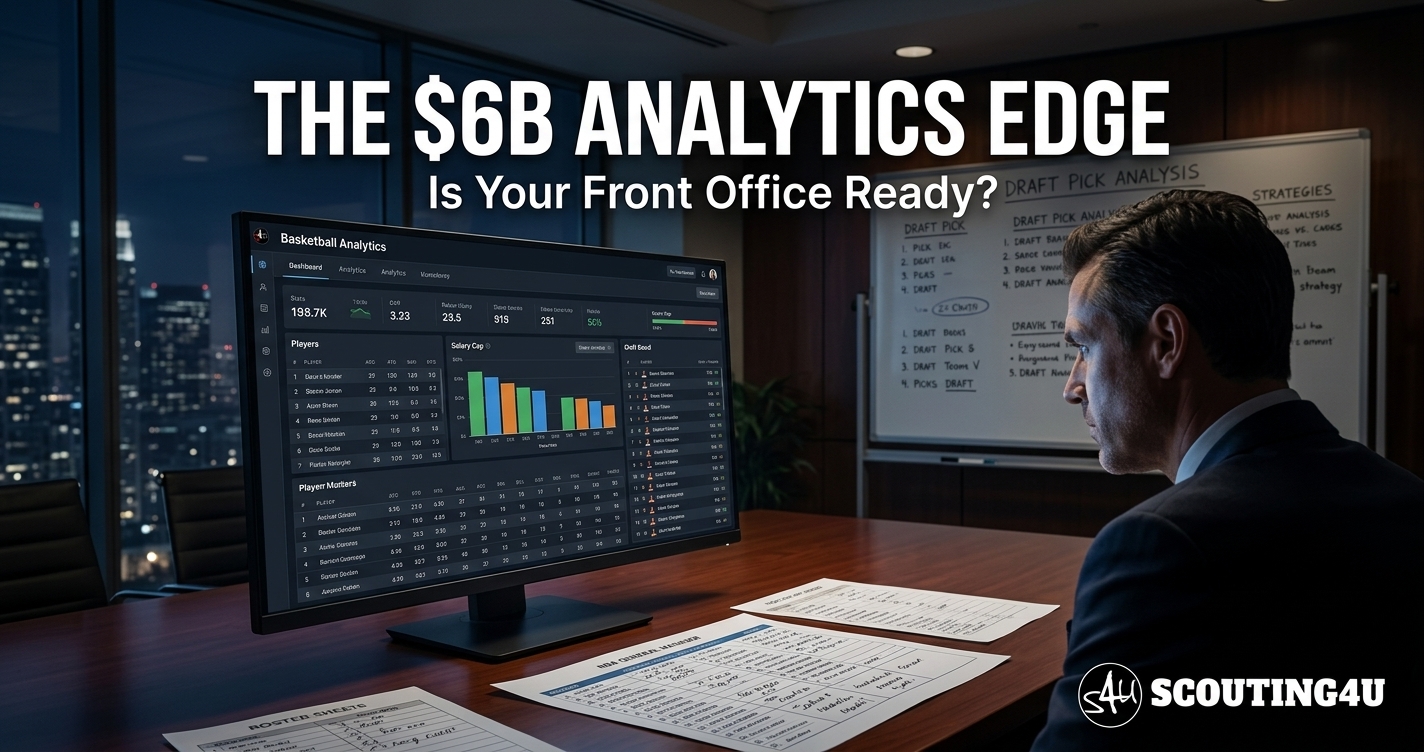
The basketball analytics market's $6B future by 2033
Key Takeaways
The basketball analytics market is projected to reach $6 billion by 2033.
AI technologies are transforming scouting and player analysis at every level.
Scouting4U leads the field with AI-powered scout report generators.
Market trends point to accelerating adoption of data tools through 2026 and beyond.
Teams that ignore analytics risk falling behind competitors who use data daily.
Why the Basketball Analytics Market Growth Authority Post Matters Now
The basketball analytics market growth authority post captures something real: data has moved from a front-office curiosity to the backbone of how teams scout, recruit, and compete. This is not a slow shift. It is happening fast, and the financial numbers back it up.
Market projections put the global basketball analytics sector at $6 billion by 2033. That figure reflects years of compounding investment in AI tools, video analysis platforms, and player tracking systems. For coaches, scouts, and general managers, understanding this trajectory is no longer optional. It is a basic job requirement.
Scouting4U has positioned itself at the center of this change. With tools built for real scouting workflows, it shows what the basketball analytics market growth authority post describes in practice, not just in theory. Every organization asking whether to invest in analytics should treat this basketball analytics market growth authority post as a starting point for that conversation.
Market Growth Projections: What $6 Billion Means
When the basketball analytics market growth authority post references $6 billion by 2033, that number deserves some unpacking. The current market sits in the low single-digit billions, meaning the projected growth requires sustained annual expansion through the next decade.
Several forces are driving this. NBA franchises have normalized large analytics departments. Teams like the Milwaukee Bucks, Golden State Warriors, and Boston Celtics employ full data science staff alongside traditional coaches. European leagues and college programs are following suit. The demand for affordable, scalable analytics tools has grown sharply at those levels, where front offices cannot afford enterprise-grade solutions.
The broadcast and media industry is also investing heavily in real-time data. Viewer engagement metrics show that fans want live statistics, predictive overlays, and player comparison graphics during games. That demand feeds commercial investment in the same platforms scouts and coaches use.
This basketball analytics market growth authority post tracks those investment flows because they determine which tools get built and which organizations can afford them. The $6 billion projection is not a ceiling. It is a floor if adoption continues at its current pace.
For a deeper look at where these numbers are heading, our Basketball Analytics Market Growth Trends 2026: Future Insights post breaks down the near-term projections in detail.
AI in Basketball Scouting: The Practical Shift
The basketball analytics market growth authority post consistently points to AI as the primary engine of change. That is accurate. But it is worth being specific about what AI actually does in a scouting context, because the term gets used loosely.
AI in scouting means automated video tagging, pattern recognition across large data sets, natural language report generation, and predictive modeling for player development. It does not mean replacing scouts. It means a scout can process five players in the time it used to take to process one.
Scouting4U's AI scout report generator is a direct example. A scout uploads game footage or pulls from an existing database, and the tool produces a structured report covering tendencies, efficiency metrics, and comparative rankings. What took several hours now takes minutes.
This matters for teams operating with limited staff. A mid-level European club cannot afford five full-time analysts. But it can afford a subscription to a platform that gives its one scout the output of a team of five. That is the practical promise this basketball analytics market growth authority post keeps returning to: better decisions with fewer resources.
Read more about how this technology works in practice at AI Scout Report: 2-Minute Revolution in Analysis.
Basketball Analytics Market Growth Authority Post: Key Trends Through 2026
The basketball analytics market growth authority post identifies several trends that will define the next two years. These are not speculative. They are already playing out across leagues and organizations.
Metrics standardization is one of the biggest shifts. Across professional basketball, teams are converging on a common set of advanced metrics: Player Efficiency Rating (PER), True Shooting Percentage (TS%), Usage Rate (USG%), and on/off net rating splits. This shared vocabulary makes cross-team comparisons and trade evaluations more efficient.
Youth-level adoption is accelerating faster than most observers expected. Academy programs in Spain, France, and the Balkans are now using analytics tools that would have been considered cutting-edge at the NBA level a decade ago. The cost of data collection has dropped sharply, and platforms like Scouting4U have made analysis accessible without a large technical team.
Recruitment analytics is shifting from supplementary to central. Clubs no longer treat data as a second opinion. The analytics department often initiates the shortlist, and scouts validate those findings through live observation. That is a meaningful reversal from how recruitment worked five years ago.
Each of these trends is part of what the basketball analytics market growth authority post documents as structural change rather than a temporary spike in interest.
Our guide on Data-Driven Basketball Recruitment: A Front Office Guide covers this shift in detail, with practical steps for front offices at every level.
The Role of Player Tendency Analysis
The basketball analytics market growth authority post is not just about macro numbers. At the individual player level, tendency analysis has become one of the most-used tools in daily scouting work.
Tendency analysis tracks what a player does in specific situations: pick-and-roll coverage, shot selection under pressure, ball movement in transition, and defensive positioning on closeouts. The patterns are not always obvious from watching a game once. They emerge over dozens of possessions.
This is where AI tools add the most immediate value. A coach preparing for a playoff opponent can pull a tendency report on every player in the opposing rotation within a day. Without AI, that process would require a staff of analysts working through the week.
Knowing that an opponent's primary ball-handler goes left on 73% of pick-and-roll possessions, or that a wing shooter takes 80% of catch-and-shoot attempts from the left corner, directly influences defensive game planning. That is not abstract. It changes what you run in practice on Wednesday before a Friday game.
The basketball analytics market growth authority post treats tendency analysis as one of the clearest examples of how data produces immediate competitive returns. You can read a deeper breakdown at Basketball Player Tendency Analysis Scouting: A Secret Weapon.
Scouting4U's Position in the Market
The basketball analytics market growth authority post describes an industry in motion. Scouting4U is one of the companies shaping that motion rather than simply responding to it.
Founded by Daniel Gutt, Scouting4U brings decades of direct basketball experience to its product development. That matters because many analytics platforms are built by engineers who understand data but have never sat in a film session or written a scouting report. Scouting4U was built by people who have done those things, which shows in how the tools are designed.
The platform covers professional and semi-professional leagues across Europe, with a growing database of player profiles, game footage, and statistical archives. The AI tools sit on top of that foundation. You are not just getting automated analysis of abstract data. You are getting analysis of real players, in real leagues, with context that only comes from years of database building.
For a full overview of what the platform offers, the Scouting4U platform features and tools page gives a clear breakdown.
Historical Context: How Basketball Analytics Got Here
The basketball analytics market growth authority post exists in a specific historical moment, but the path to this point started decades ago. Understanding that history explains why the current acceleration is happening.
In the early 2000s, analytics in team sports was associated mainly with baseball. The publication of Michael Lewis's "Moneyball" in 2003 made the concept mainstream. Basketball was slower to adopt the same principles, partly because the sport's continuous flow made possession-level tracking harder than in baseball's discrete events.
The shift accelerated in the 2010s. SportVU camera systems installed in NBA arenas starting in 2013 generated spatial tracking data that simply did not exist before. Suddenly, teams could measure defensive footwork, transition speed, and off-ball movement at scale.
By the mid-2010s, analytics had moved from being a competitive advantage to a baseline expectation. Teams without analytics departments were the outliers. Now, that same transition is happening at the European club level, the college level, and increasingly in youth academies. The basketball analytics market growth authority post reflects a market that is, in many ways, catching up to a professional standard that the NBA set ten years ago.
This history matters when interpreting the $6 billion projection. Markets do not scale that quickly without genuine organizational demand. The demand is real, and the basketball analytics market growth authority post is one clear signal of it.
What Teams Actually Do With Analytics Data
The basketball analytics market growth authority post describes a large and growing market. But markets are made up of individual decisions. Here is what analytics data actually looks like in use.
Recruitment teams use player comparison tools to evaluate prospects against known benchmarks. Instead of relying on gut feel to decide whether a young wing player projects to professional level, an analyst can run a similarity search against players who made the same transition successfully. The pattern match is not definitive, but it adds structure to what would otherwise be a purely subjective call. You can see how this works in practice at Basketball Player Comparison Tool: Data-Driven Insights.
Coaching staffs use shot quality data to identify lineup combinations that generate good looks without depending on isolation scoring. The insight is not always that your best player should shoot more. Sometimes the data shows that a specific two-man combination generates high-value shots consistently, and the answer is to run that pairing in late-game situations.
Player development staff uses efficiency splits to identify where a player's performance drops off. If a player's TS% falls significantly in the fourth quarter compared to the first three, that is a fitness or conditioning signal, not necessarily a skill gap. The response is different depending on what the data shows.
None of this replaces human judgment. The basketball analytics market growth authority post does not argue that it does. What analytics does is give human judgment better inputs. That is the practical case for the market growth this basketball analytics market growth authority post tracks.
Implications for Scouts and Coaches
The basketball analytics market growth authority post has direct implications for individual professionals, not just organizations. Scouts and coaches who build analytics literacy now will have a clear advantage over those who treat data as someone else's job.
This does not mean everyone needs to learn Python or build statistical models. It means being able to read an advanced statistics report, ask the right questions about the methodology, and integrate data findings into practical decisions. Those are learnable skills.
The pressure to develop those skills is already there. NBA teams have been hiring analytics-literate coaches for years. The expectation is spreading to European professional leagues. At the college level, athletic departments are investing in platforms that give coaching staff direct access to data tools without requiring a full analytics department to run them.
For scouts, the workflow is changing. The job is no longer just travel, watch, and write. It now includes pulling data on a prospect before traveling, comparing live observations against the statistical profile, and flagging discrepancies for further review. The basketball analytics market growth authority post describes this as market growth. For scouts, it is a professional evolution. Those who adapt to it will find their observations carry more weight, not less, because the data gives context that raw watching cannot provide.
The Road to 2033
The basketball analytics market growth authority post projects $6 billion by 2033. Getting there requires continued investment from multiple directions.
Hardware costs for tracking systems need to keep falling so that smaller leagues can afford installation. Software platforms need to stay accessible for organizations without dedicated technical staff. The basketball community itself needs to keep training coaches, scouts, and front office staff to work with data as a standard part of the job.
The AI side of the market will grow fastest. Generative AI tools that produce natural language scouting reports, video auto-tagging systems that eliminate manual clip labeling, and predictive models for injury risk and player development will all see significant investment through the end of the decade.
Scouting4U is already operating in this space. The basketball analytics market growth authority post is not a future vision for the platform. It is a description of what the platform is already doing. Organizations that want to understand how that translates into day-to-day scouting and roster decisions can find practical examples at 5 Basketball Roster Building Strategies for Success.
The market will not wait for organizations that are still deciding whether analytics is worth pursuing. That window is closing. The basketball analytics market growth authority post exists precisely to clarify what is at stake for those still on the fence.
Conclusion
The basketball analytics market growth authority post is a reference point for anyone who needs to understand where this industry stands and where it is heading. The $6 billion projection by 2033 is not a marketing claim. It reflects real investment flows, real adoption curves, and real changes in how basketball organizations make decisions.
The basketball analytics market growth authority post also reflects something more immediate: the gap between organizations using these tools well and those that are not is widening. Every season without a serious analytics capability is a season at a structural disadvantage.
Scouting4U exists to close that gap for organizations that need capable tools without the overhead of building an internal analytics department from scratch. If you want to see what that looks like in practice, the Inside S4U's AI Scout Report Generator: Basketball's Future post is the right place to start. And if you are ready to look at options, the Scouting4U subscription plans and pricing page lays out what access costs at different levels.
The market is moving. The basketball analytics market growth authority post tracks that movement. The question for every organization is simply whether to move with it or wait.
Frequently Asked Questions
What is the projected value of the basketball analytics market by 2033?
The market is projected to reach $6 billion by 2033, driven by widespread adoption of AI tools, player tracking systems, and data-driven recruitment platforms across professional and amateur leagues worldwide.
How does AI improve the speed and quality of basketball scouting?
AI tools automate video tagging, pattern recognition, and report generation. A scout using an AI-powered platform can produce a detailed player report in minutes rather than hours, covering tendencies, efficiency metrics, and comparative rankings against similar players.
Is basketball analytics only relevant for NBA-level teams?
No. European clubs, college programs, and youth academies are all adopting analytics tools. The cost of data collection has dropped significantly, and platforms like Scouting4U are built for organizations that do not have large in-house analytics departments.
What metrics are most commonly used in modern basketball analytics?
The most widely used advanced metrics include Player Efficiency Rating (PER), True Shooting Percentage (TS%), Usage Rate (USG%), and on/off net rating splits. Tendency data - tracking what a player does in specific game situations - is also central to scouting workflows.
How can a coach or scout start using analytics without a technical background?
Start by learning to read advanced statistics reports and understanding what each metric measures. Platforms like Scouting4U are designed for basketball professionals, not data scientists. The interface is built around scouting workflows, so the learning curve is about basketball context, not software engineering.
Enjoyed this article? Share it with others!
Founder & Lead Scout, Scouting4U
2x EuroLeague champion with 30+ years in professional basketball. Daniel won EuroLeague titles with Maccabi Tel Aviv, helped build the staff behind the 2007 European Championship, and has delivered 100+ professional scouting reports across 50+ leagues. If it happened in a European basketball front office, he was probably in the room. He founded Scouting4U in 2010 to bring championship-level scouting intelligence to every club.
No reviews yet. Be the first to share your experience!
Related Articles
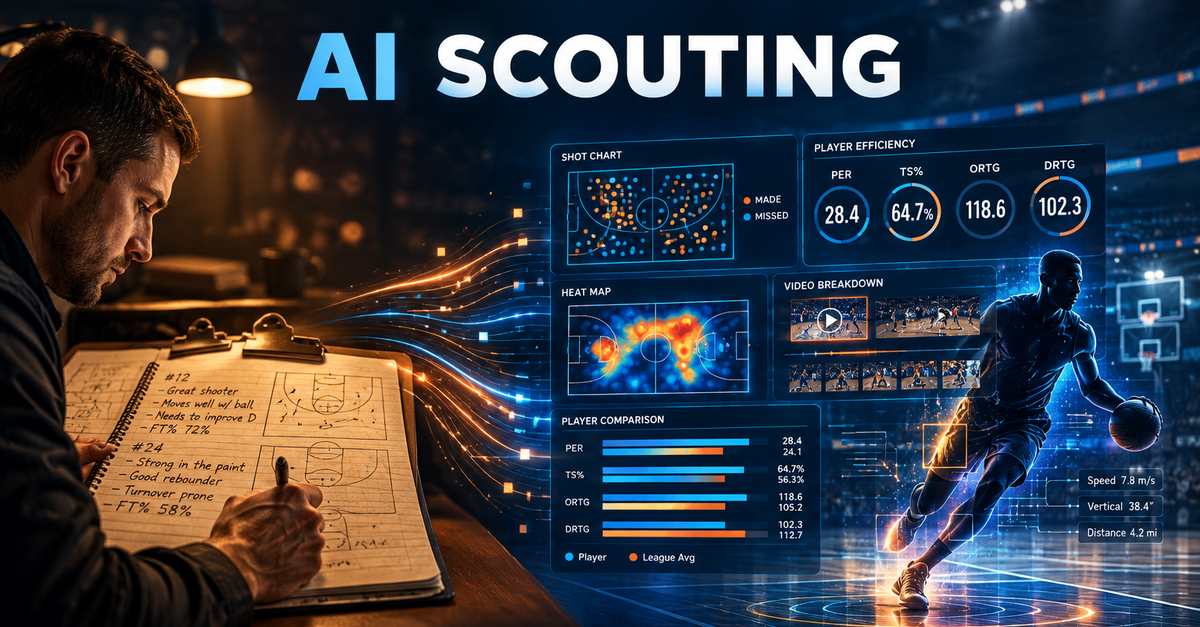
Future of Basketball Scout Reports: AI & Innovation
Key Takeaways Basketball scout reports are changing fast because of AI. Data collection and analysis now happen in a fr...
AI Scouting Reports in Basketball: The Scouting Edge
Key Takeaways AI scouting reports basketball tools give coaches faster, clearer data on players. Scouting4U pairs AI an...
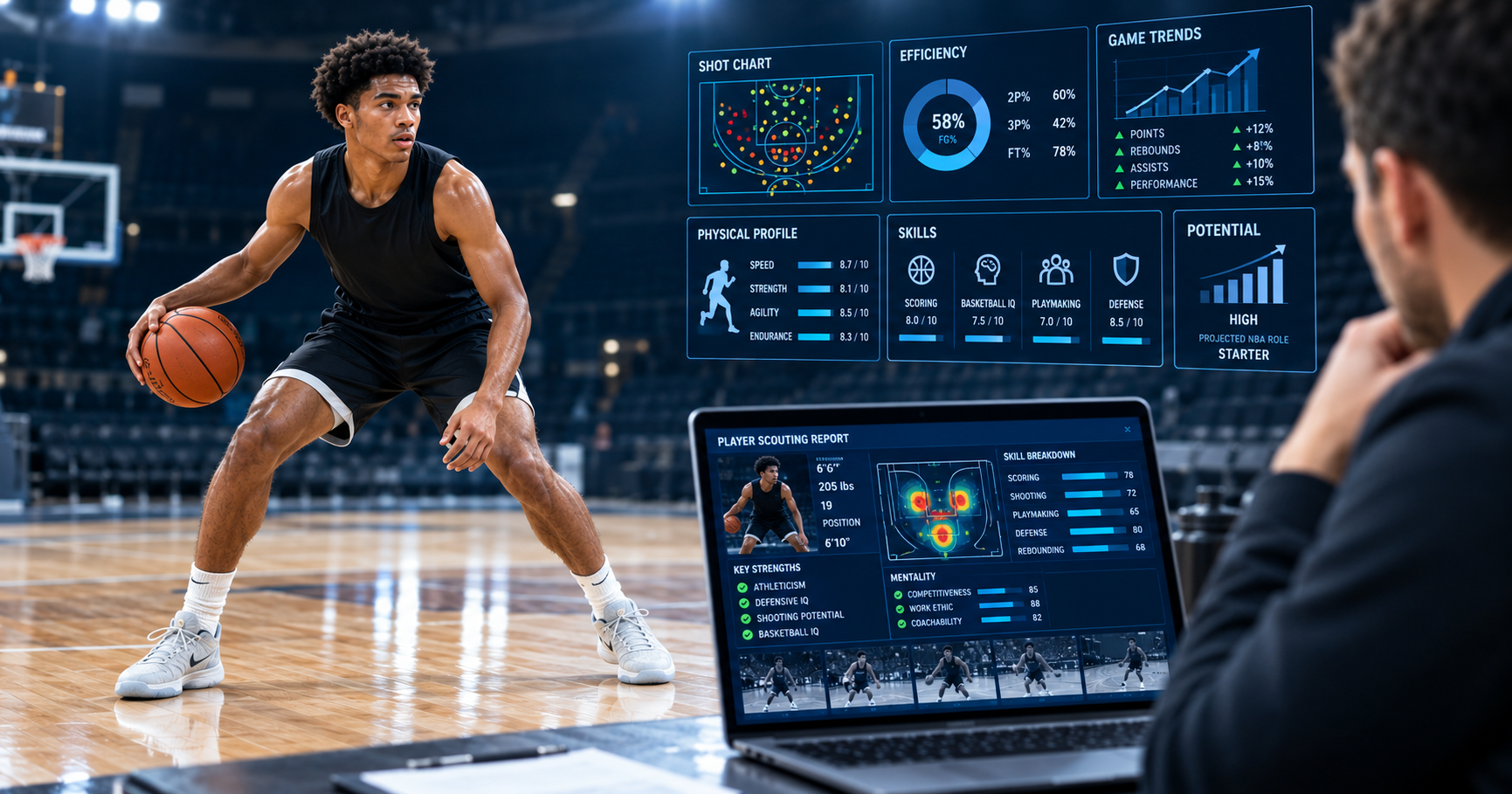
Analyzing Basketball Player Potential: Scouting Insights
Key Takeaways Analyzing basketball player potential combines data analysis with scouting intuition. Core metrics includ...