
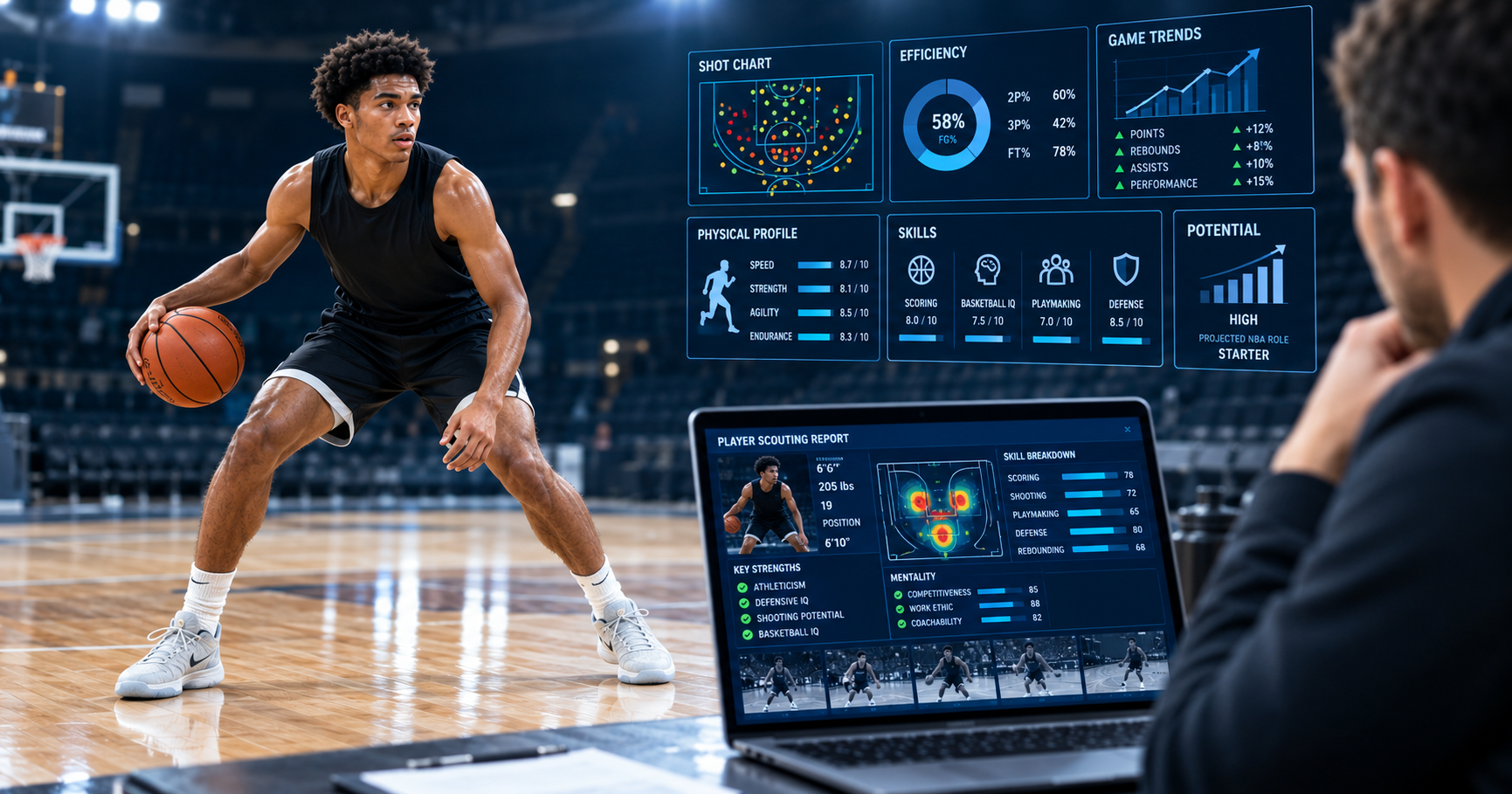
Analyzing Basketball Player Potential: Scouting Insights
Key Takeaways
- Analyzing basketball player potential combines data analysis with scouting intuition.
- Core metrics include PER, TS%, USG%, and AST%.
- Scouting4U offers tools to streamline scouting reports and player evaluations.
- Historical examples show how analytics have changed basketball scouting.
- Effective scouting involves both on-site observations and remote analysis.
What Analyzing Basketball Player Potential Really Means
Analyzing basketball player potential is harder than it looks. You are trying to predict the future - and basketball futures are messy. A scout must weigh numbers against instinct, physical tools against mental makeup, and current performance against projected growth. Get one of those wrong and you miss the next Dirk Nowitzki or draft the wrong guy at a high pick. Analyzing basketball player potential well separates good scouting departments from great ones. This guide walks through exactly how to do it.
Essential Metrics for Analyzing Basketball Player Potential
Numbers do not tell the whole story, but they narrow the field fast. When analyzing basketball player potential at any level, these are the metrics that matter most.
Player Efficiency Rating (PER)
PER is a per-minute summary of a player's production. It counts positive outcomes - field goals, assists, rebounds, steals, blocks - and subtracts negatives like turnovers and missed shots. The NBA average sits at 15. A player posting 18 or above is contributing well. PER has real limits: it rewards usage and does not capture defense cleanly. Use it as a starting point, not a conclusion.
Want to go deeper on how advanced stats work? Advanced Basketball Statistics: Must-Know Metrics breaks down the numbers scouts rely on most.
True Shooting Percentage (TS%)
TS% measures scoring efficiency across field goals, three-pointers, and free throws. A player shooting 38% from the field might actually be efficient if they draw fouls and shoot threes at a solid clip. TS% captures that nuance. The league average is roughly 57%. Anything above 60% from a high-usage player is genuinely impressive. For a full breakdown, see our guide on True Shooting Percentage Basketball: Calculation & Insights.
Usage Rate (USG%)
Usage rate tells you how many possessions a player consumes when on the floor. A high USG% paired with strong efficiency numbers signals a player who can handle a big role. A high USG% paired with poor efficiency signals someone who is taking shots they should not be taking. Context matters here. Analyzing basketball player potential requires you to read these two numbers together, not separately.
Assist Percentage (AST%)
AST% estimates how many teammate field goals a player assists on while he is on the court. For guards and playmakers, this number tells you a lot about court vision and decision-making. A college player with a 35% AST% who also keeps his turnover rate low is showing real passing quality, not just volume.
Qualitative Factors Scouts Cannot Ignore
Statistics only go so far. Two players can post identical PER and TS% numbers and have completely different ceilings. Analyzing basketball player potential means looking beyond the box score at factors that do not show up in a spreadsheet.
Basketball IQ is the ability to read situations quickly. Does the player recognize a mismatch before it develops? Do they make the right pass under pressure? These decisions happen in half a second. You cannot teach this at 22 years old - you can only look for it.
Work ethic and coachability matter just as much. A player who arrives early, watches film, and adjusts based on coaching feedback will keep improving. One who does not will plateau. Scouts talk to coaches, teammates, and trainers for exactly this reason. References tell you things tape cannot.
Physical projection involves asking whether a player's body is done developing. A 19-year-old with a thin frame who moves well has room to add strength. A 24-year-old who plays the same way is probably at his ceiling. Body composition, wingspan relative to height, and foot speed all factor into the projection when analyzing basketball player potential at the professional level.
Competitive temperament separates players in close games. Does the player want the ball in the fourth quarter? Do they respond to mistakes by locking in or shutting down? Watch them in tight situations. That is when character shows up on film.
The Role of Video Analysis in Modern Scouting
Video analysis changed scouting permanently. A scout used to have to be in the gym to evaluate a player. Now, detailed film lets you watch a player's tendencies, footwork, off-ball movement, and defensive habits from anywhere in the world. Analyzing basketball player potential through video lets you see patterns across a full season, not just one game.
Platforms like Scouting4U let scouts tag specific plays, clip sequences by game situation, and build evaluations backed by film. Instead of writing "struggles in pick-and-roll defense," you attach three clips that show exactly how and why. That specificity changes how organizations make decisions. Learn more about how this works at the Scouting4U platform features and tools page.
Video is especially useful for evaluating players in leagues where scouts cannot attend every game. Remote scouting has grown fast at the college and international levels. Coaches and scouts now build full reports without leaving their offices. For more on how that process works, read Mastering Basketball Video Analysis for Coaches.
Shot Chart Analysis and Spatial Awareness
Shot charts add another layer to analyzing basketball player potential. They show where a player takes shots and what percentage they make from each zone. A player who looks like a decent scorer in the box score might actually be inefficient from the mid-range while being dangerous from the corners. Shot charts reveal that immediately.
Understanding shot selection is part of understanding offensive fit. A team that plays a lot of pick-and-roll wants players who can catch-and-shoot from the corners or finish at the rim. A shot chart tells you instantly whether a prospect fits that system. See how scouts use this data in Reading Shot Charts Like a Pro: Zone Analysis.
Historical Context: How Scouting Has Changed
Old-school scouting ran on relationships and gut instinct. A scout who had seen thousands of games built a feel for talent that was hard to explain but often accurate. The problem was bias. Scouts sometimes passed on players who did not fit a physical prototype, even when the production was clearly there.
The Houston Rockets were among the first NBA teams to systematically use analytics in roster decisions. Their approach, documented in various sports management studies, pushed the league toward evidence-based evaluation. Today, virtually every NBA team has an analytics department working alongside traditional scouts.
Case Study: Dirk Nowitzki
Dirk Nowitzki's path to the NBA is a clear example of how analyzing basketball player potential requires looking past surface-level assumptions. American scouts in the late 1990s had little framework for a 7-foot European who could shoot off the dribble and post up guards. Holger Geschwindner, his longtime trainer, had developed a unique skill set in Nowitzki that did not match any existing template.
Donnie Nelson saw something others missed. He pushed the Dallas Mavericks to take Nowitzki ninth overall in 1998. Twenty-one seasons, one MVP, and one championship later, it stands as one of the best picks in draft history. The lesson: when analyzing basketball player potential, historical bias can make scouts blind to players who do not fit a familiar mold.
Combining Technology with Traditional Scouting
The best scouting departments today use both data and human judgment. Neither replaces the other. Numbers tell you what happened. A scout tells you why, and what it means going forward. Analyzing basketball player potential at a high level requires both inputs working together.
Scouting4U was built with that principle in mind. The platform helps scouts generate structured reports, tag film efficiently, and track players across multiple seasons. Scouts spend less time on formatting and more time on actual evaluation. If you are interested in seeing what the platform can do for your organization, check out the available Scouting4U subscription plans and pricing.
Remote scouting tools have also made it easier to track players in leagues that do not get regular broadcast coverage. A scout in New York can now evaluate a prospect in Lithuania, Croatia, or Argentina with the same depth of analysis they would apply to a player in the ACC. Analyzing basketball player potential globally is now genuinely possible at scale.
Building a Complete Scouting Report
A complete player evaluation pulls together metrics, video, physical tools, and qualitative assessments into one coherent picture. Each piece informs the others. High PER with poor shot chart data might mean a player is efficient in easy situations but struggles in harder ones. Video confirms or complicates what numbers suggest.
When analyzing basketball player potential for a draft or recruitment decision, structure matters. A report that jumps between observations without connecting them is hard to act on. The best reports tell a clear story: here is what this player does, here is where he projects to grow, and here is how he fits our system. For a practical framework, see How to Create a Basketball Scout Report in 2026.
Analyzing basketball player potential consistently, across many players, also reveals patterns. Scouts who evaluate hundreds of players per season develop a calibrated sense of where a specific player ranks within a larger pool. That comparative perspective is something raw data alone cannot provide.
Frequently Asked Questions
What does analyzing basketball player potential actually involve?
Analyzing basketball player potential means combining statistical metrics, video evaluation, physical projection, and qualitative factors like work ethic and basketball IQ. No single data point decides a player's future. Scouts build a full picture by looking at all of these together, ideally across multiple games and competitive contexts.
Which stats matter most when evaluating a player's ceiling?
PER, True Shooting Percentage, Usage Rate, and Assist Percentage are all useful starting points. But context matters - a high USG% only means something when combined with strong efficiency numbers. Analysts also look at on/off splits, which show how a team performs with and without the player on the court.
How does video analysis improve the scouting process?
Video lets scouts study tendencies, off-ball behavior, defensive positioning, and decision-making that raw stats never capture. Platforms like Scouting4U allow scouts to clip and tag specific plays, making it easier to build evidence-based reports and compare players across different leagues and game situations.
Can amateur or college teams benefit from player potential analysis?
Absolutely. Analyzing basketball player potential is not just for NBA teams. College programs, semi-professional leagues, and amateur clubs all benefit from structured evaluation. Understanding which players are likely to improve - and in what areas - helps coaches build better rosters and develop individual players more effectively.
How do I start building a scouting report on a player?
Start with available stats, then build a film study around specific game situations - pick-and-roll defense, late-clock offense, transition play. Note patterns across multiple games, not just standout moments. Then add qualitative observations from coaches or trainers who know the player. Tools like Scouting4U can structure that process and save you significant time.
Enjoyed this article? Share it with others!
Founder & Lead Scout, Scouting4U
2x EuroLeague champion with 30+ years in professional basketball. Daniel won EuroLeague titles with Maccabi Tel Aviv, helped build the staff behind the 2007 European Championship, and has delivered 100+ professional scouting reports across 50+ leagues. If it happened in a European basketball front office, he was probably in the room. He founded Scouting4U in 2010 to bring championship-level scouting intelligence to every club.
No reviews yet. Be the first to share your experience!
Related Articles

Mastering Basketball Service: Scouting Insights & Tools
Key TakeawaysA strong basketball service covers everything from player evaluation to game strategy analysis.Scouting4U g...
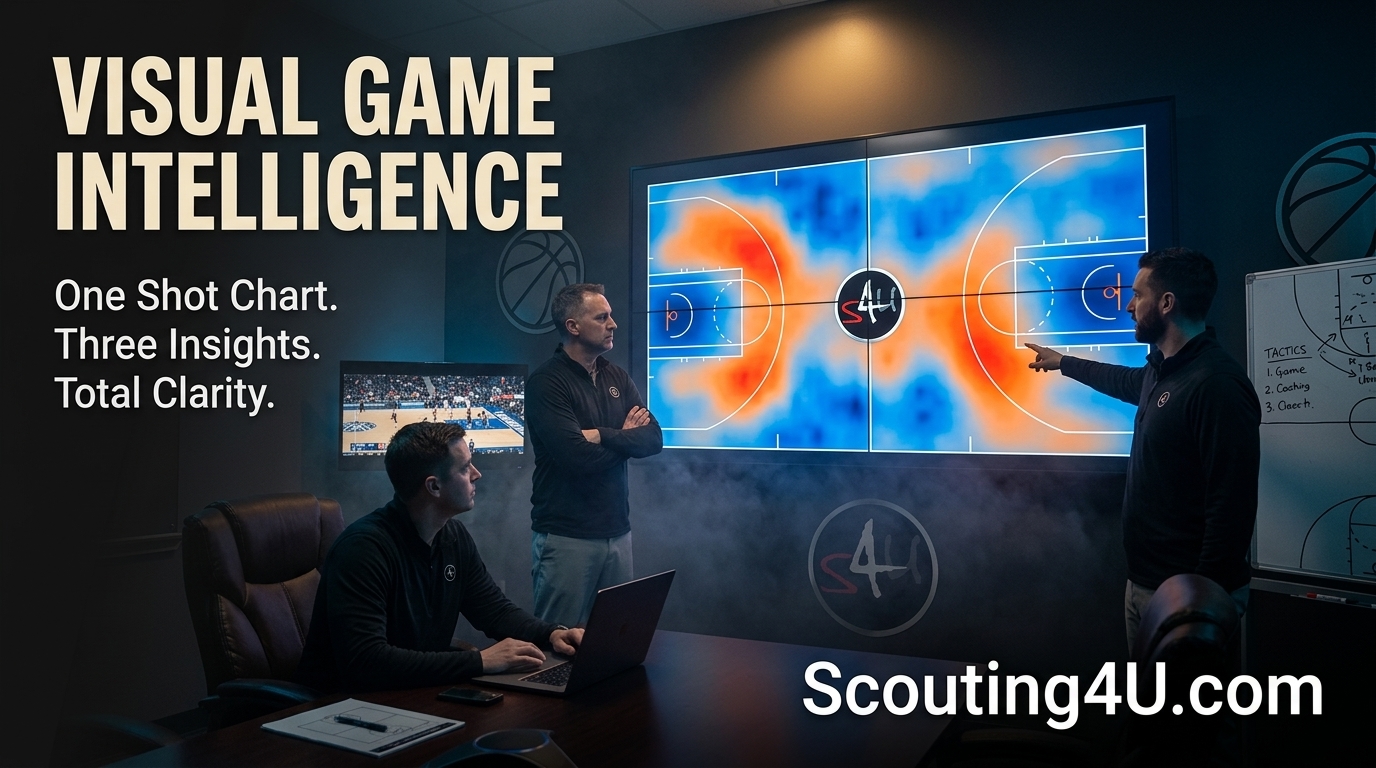
One Shot Chart. Three Insights Visual: Game Plan Revolution
Key TakeawaysA basketball shot chart three insights visual approach reveals high-efficiency zones, player tendencies, an...
How Do Coaches Prepare Scouting Reports?
Basketball Scouting Report Poll Coaches: How Coaches Actually PrepareEvery basketball scouting report poll coaches parti...