
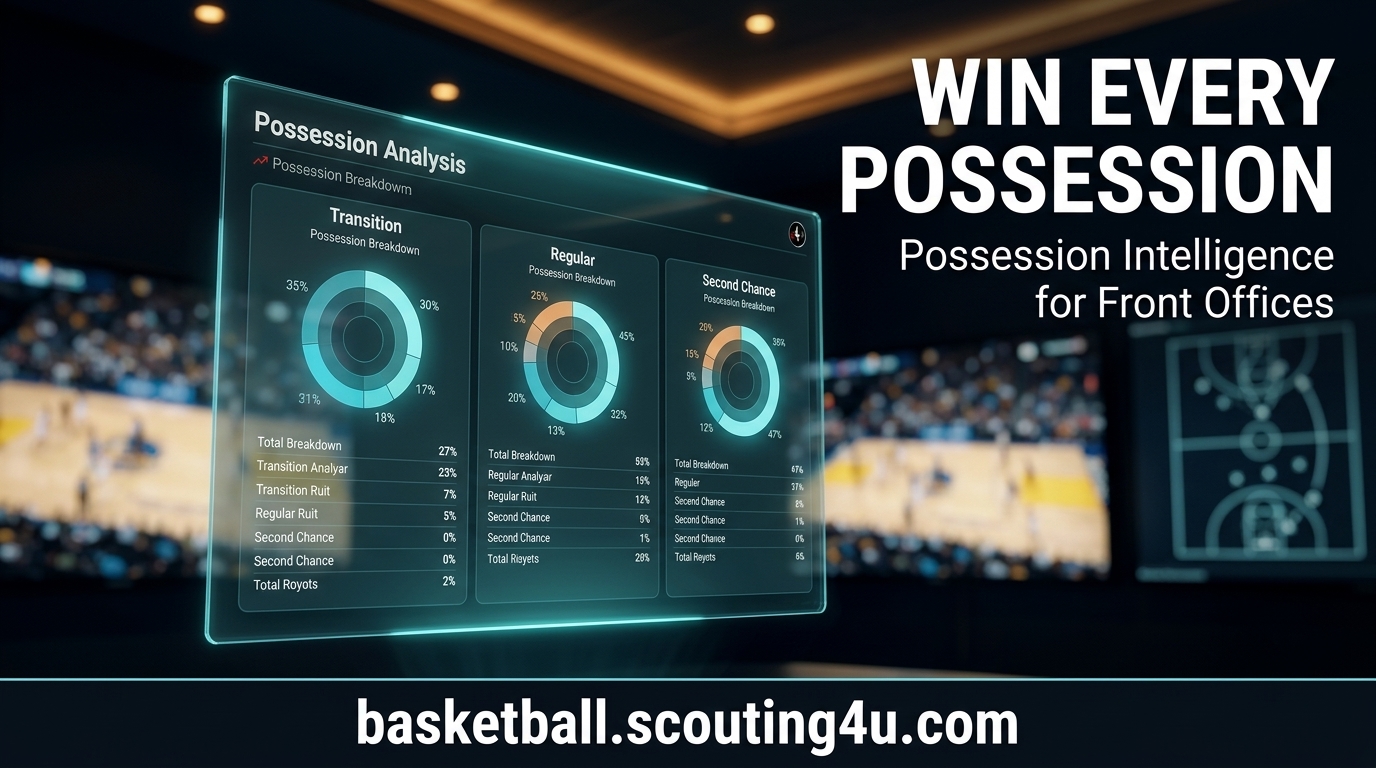
Possession Analysis: Transition, Regular, Second Chance
What Possession Type Analysis Transition Regular Second Chance Actually Tells You
Possession type analysis transition regular second chance is one of the most practical frameworks in modern basketball analytics. It breaks every offensive possession into one of three categories - transition, regular, and second chance - and lets coaches see exactly where points come from and where they get left on the floor. Transition plays account for roughly 28% of possessions, regular half-court sets make up about 54%, and second chance opportunities cover the remaining 18%. Those numbers shift game to game, opponent to opponent, and understanding those shifts is what separates prepared coaches from reactive ones.
This article walks through each possession type, explains why the breakdown matters, and shows how to use possession type analysis transition regular second chance data to make smarter decisions before tip-off and at halftime. Whether you coach at the professional level or are building a youth program, the framework applies the same way.
Why Possession Type Analysis Transition Regular Second Chance Matters
Most teams track points per possession. Fewer teams track points per possession by type. That distinction is significant. A team might average 1.05 points per possession overall but only 0.82 points per regular possession - meaning their efficiency looks fine on paper while their half-court offense quietly bleeds points every game.
When you run possession type analysis transition regular second chance consistently, you stop managing averages and start managing specific situations. You find out that your team scores efficiently in transition but stalls in late-clock regular possessions. You notice that second chance rate spikes when a certain lineup plays together. These are the details that actually change rotations and practice priorities.
Possession type analysis transition regular second chance also gives you a common language across your staff. When the data shows your regular possession efficiency dropped from 0.98 to 0.81 over three games, that is a conversation starter with real numbers behind it - not a debate about feel or impression.
For a deeper look at how analytics tools support this kind of preparation, the Scouting4U platform features page covers what is available for coaches working at every level.
Transition Possessions: Speed, Spacing, and Decision-Making
Transition possessions start before the defense is set. The offense has a numbers advantage, open lanes, or both. At 28% of possessions, transition play is not a minor piece of the game - it is more than a quarter of every offensive action a team takes.
What makes transition hard to coach is that decision quality degrades under speed. Players who make good choices in half-court sets sometimes make poor ones in transition because the read happens faster. The consequences of errors - turnovers, bad fouls, open layups for the other team - are immediate.
Possession type analysis transition regular second chance data helps here in two ways. First, it tells you your transition rate. If your team generates transition possessions at a low rate, you need to ask whether that is a deliberate choice or a structural problem. Some teams are built to play slower, and that is fine. But if you want transition offense and are not getting it, the data points to where the breakdown happens - whether it is missed outlet passes, slow ball movement up the floor, or lack of running lanes.
Second, it tells you your transition efficiency. You can score 28% of your possessions in transition but only convert them at 0.90 points per possession - below the league average - which means your fast-break approach is actually hurting you. The data makes that visible right away.
Possession type analysis transition regular second chance applied to transition situations often reveals film review priorities too. When conversion is poor in transition, you usually find the same two or three decision errors repeating across multiple games. That is coachable. You just need the data to surface it first.
Understanding how different offensive systems create and use transition opportunities is covered in the complete guide to data-driven basketball.
Regular Possessions: The Half-Court Game Wins Championships
At 54% of possessions, regular half-court sets are the majority of basketball. Teams that win in the half-court win most games. Yet regular possession efficiency is where most teams have the most room to improve, because it is also where opposing defenses have the most time to prepare.
Possession type analysis transition regular second chance data on regular possessions gives coaches a window into shot quality, ball movement, and late-clock decision-making. A typical breakdown might show that a team's first 10 seconds of a possession produces shots at 1.12 points per possession, while possessions lasting 16 or more seconds produce only 0.78 points per possession. That gap tells you everything about how late-clock situations need to be addressed in practice.
Regular possession analysis also reveals play-type tendencies. How often does the offense generate possessions ending in pick-and-roll actions? What percentage end in isolation? Which play types produce the best shot quality against specific defensive schemes? These questions have answers in the data, and those answers should drive what you run in games.
Coaches working on pick-and-roll coverage from the defensive side can apply possession type analysis transition regular second chance in reverse. See the guide to analyzing pick-and-roll defense coverage for a direct application of this type of breakdown.
Half-court offense also exposes lineup-specific weaknesses. Certain five-man groups might generate good transition numbers but collapse in regular possession situations because they lack spacing or a reliable ball-handler. Possession type analysis transition regular second chance broken down by lineup reveals those mismatches before they blow up in a playoff game.
The time breakdown within regular possessions matters too. Teams that consistently force late-clock situations are usually dealing with a spacing problem, a shortage of reliable initiators, or both. Identifying which is true changes your offseason personnel decisions.
Second Chance Possessions: The 18% That Changes Games
Second chance possessions - those that follow an offensive rebound - account for about 18% of possessions. That sounds modest. In a 75-possession game, that is roughly 13-14 extra scoring opportunities. Over a full season, those opportunities have a measurable impact on point differential and win percentage.
Offensive rebounding is one of the most debated topics in modern basketball. Some analytics frameworks suggest the risk of allowing transition defense is not worth the reward of chasing offensive boards. Others show that certain teams generate second chance possessions at rates high enough to offset that risk entirely. The right answer depends on your personnel and your defensive transition rules.
Possession type analysis transition regular second chance data on second chance plays should show you three things. First, your offensive rebound rate - how often you actually secure the board. Second, your conversion rate after securing the board - many teams grab offensive rebounds and then throw up contested put-backs at poor efficiency rather than resetting for a better look. Third, the defensive cost - what transition defense looks like for your opponents after you commit to offensive rebounding.
These three numbers together give you a real cost-benefit picture instead of a philosophical argument about whether to crash the glass. Possession type analysis transition regular second chance removes the guesswork from that debate.
For coaches thinking about how second chance rates connect to broader lineup and rotation decisions, the analysis in basketball starters and bench rotation data applies directly to how different groups perform across all three possession types.
Using Possession Type Analysis Transition Regular Second Chance for Opponent Scouting
Possession type analysis transition regular second chance is not just a self-evaluation tool. It is one of the best opponent scouting frameworks available because it tells you where an opposing team gets its offense and where they are vulnerable.
If an opponent generates 35% of their possessions in transition - well above average - your defensive priority is clear. Limit their transition opportunities. Push the pace off the free throw line when you shoot. Make outlet pass decisions conservatively. Protect against leak-outs on made baskets. You do not need to guess at a scouting report when the possession type breakdown hands you the answer directly.
Similarly, if an opponent ranks near the top for second chance rate, your defensive rebounding assignments become a game prep priority. If they struggle in regular possession efficiency despite a good overall points-per-possession number, you know their offense depends heavily on transition and second chance points. Slowing the game down and limiting offensive boards becomes a viable game plan.
Possession type analysis transition regular second chance works equally well when evaluating opponents for tournament preparation. Over a five-game stretch, possession type trends reveal more about a team's true identity than any single game result does.
Applying these scouting filters takes time and good data. The scouting tip on filtering stats by game result explains how filtering possession data by game context - wins vs. losses, home vs. away, against different defensive schemes - adds another layer to opponent preparation.
Integrating Possession Type Data Into Practice
Data without application is just numbers. Possession type analysis transition regular second chance earns its value when it changes what happens at practice and in timeouts.
A practical approach: review your possession type breakdown every week during the season. Note shifts in your transition rate, regular possession efficiency, and second chance numbers. If transition rate drops two weeks in a row, ask whether it reflects a change in opponent style, a change in your defensive rebounding, or fatigue. If second chance rate jumps against a certain type of defense, ask why and whether that is repeatable.
Build practice segments around the possession type where your team underperforms. If regular possession efficiency is your problem, run more half-court scenarios with late-clock restrictions. If second chance conversion is poor, work on post-rebound decision-making rather than just celebrating the board itself.
Possession type analysis transition regular second chance also gives younger coaches a structure for building weekly practice plans. Instead of relying on instinct alone, the data tells you which possession type needs the most attention each week. That is especially useful during long stretches of the season when fatigue affects both players and coaching staff judgment.
Coaches who want to go further with game statistics and how to track this data systematically can find a practical walkthrough in the guide to mastering basketball game statistics software.
Possession Type Analysis Transition Regular Second Chance in Game Adjustments
Halftime adjustments are the most visible moment when possession type analysis transition regular second chance pays off in real time. A first half where the opposing team generated 12 transition possessions tells you exactly what failed defensively. A first half where your regular possession efficiency sat at 0.75 points per possession tells you that the half-court sets you ran were not working against their defense.
Coaches who arrive at halftime with possession type data make specific adjustments. Coaches who arrive with only a score and a gut feeling make general ones. The difference shows up in second halves.
Possession type analysis transition regular second chance also applies at the timeout level. If you notice during the third quarter that second chance opportunities have dried up - or that the opponent is getting them at an unusual rate - you have information to act on before it becomes a problem in the fourth.
Possession type analysis transition regular second chance gives you the language and the evidence to tell your team exactly what to change and why. That specificity is the difference between an adjustment that lands and one that gets ignored.
For coaches interested in how video analysis complements possession type data in real game preparation, the complete guide to basketball video analysis is a natural next step.
Frequently Asked Questions
What is possession type analysis transition regular second chance?
Possession type analysis transition regular second chance is a framework that categorizes every offensive possession into one of three types: transition (fast-break situations before the defense is set), regular (structured half-court sets), and second chance (possessions following an offensive rebound). Analyzing the rate and efficiency of each type gives coaches and scouts a detailed picture of how a team generates its offense and where it loses points.
Why does possession type analysis transition regular second chance matter more than overall points per possession?
Overall points per possession can mask significant inefficiencies in one or two possession types. A team might look average overall but be strong in transition and poor in the half-court. Possession type analysis transition regular second chance splits that number into actionable pieces, so coaches know exactly where to focus preparation and which situations to prioritize or avoid in games.
How often should coaches review possession type analysis transition regular second chance data?
Weekly reviews during the season work well for tracking trends. For opponent preparation, reviewing their season-long possession type breakdown at least 48 hours before a game gives you enough time to build practice segments and adjust rotations around what the data shows. After each game, a quick check of your own possession type numbers - especially if the result was unexpected - reveals whether a win or loss was driven by efficiency or by possession type distribution.
Can possession type analysis transition regular second chance be applied at the youth level?
Yes, though the benchmarks shift. Youth teams often have higher second chance rates because rebounding fundamentals are still developing, and transition rates can vary widely depending on coaching philosophy. The framework still applies: understanding where a youth team's possessions come from and which type they convert most efficiently helps coaches decide what to work on. At younger levels, improving second chance defense and regular possession decision-making usually yields the fastest results. For more on building structure at the youth level, see the article on creating a youth basketball development plan that works.
Where can I access tools to run possession type analysis transition regular second chance for my team?
Scouting4U provides analytics tools built specifically for basketball coaches and scouts who want to apply possession type analysis transition regular second chance in their preparation. You can review what the platform offers at the features page or explore subscription plans and pricing to find the option that fits your team's needs. For specific questions about implementation, the contact page connects you directly with the team for a walkthrough or demo.
Enjoyed this article? Share it with others!
Founder & Lead Scout, Scouting4U
2x EuroLeague champion with 30+ years in professional basketball. Daniel won EuroLeague titles with Maccabi Tel Aviv, helped build the staff behind the 2007 European Championship, and has delivered 100+ professional scouting reports across 50+ leagues. If it happened in a European basketball front office, he was probably in the room. He founded Scouting4U in 2010 to bring championship-level scouting intelligence to every club.
No reviews yet. Be the first to share your experience!
Related Articles

Analyzing Basketball Player Potential: Scouting Insights
Key Takeaways Analyzing basketball player potential combines data analysis with scouting intuition. Core metrics includ...

Mastering Basketball Service: Scouting Insights & Tools
Key TakeawaysA strong basketball service covers everything from player evaluation to game strategy analysis.Scouting4U g...

One Shot Chart. Three Insights Visual: Game Plan Revolution
Key TakeawaysA basketball shot chart three insights visual approach reveals high-efficiency zones, player tendencies, an...