
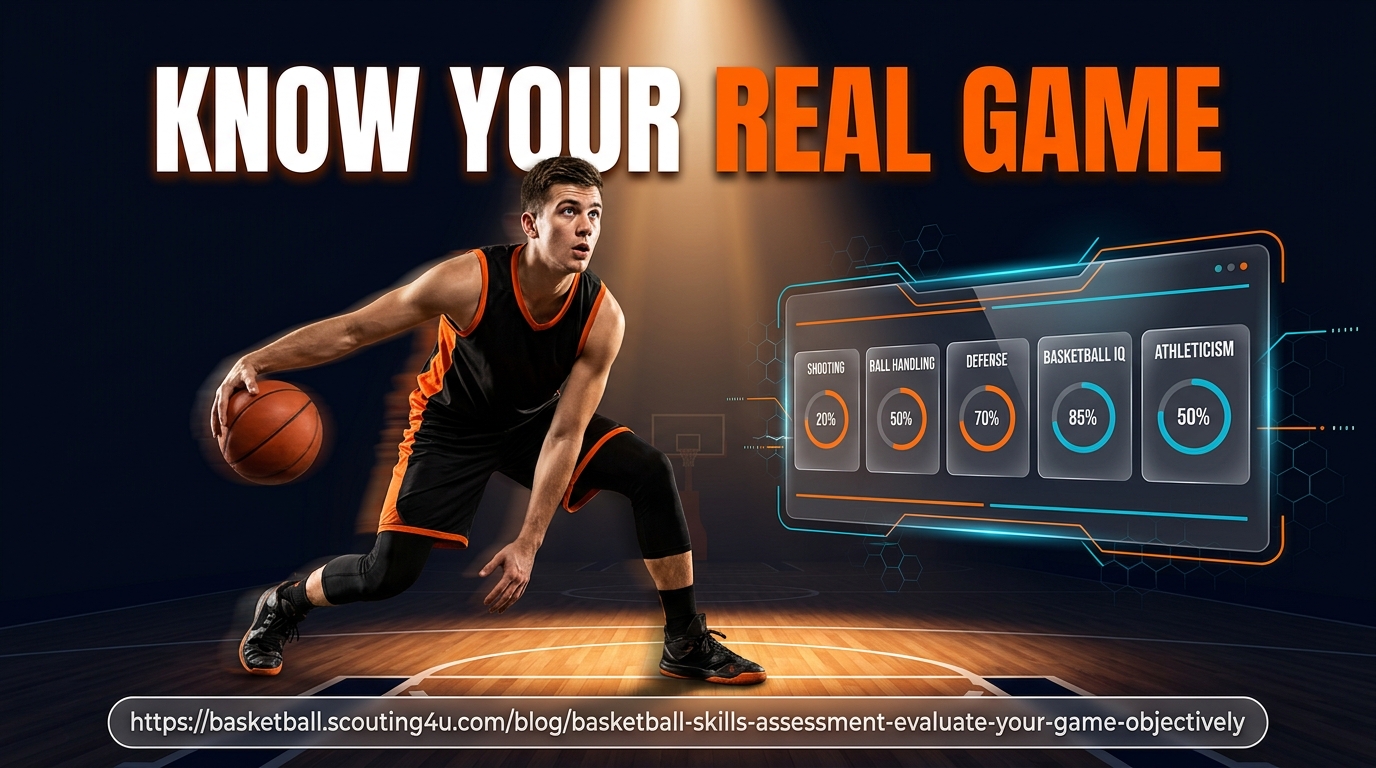
Basketball Skills Assessment: Evaluate Your Game Objectively
Key Takeaways
A structured basketball skills assessment is crucial for player development and scouting.
Tracking stats like PER and TS% can highlight areas for improvement.
Use Scouting4U for comprehensive analytics and player profiling.
Historical examples show the evolution of successful basketball analytics.
A structured assessment can enhance youth basketball development plans.
What Is Basketball Skills Assessment?
A basketball skills assessment is an essential process for players who want to improve their game and get noticed by scouts. It means evaluating a player's abilities through specific metrics and structured analysis. A good assessment gives you a clear picture of your strengths and the areas where you need work. Without this kind of objective review, it is easy to train hard but in the wrong direction. Every serious player and coach should treat basketball skills assessment as a regular practice, not a one-time event.
Modern basketball demands more than raw talent. Coaches and scouts want data. They want to see numbers that support what they observe on the court. A thorough evaluation bridges the gap between gut feeling and hard evidence. It helps players earn roster spots, development contracts, and scholarships. It also helps coaches build better training programs for their entire team.
Key Metrics in Basketball Skills Assessment
To run an effective basketball skills assessment, you need to focus on the right metrics. The most trusted ones include Player Efficiency Rating (PER), True Shooting Percentage (TS%), and Usage Rate (USG%). Each metric tells a different part of the story. Together, they give you a full picture of how a player performs. Learning to read these numbers is a core skill for any coach, scout, or ambitious player. For a deeper dive into the numbers, check out this guide on Mastering Basketball Analytics: PER and True Shooting.
Player Efficiency Rating (PER)
PER is one of the most widely used tools in any player evaluation. It measures a player's total contributions in a single number. PER accounts for points, rebounds, assists, steals, blocks, turnovers, and fouls. A league-average PER sits at 15. Any score above 20 signals an elite performer. When you track PER over several games or seasons, you can see real growth — or a real decline — very clearly.
True Shooting Percentage (TS%)
TS% measures scoring efficiency. It factors in two-point field goals, three-pointers, and free throws in one formula. Traditional field goal percentage misses a lot of context. TS% fills that gap. A player who scores 20 points on 25 shots is less efficient than one who scores 20 points on 16 shots. In any solid evaluation, TS% is one of the first numbers you look at. Improving TS% often means better shot selection, not just better shooting.
Usage Rate (USG%)
USG% tells you how often a player is involved in plays while on the court. A high usage rate shows a player has a big offensive role. A low usage rate may reveal untapped potential or a role player who specializes in other areas. During player evaluation, USG% helps coaches decide if a player is being used correctly. It also helps players understand their role and push for more responsibility when the time is right.
Additional Metrics Worth Tracking
Beyond PER, TS%, and USG%, a complete basketball skills assessment should also look at several other numbers. Assist-to-turnover ratio shows decision-making quality. Defensive Rating measures how many points a team allows per 100 possessions when a player is on the floor. Box Plus/Minus (BPM) estimates a player's points impact per 100 possessions. Rebounding percentage compares a player's rebound total to available rebounds while they play. Each of these adds depth to your understanding of a player's true value. To learn how to gather these numbers in game situations, read How to Track Basketball Stats Player Like a Pro.
Building a Structured Basketball Skills Assessment Plan
A structured plan makes player development systematic. Without a plan, players train randomly and coaches evaluate inconsistently. A good basketball skills assessment plan has three core phases: goal setting, progress tracking, and regular evaluation. Each phase feeds into the next. When you repeat this cycle throughout a season, improvement becomes measurable and repeatable.
Phase 1 — Goal Setting
Start every assessment by setting clear goals. Use the SMART framework: Specific, Measurable, Attainable, Relevant, and Time-bound. Vague goals like "get better at defense" do not work. A SMART goal sounds like this: "Raise my Defensive Rating from 108 to 102 within the next eight weeks." Specific goals let you design a training plan with purpose. They also give you a deadline that keeps you accountable.
Phase 2 — Tracking Progress
Once goals are set, you need a reliable system to track your numbers. Use a spreadsheet, a notebook, or a dedicated platform. Record your stats after every game or practice session. Look for trends over time. A single bad game means little. A pattern over ten games means everything. Regular tracking turns your basketball skills assessment from a snapshot into a full story. It also shows coaches that you are serious about your development.
Phase 3 — Regular Evaluation
Schedule formal evaluation points — every two weeks or once a month works well. Compare your current numbers to your goals. Celebrate improvements. Adjust goals that are no longer realistic. Add new goals as old ones are achieved. This cycle keeps your development process alive and useful. Without regular evaluation, even the best tracking system becomes just a collection of numbers nobody acts on.
How Scouting4U Elevates Your Basketball Skills Assessment
Scouting4U is one of the most powerful platforms available for player evaluation today. Built with EuroLeague-level expertise, it combines advanced analytics, player profiling, and video analysis in one place. Coaches can evaluate entire rosters quickly. Scouts can compare players across leagues with standardized data. Players can study their own game film and understand exactly where they need to grow.
The platform makes basketball skills assessment faster and more accurate. Instead of spending hours sorting through raw stats, you get clean dashboards that highlight what matters. You can build custom player profiles, track development over time, and share reports with other coaches or agents. Scouting4U turns what used to take days into a process that takes minutes. Explore the full range of tools available on the Scouting4U platform features and tools page to see how it supports every stage of player development.
If you are ready to elevate your evaluation process to a professional level, check out the available Scouting4U subscription plans and pricing to find the right fit for your needs.
The Role of Video Analysis in Basketball Skills Assessment
Video analysis is one of the most underused tools in player evaluation at the youth and amateur levels. At the professional level, every team uses it. Video lets you see what the numbers cannot fully explain. You can watch footwork, read defensive positioning, and study off-ball movement in a way that box scores never capture. When you combine video with data, your basketball skills assessment becomes far more complete.
The process is straightforward. Record games or practice sessions. Break the film into clips by situation — pick-and-roll defense, transition offense, shot attempts. Review each clip with specific questions in mind. What did the player do well? Where did they hesitate or make the wrong read? This kind of targeted review is what separates a good evaluation from a great one. For a full walkthrough of how to use film effectively, visit Basketball Video Analysis: The Complete Guide to Game Film.
Basketball Skills Assessment for Youth Development
Youth coaches often overlook formal player evaluation. They focus on fun and fundamentals, which is right. But adding structure to assessment does not mean losing the joy of the game. Even simple tracking — shooting percentages, turnover counts, assist totals — teaches young players to understand the game at a deeper level.
Start with basic drills. Measure shooting accuracy from three spots on the floor. Time agility runs through cone courses. Count successful passes in live scrimmages. Record these numbers and share them with players and parents. Young athletes respond well to seeing their own growth in numbers. A consistent basketball skills assessment process builds habits that stay with players throughout their careers.
As players reach high school age, introduce more advanced metrics. Teach them what PER means and how TS% works. Show them how scouts use these numbers to make decisions. A player who understands the evaluation process from a young age has a real competitive advantage when it matters most.
Preparing for Basketball Combines with Skills Assessment
Basketball combines test players in front of scouts and decision-makers. Preparation is everything. A focused basketball skills assessment in the weeks before a combine reveals what to work on and what to showcase. Do not arrive at a combine hoping to perform well. Arrive knowing exactly where your strengths lie because your data told you so.
Focus on the drills that combine scouts prioritize. Agility, explosiveness, shooting off movement, and decision-making under pressure are always tested. Use your assessment data to identify your weakest area and dedicate extra time to it. If your TS% is low, drill mid-range pull-ups and free throws daily. If your defensive rating is poor, work on footwork and communication. Let the data drive your preparation. For more on how scouting evaluations work at a high level, read Basketball Scouting: The Definitive Guide for Modern Scouts.
The Historical Evolution of Basketball Skills Assessment
The way coaches and scouts evaluate players has changed dramatically over the past 30 years. In the 1980s and early 1990s, coaches relied almost entirely on what they saw with their own eyes. Points, rebounds, and assists were the only numbers most people tracked. Scouting reports were written by hand and shared through personal networks.
The data revolution began in earnest in the early 2000s. Teams like the San Antonio Spurs and the Dallas Mavericks began investing in analytics departments. Advanced metrics like PER and TS% entered the mainstream. Draft picks were evaluated with more precision. Role players were valued in new ways based on spacing, defensive effort, and efficiency rather than raw scoring totals.
Today, basketball skills assessment at the professional level includes optical tracking, machine learning models, and real-time biometric data. Cameras track every player on the court 25 times per second. Algorithms calculate speed, distance covered, and shot quality on every possession. What started as simple stat sheets has become one of the most data-rich industries in all of professional sports. Even at the youth and amateur levels, affordable tools now make rigorous player evaluation accessible to anyone willing to use them.
Common Mistakes in Basketball Skills Assessment
Even well-intentioned evaluation plans fail when they fall into common traps. Avoiding these mistakes saves time and produces better results.
The first mistake is tracking too many metrics at once. When everything feels important, nothing is. Pick three to five key metrics for each cycle. Master those before adding more. The second mistake is ignoring context. A player's numbers look very different on a bad team versus a great team. Always compare performance to role, not just to league averages. The third mistake is skipping the qualitative side. Numbers explain what happened. Video explains why. A basketball skills assessment that uses only one or the other is incomplete. The fourth mistake is evaluating too infrequently. Quarterly assessments miss important trends. Monthly or bi-weekly check-ins keep development on track.
Conclusion
A consistent, data-driven basketball skills assessment is one of the most powerful tools available to players, coaches, and scouts. It replaces guesswork with clarity. It turns raw observations into actionable plans. Whether you are a youth coach building fundamentals, a college player chasing a professional contract, or a scout evaluating talent across multiple leagues, a rigorous evaluation process gives you the edge you need. Start simple, track consistently, use video alongside data, and let the numbers guide your decisions. The players and coaches who commit to regular assessment are the ones who develop fastest and perform best when it counts.
Frequently Asked Questions
What is the main goal of a basketball skills assessment?
The main goal is to evaluate a player's abilities objectively. It identifies clear strengths and specific weaknesses. It also provides a structured development plan based on real data rather than opinion alone.
How do I start a basketball skills assessment for the first time?
Begin by choosing three to five key metrics to track. Good starting points are PER, True Shooting Percentage, and assist-to-turnover ratio. Record these numbers after every game. Use a platform like Scouting4U to organize your data and spot trends over time.
How often should I conduct a basketball skills assessment?
For most players and coaches, a formal review every two to four weeks works well during the season. Off-season assessments should happen at the start and end of each training block. More frequent informal checks — after every game — keep you aware of short-term trends.
How can Scouting4U improve my basketball skills assessment process?
Scouting4U provides advanced analytics tools, customizable player profiles, and video analysis features in one platform. It makes evaluation faster and more accurate. Coaches can assess full rosters quickly, and players can study their own game film to understand their development in detail.
Why is video analysis important in a basketball skills assessment?
Video analysis reveals things that statistics cannot. It shows footwork, off-ball decisions, defensive positioning, and court vision. When you combine video review with metric tracking, your overall evaluation becomes much more complete and actionable. Video helps you understand not just what happened, but why it happened.
Enjoyed this article? Share it with others!
Founder & Lead Scout, Scouting4U
2x EuroLeague champion with 30+ years in professional basketball. Daniel won EuroLeague titles with Maccabi Tel Aviv, helped build the staff behind the 2007 European Championship, and has delivered 100+ professional scouting reports across 50+ leagues. If it happened in a European basketball front office, he was probably in the room. He founded Scouting4U in 2010 to bring championship-level scouting intelligence to every club.
No reviews yet. Be the first to share your experience!
Related Articles
Basketball Combine Preparation: What Scouts Measure
What Is Basketball Combine Preparation?Basketball combine preparation is the structured process of getting ready to perf...
Creating a Youth Basketball Development Plan That Works
Key TakeawaysA youth basketball development plan is crucial for player growth and scouting readiness.Tracking basketball...

How to Build a Basketball Player Profile for Scouts
Key TakeawaysCreating a strong basketball player profile for scouts is crucial for getting noticed.Track essential baske...