
European vs American Basketball Analytics: Scouting Differences
Playing Style Analytics for US Markets
Basketball is a global sport loved by millions. But the game looks very different depending on where you play. For scouts, understanding these differences is crucial. Two of the most prominent regions are the United States and Europe. Each has its own style, systems, and culture. This guide breaks down the European vs American basketball debate in clear, practical terms. Whether you scout domestically or internationally, the European vs American contrast shapes how you evaluate every player you watch. Platforms like Scouting4U are built to help scouts navigate exactly these cross-regional differences with precision and confidence.
Knowing these European vs American basketball differences helps you understand why a player who dominates in the Euroleague might struggle in the NBA. The European vs American divide also explains why the global talent pool keeps growing stronger. Teams that understand both systems gain a real edge in recruitment and roster building. Scouting4U gives analysts the tools to compare players across both regions without losing critical context.
International Talent Evaluation in Chicago and Denver
Scouting4U is designed for scouts who work across international and domestic markets. The platform gives you context-rich data, video tools, and cross-league filters. Scouting4U makes it easier to evaluate players from vastly different systems side by side. Whether you are watching a Euroleague wing or a college small forward, Scouting4U helps you ask the right questions about each player's game. The Scouting4U platform is trusted by coaches, agents, and analysts across Europe and North America. That broad reach makes Scouting4U uniquely valuable in the European vs American scouting landscape.
Scouting4U normalizes statistics across leagues so you can compare fairly. You can filter by competition level, role, age, and system type. Scouting4U also provides video integration so raw numbers are always paired with visual confirmation. This combination of data and context is what separates Scouting4U from generic analytics tools. Learn more about what Scouting4U offers by visiting the Scouting4U platform features and tools page.
Development Pathway Tracking for American Scouts
Team-Centric vs Individual-Centric
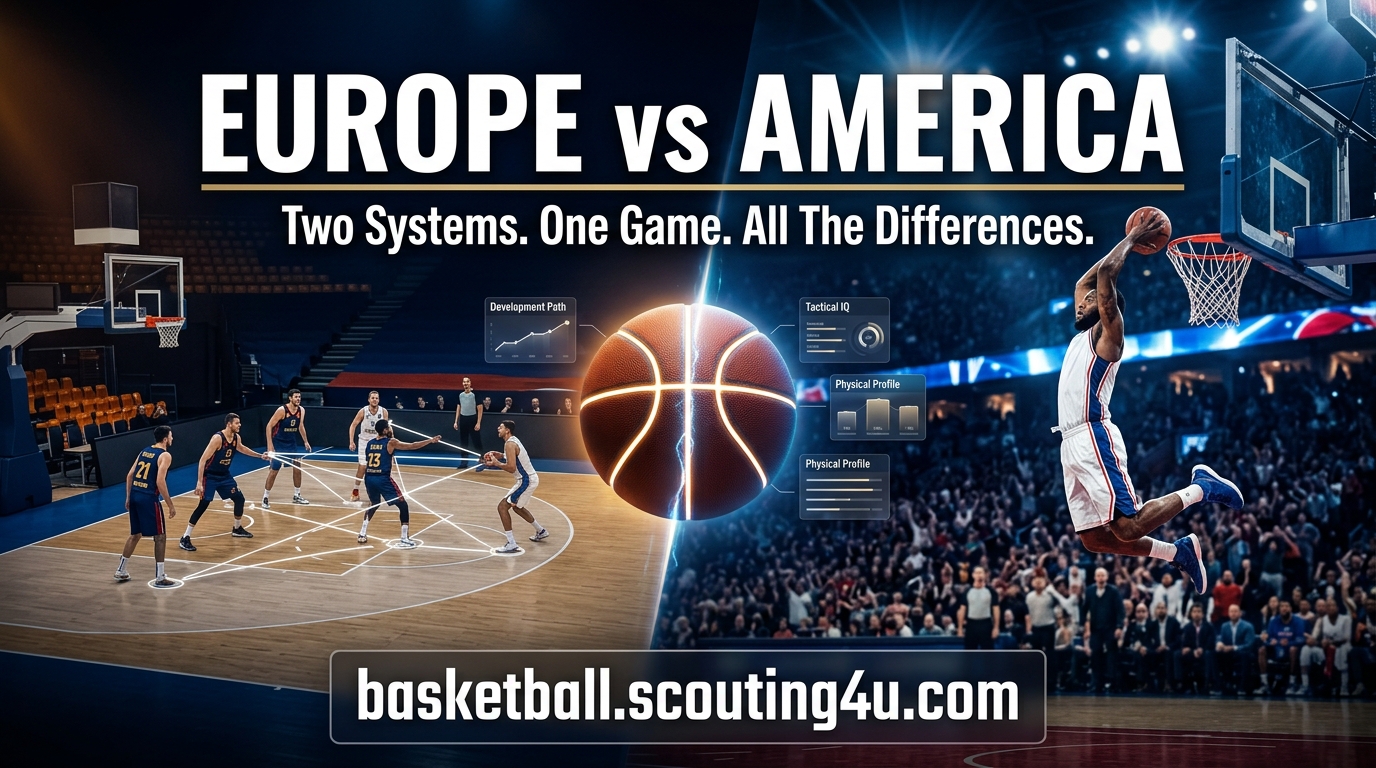
One of the biggest differences in the European vs American basketball comparison is team play. European basketball focuses on collective effort and strategy. American basketball puts individual talent and athleticism front and center.
In Europe, players learn to excel within systems. Ball movement, spacing, and tactical discipline are the priorities. Coaches build structure from a young age. The goal is to produce players who fit into a well-organized scheme.
In the United States, the approach is different. High school and college basketball celebrate individual skills. Players are encouraged to develop their own game. This leads to spectacular one-on-one plays and athletic highlights. These traits are highly valued in the American system.
The European vs American basketball contrast matters a lot for scouts. A European player may be an elite system player but need time to adapt to a more free-flowing American style. An American player may have incredible tools but need to learn how to fit into a structured team offense. Spotting this gap early saves teams time and money. Scouting4U helps you flag these transition risks before you commit roster resources.
Want to learn more about how scouts evaluate these traits? Read our guide on how to get scouted in basketball for a deeper look at what evaluators are really watching for.
Physicality and Pace
European basketball tends to be more physical than American basketball. Games in Europe feature more half-court sets and deliberate playmaking. Players must be technically sound. They need to read defenses, make smart cuts, and execute set plays under pressure.
American basketball, especially the NBA, is famous for its speed. High-scoring games and fast transitions are the norm. Players move at full pace from end to end. This style rewards elite athleticism and quick decisions.
The European vs American basketball pace difference is something scouts must weigh carefully. A player with elite footwork and IQ may thrive in either system. A player who relies purely on speed may struggle when the game slows down in Europe. Speed alone does not guarantee success across both systems. Scouting4U lets you track pace-adjusted metrics so you can measure a player's efficiency in context, not just in raw numbers.
Shooting and Spacing
European basketball has produced some of the world's best shooters. The emphasis on spacing and ball movement creates many open looks. Players from European systems often have clean mechanics and high shooting efficiency.
American players are increasingly skilled shooters too. The NBA has shifted heavily toward three-point shooting and floor spacing. But the path to developing that skill differs. In the European vs American basketball context, American players often develop shooting through individual training. European players develop it through system repetition.
The European vs American gap in shooting development is narrowing. Both systems now produce elite marksmen. But the method behind the skill remains distinct. Scouting4U tracks shooting efficiency metrics across leagues so you can compare shooters fairly, regardless of where they play. To understand how shooting efficiency is measured, check out our article on mastering shot selection and scoring efficiency.
European vs American Coaching and Development
Coaching Philosophies
Coaching in Europe is known for its structure and discipline. European coaches build detailed systems. They demand that players understand their roles deeply. This produces technically strong players who contribute well to the team.
American coaching varies more widely. Some coaches run tight systems. Others give players freedom to create and improvise. This freedom helps players develop individual skills and playmaking instincts. Those instincts are highly valued at the professional level.
Neither approach is better. They are simply different. The best coaches in both regions blend structure with creativity. This is a key theme in the European vs American basketball discussion. Scouts who understand both coaching styles make better long-term projections. Scouting4U helps you track system fit by mapping how a player performed inside specific tactical frameworks.
Player Development Systems
European basketball clubs invest heavily in youth development. Young players often join academy teams as early as age 10 or 12. They move through multiple competitive levels over many years. By the time they reach the senior level, they are polished and system-ready.
In the United States, the path is different. Most elite players develop through high school and college basketball. These environments are highly competitive and very public. Players showcase their talents, and the best ones enter the NBA Draft. The timeline is often faster, but development can be less systematic.
This European vs American basketball development gap has real consequences for scouts. European prospects may be more ready in tactical areas. American prospects may have higher ceilings in athleticism and individual skill. Understanding both pathways leads to better evaluations. Scouting4U tracks development trajectories over time, giving you a fuller picture of where a player is headed. For a deeper look, visit our complete guide to basketball player development.
Game Rules and Structure
Rule Variations
Several rule differences exist between European and American basketball. These differences change how the game is played and officiated. The European vs American rulebook gap affects everything from defense to shot selection.
Here are some key examples:
Three-point line: The NBA three-point line is farther from the basket than in FIBA play. European shooters may need to adjust their range when moving to the NBA.
Shot clock: Both the NBA and FIBA use a 24-second shot clock. FIBA resets the clock to 14 seconds after an offensive rebound. The overall pace and interpretation can still feel different.
Goaltending: European rules allow players to touch a ball on the rim. NBA rules do not. This can confuse European players new to the American game.
Defensive three-seconds: The NBA enforces this rule strictly. European leagues do not. This changes how defenses are structured on both sides.
These rule differences add up. They change spacing, strategy, and decision-making. In the European vs American basketball comparison, scouts should always factor in rule variations when watching international prospects. Ignoring the rules context leads to flawed evaluations. Scouting4U accounts for these rule differences in how it structures cross-league data filters and player profiles.
Tournament and League Structure
The structure of leagues and tournaments is very different between the two regions. This structure shapes how players perform and develop throughout a season.
In Europe, top clubs compete in domestic leagues and the Euroleague. Players face multiple styles and levels of competition throughout the season. It can be exhausting, but it also accelerates development. The European vs American volume of competition is a real factor in how players mature.
In the United States, the NBA is the primary focus. Teams play an 82-game regular season followed by a demanding playoff run. Players must manage their bodies and maintain focus across many months.
For scouts and analysts, understanding league structure helps put performance data in context. A player averaging 18 points in a weak domestic league is very different from one doing it in the Euroleague. Scouting4U helps you compare players across different leagues with the right context and filters. Visit our Scouting4U subscription plans and pricing page to find the right plan for your scouting operation.
Analytics and Scouting in European vs American Systems
Modern basketball scouting relies heavily on data. This is true in both Europe and the United States. But the metrics used and the context required can differ significantly in European vs American basketball environments. Scouting4U was built to bridge exactly this gap.
In the NBA, advanced analytics are deeply embedded in team operations. Metrics like PER, true shooting percentage, and on/off splits are standard tools. In Europe, analytics adoption has grown fast, especially at the Euroleague level. The European vs American analytics gap is closing quickly. Scouting4U is at the forefront of that convergence, offering tools calibrated for both systems.
For a strong foundation in basketball analytics, read our guide on mastering basketball analytics: PER and true shooting.
When scouting across both systems, it is important to normalize statistics. A player's numbers mean more when you know the pace, competition level, and role they played. Scouting4U provides cross-league comparison tools that are now essential for any serious scouting operation. This is especially true in European vs American basketball scouting, where league contexts vary widely. Scouting4U makes that normalization automatic, saving analysts hours of manual work.
European vs American player comparisons also require an understanding of opponent quality. A strong performance against top Euroleague competition carries more weight than similar numbers in a weaker league. Scouting4U transforms raw data into actionable insight by layering in opponent quality scores for every game logged. Understanding opponent tendencies is also key. If you want to explore how to use data for deeper analysis, our complete guide to basketball opponent analysis using Scouting4U is a great resource.
Cultural Influences on European vs American Basketball
Basketball Culture
Culture shapes how basketball is played and valued. In Europe, basketball competes with soccer for popularity. This means fewer resources go to basketball in some countries. European systems focus on efficiency and strategic depth. They do more with less.
In the United States, basketball is a major cultural force. It is deeply rooted in urban communities and widely covered by media. Individual stars are celebrated. Athletic brilliance is rewarded. This cultural backdrop shapes how players are trained and marketed.
Neither culture is superior. Both produce great players and great basketball. But they produce different kinds of greatness. The European vs American basketball cultural divide is real and meaningful. Scouts who appreciate both cultures are better equipped to find talent anywhere in the world. Scouting4U supports scouting across all major markets, from the EuroLeague to the G League, helping teams find talent without geographic blind spots.
Fan Engagement
Fan culture is also very different between regions. European basketball fans are known for their passion. Games feature organized chants, flags, and intense atmospheres. The connection between fans and clubs runs deep. Many clubs have histories stretching back decades.
American fans are equally passionate but engage differently. The NBA experience blends sport and entertainment. High-profile events like the All-Star Game attract global audiences. Social media amplifies individual player brands in ways that are uniquely American.
For players, adapting to a new fan culture can be challenging. European players joining the NBA often talk about adjusting to the media spotlight. American players going to Europe sometimes find the crowd intensity surprising. This is another layer of the European vs American basketball transition that scouts should keep in mind. A player's mental adaptability matters as much as their physical skills. Scouting4U allows scouts to log qualitative notes alongside statistical data, capturing these softer indicators in a structured way.
What Does the European vs American Divide Mean for Scouts?
Understanding the European vs American basketball divide is not just academic. It has real practical value for scouts and team builders. The best evaluators treat this knowledge as an essential tool. Scouting4U is built to support exactly that kind of informed, context-aware evaluation.
Here is what good scouts keep in mind:
Context matters: A player's stats must be evaluated within their system and league.
Transferable skills: Look for skills that travel across styles - shooting, defense, IQ, and motor.
Adaptability: Players who have competed in multiple systems often adapt more easily.
Development trajectory: European players often peak later. American players may have higher early ceilings but more variance.
Cultural fit: Consider how a player will adjust to a new environment, language, and team culture.
The European vs American basketball comparison also reveals what each region does well. Europe consistently produces intelligent, disciplined players. America consistently produces explosive, high-ceiling athletes. The most successful teams blend both profiles. Scouting4U helps you build those blended rosters by giving you reliable data on players from every major league.
The global basketball market is growing fast. The best scouts evaluate talent across all regions without bias. Mastering the European vs American basketball comparison is a core part of that skill set. It separates good scouts from great ones. Scouting4U gives every scout the infrastructure to work at that elite level, regardless of their budget or team size.
For a closer look at the European side of the equation, explore our ultimate European basketball leagues guide. It covers the top leagues, competition levels, and what scouts should know before watching European prospects.
Common Scouting Mistakes in European vs American Evaluation
Even experienced scouts make mistakes when crossing the European vs American divide. Being aware of these pitfalls can sharpen your evaluations significantly. Scouting4U is designed to help you avoid the most costly errors.
One common mistake is comparing raw stats without adjusting for league context. A player scoring 20 points per game in a weaker European league may not replicate that in the NBA. Always account for competition level before drawing conclusions. Scouting4U automates much of this adjustment, flagging when numbers need to be read in context.
Another mistake is undervaluing tactical intelligence. Many scouts trained in the American system overlook how well a European player reads the game. Smart positioning, off-ball movement, and defensive IQ are hard to quantify but extremely valuable. Scouting4U includes tagging tools that let you log these qualitative observations alongside traditional stats.
A third mistake is ignoring cultural and personal factors. A player may have the physical tools to succeed but struggle with language barriers, homesickness, or media pressure. These human factors play a real role in whether a European vs American transition succeeds. Scouting4U allows scouts to document player background, interview notes, and adaptability flags within each player profile.
Want to avoid the most common evaluation errors? Read our article on 5 scouting mistakes that cost games and how AI can fix them. It applies directly to European vs American cross-regional scouting scenarios.
Conclusion
The European vs American basketball debate is not about which style is better. It is about understanding that the game is played differently in different places. From playing style and coaching philosophy to game rules and cultural context, each region offers something unique. The European vs American lens helps scouts see players more clearly and evaluate them more fairly. Scouting4U gives you the tools to apply that lens consistently across every player you evaluate.
Scouts who appreciate these European vs American basketball differences make smarter evaluations. They identify players who will thrive in new environments. They build better teams by combining the best of both worlds. The European vs American knowledge gap is one of the most valuable edges a scout can develop. Scouting4U helps close that gap by putting the right data, context, and video tools in your hands.
Basketball is a global game. The most successful teams and scouts treat it that way. Whether you are analyzing a Euroleague prospect or an NCAA standout, understanding the European vs American basketball framework makes every evaluation sharper and more reliable. Scouting4U is the platform built to support that global, cross-regional approach from day one. To see everything Scouting4U can do for your operation, visit the about Scouting4U, founders, and history page and learn how the platform was built to serve scouts at every level.
Frequently Asked Questions
What is the main difference between European and American basketball?
The biggest European vs American basketball difference is team play versus individual play. European basketball focuses on structured systems, ball movement, and tactical discipline. American basketball places more value on individual skill, athleticism, and one-on-one ability. Scouting4U helps analysts evaluate players from both systems using metrics calibrated for each context.
Is European basketball more physical than American basketball?
Generally, yes. European basketball tends to be more physical and slower-paced. Games feature more half-court offense and deliberate playmaking. American basketball, especially the NBA, is faster and more transition-oriented. The European vs American pace gap is one of the first things players notice when switching leagues. Scouting4U tracks pace-adjusted metrics so scouts can account for these differences in their evaluations.
Are the rules different in European and American basketball?
Yes. Key European vs American basketball rule differences include the distance of the three-point line, goaltending rules, and defensive three-second enforcement. European basketball uses FIBA rules. The NBA has its own rulebook. These differences affect strategy and how players adjust when moving between leagues. Scouting4U structures its data filters to account for these rule variations automatically.
Why do European players often succeed in the NBA?
European players are typically well-trained in fundamentals, spacing, and team dynamics. Their development systems are structured and long-term. This produces technically sound players who are ready to contribute to team-oriented NBA rosters. The European vs American skill gap has narrowed significantly as more international talent enters the league each year. Scouting4U makes it easier to identify which European prospects have the transferable skills to succeed at the NBA level.
How do scouts compare European and American basketball players?
Good scouts look at performance in context. They consider the league level, system, role, and competition quality. They also look for transferable skills like shooting, defense, and basketball IQ. Scouting4U provides analytics tools that normalize stats across leagues, making European vs American cross-regional comparison much more accurate and efficient.
Which basketball system produces better players - European or American?
Both systems produce elite players. American basketball tends to develop high-ceiling athletes with great individual skills. European basketball tends to produce technically polished, system-ready players. The best talent evaluators value both approaches. They look for players who can adapt to different environments. The European vs American debate is best viewed as complementary rather than competitive. Scouting4U is built to help scouts find and evaluate the best players from both systems without bias.
Enjoyed this article? Share it with others!
Founder & Lead Scout, Scouting4U
2x EuroLeague champion with 30+ years in professional basketball. Daniel won EuroLeague titles with Maccabi Tel Aviv, helped build the staff behind the 2007 European Championship, and has delivered 100+ professional scouting reports across 50+ leagues. If it happened in a European basketball front office, he was probably in the room. He founded Scouting4U in 2010 to bring championship-level scouting intelligence to every club.
No reviews yet. Be the first to share your experience!
Related Articles

Analyzing Basketball Player Potential: Scouting Insights
Key Takeaways Analyzing basketball player potential combines data analysis with scouting intuition. Core metrics includ...

Mastering Basketball Service: Scouting Insights & Tools
Key TakeawaysA strong basketball service covers everything from player evaluation to game strategy analysis.Scouting4U g...

One Shot Chart. Three Insights Visual: Game Plan Revolution
Key TakeawaysA basketball shot chart three insights visual approach reveals high-efficiency zones, player tendencies, an...