
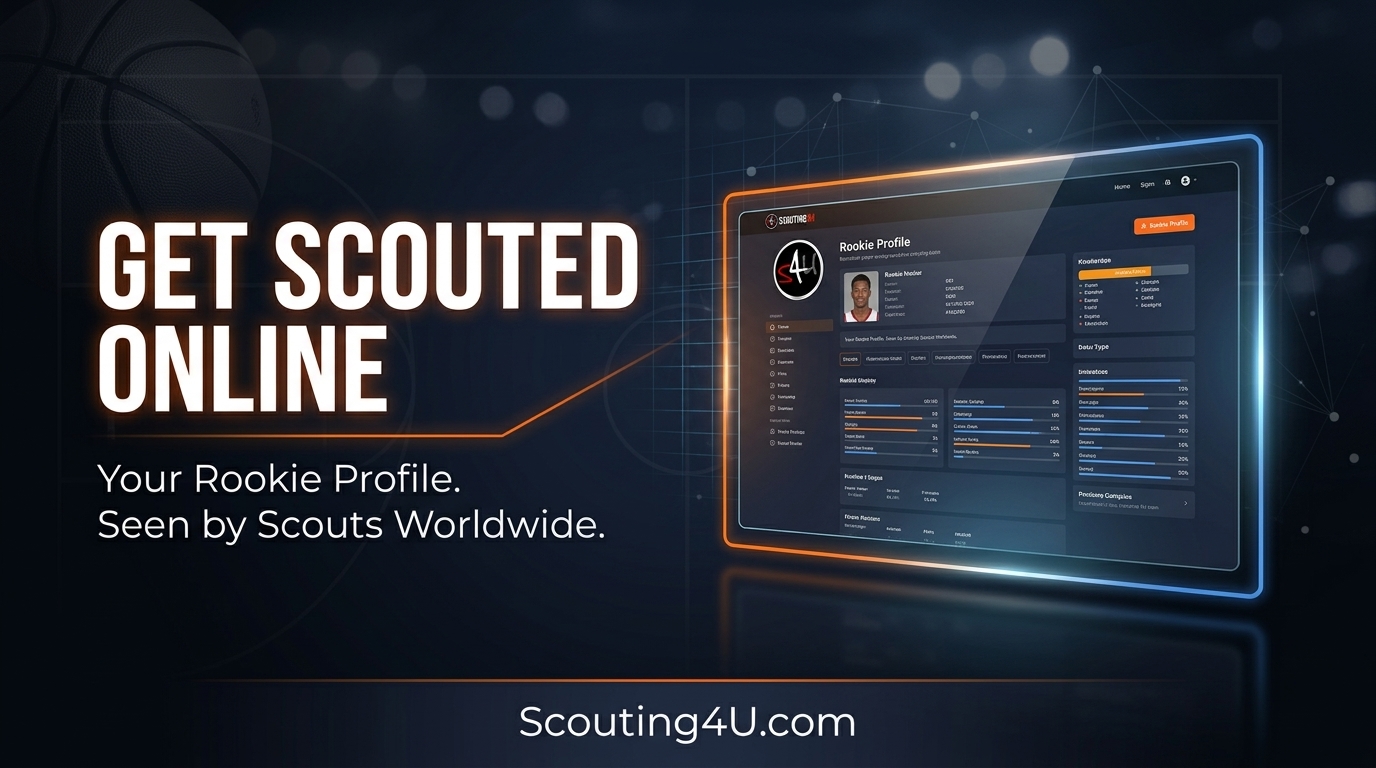
Rookie Player Profile: Get Scouted Online Easily
Key Takeaways
Setting up a rookie player profile to get scouted online is the most direct path to visibility in today's market.
Scouts now search digital platforms first - your online presence is your first audition.
Consistent profile updates with stats, video, and context give you a real edge over players who post once and disappear.
Understanding basic analytics helps you present the numbers scouts actually care about.
Why Every Rookie Player Profile Needs to Get Scouted Online Now
Getting noticed in basketball used to mean being in the right gym at the right time. That has changed. Today, a rookie player profile that gets scouted online can reach coaches and scouts in three different countries before you even lace up for your next game. The digital shift in recruiting is real, and it happened faster than most players realized.
Scouts at every level - from semi-pro leagues to European first divisions - now use online databases as their first filter. They search by position, height, age, and statistics before they ever watch a single minute of film. If you are not in that database, you are not in the conversation. It is that simple.
This is not just about elite talent. Mid-tier prospects who build a strong rookie player profile and get scouted online consistently outperform more talented players who have no digital footprint. Visibility is a skill. You need to treat it like one.
Every serious player should think of their rookie player profile get scouted online strategy the same way they think about fitness - it requires ongoing effort, not a one-time setup. The players who treat digital visibility as a real part of their development process are the ones who get found. The ones who ignore it keep waiting for a scout to walk into their gym.
Platforms like Scouting4U's suite of player and scout tools were built specifically to close this gap. They give players the same presentation infrastructure that agents previously provided - without the commission or the gatekeeping. When you want your rookie player profile to get scouted online by decision-makers who matter, having the right infrastructure behind you is not optional.
What Scouts Are Actually Looking For When They Search Online
Before you build anything, you need to understand the scout's perspective. When a scout opens a player database at midnight looking to fill a roster spot, what makes them click on one profile over another?
First, completeness. A profile missing height, weight, position, or current team gets skipped. Scouts are busy. They will not email you to ask for basic information you should have included. Fill in every field.
Second, film. Not a two-minute highlights reel of dunks and buzzer beaters - actual game film that shows decision-making, movement without the ball, defensive positioning, and how you respond when things go wrong. Anyone can look good in a curated clip. Scouts want to see patterns. For a deeper look at what patterns matter most, read this breakdown of the 10 traits basketball scouts prioritize.
Third, context. Stats mean different things in different leagues. A player averaging 22 points in a recreational league and a player averaging 14 points in a competitive regional league are not the same prospect. Give scouts the context they need to evaluate your numbers honestly.
Every rookie player profile designed to get scouted online should answer three questions immediately: Who are you? Where are you playing? What do the numbers say? A profile that answers all three clearly is one a scout can actually act on.
Understanding this mindset is what separates players who use their rookie player profile to get scouted online effectively from those who build one and wonder why nothing happens. The scout's workflow drives everything. Build your profile around their process, not your own preferences.
When a scout is actively looking for a rookie player profile to get scouted online through their database, the profiles that surface fastest are the ones built with scout behavior in mind - not player pride. That is the mindset shift that changes results.
How to Build a Rookie Player Profile That Gets Scouted Online
Building a profile that actually works takes about two hours of focused effort upfront and then consistent maintenance every few weeks. Here is how to approach it.
Start with the basics: full name, nationality, date of birth, height, weight, dominant hand, and position. Do not abbreviate. Do not use nicknames unless you are widely known by one in your league. Scouts search by specific terms and your profile needs to surface in those searches.
Next, add your current team and league, followed by career history going back at least three seasons. Include stats for each season if you have them. If your league does not track official stats, film yourself and note performance metrics manually. Scouts respect the effort. A rookie player profile built to get scouted online needs real data behind it - approximations are better than empty fields.
Then comes the film section. Upload at least one full-game video and one edited clip package. The full game shows your real tendencies. The clip package shows your best moments in context. Label everything clearly - what tournament, what opponent, what date.
Finally, write a short bio. Three to five sentences. State your position, your style of play, your strongest attribute, and what you are looking for - whether that is a college program, a semi-pro contract, or a spot in a European league. This tells scouts you are serious and self-aware.
When you complete all of these steps on a platform built for this purpose, your rookie player profile is genuinely ready to get scouted online by people who matter. The difference between a profile that gets seen and one that gets ignored usually comes down to this kind of deliberate setup.
Every player who wants their rookie player profile to get scouted online at a European level should pay particular attention to league context. European scouts weigh competition level heavily. A profile that names the specific regional or national league - not just "domestic league" - gives scouts the reference point they need to place you on their radar immediately. For more on recruitment tactics that work across both the European and North American systems, these five basketball recruitment exposure tips are worth reading alongside this guide.
Video Highlights: The Make-or-Break Element
Your highlight reel is the first thing most scouts will watch, and they will decide within 30 seconds whether to keep watching. That is a hard truth, but it shapes how you should build your video content.
Lead with your best play within the first 10 seconds. Not a slow buildup - your best moment, immediately. After that, show variety. If you are a guard, show a pull-up jumper, a drive-and-finish, a skip pass, and a defensive stop. If you are a big, show post footwork, a screen-and-roll finish, a rebounding sequence, and your ability to pass out of pressure.
Keep the total reel under four minutes. Anything longer and you are testing patience scouts do not have. Cut ruthlessly. If a clip does not show something specific and positive about your game, remove it.
For more detail on what makes highlight film actually useful to a scout, this guide on creating impactful basketball highlight reels goes deep on structure, pacing, and what to include.
The goal of your film is not to impress. It is to inform. Scouts who are impressed but have no context cannot use you. Scouts who have clear, honest film of your game can. Every time you update your video content as part of your rookie player profile to get scouted online, ask yourself whether a scout watching cold would come away with a clear picture of your actual game.
Poor video quality is one of the most common ways a rookie player profile fails to get scouted online. A shaky, low-light clip from the upper corner of a gymnasium is nearly unusable. If you cannot get quality film through your team, ask a family member or friend to film your next three games from a consistent angle - mid-court level, wide enough to see full offensive sets. One good game at acceptable quality beats five unwatchable clips every time.
When scouts search for a rookie player profile to get scouted online and land on a page with well-labeled, clearly filmed video, they spend more time reviewing that player. When they land on a page with grainy, disorganized clips, they leave. Video quality is not a minor detail - it is a filter scouts apply before they even press play.
Rookie Player Profile Exposure: Building an Online Presence Beyond the Database
A profile on a scouting platform is your foundation. But a rookie player who wants to get scouted online with maximum efficiency needs a presence across multiple touchpoints.
Social media matters, but not in the way most players think. Posting every practice dunk does not build a professional reputation. What builds credibility is consistent, contextualized content - a short post after a strong game with your stat line and a brief reflection, a clip from practice with a note about what you are working on, an engagement with a coaching or scouting account that shows you are plugged into the basketball community.
Scouts and coaches look up players on Instagram and Twitter before reaching out. What they find either supports or undermines what your profile says. Make sure the story is consistent. Your rookie player profile needs to get scouted online through every channel, not just the one you put the most work into.
You should also make sure your email is professional and easy to find. A variation of your real name works fine. Obscure usernames or personal handles send the wrong signal.
Think of each social post as an extension of your rookie player profile get scouted online strategy. A scout who finds your platform profile and then sees a coherent, professional social presence will feel more confident reaching out. A scout who finds contradictory content - or nothing at all - will move on to the next player. Your digital footprint is a whole, not a collection of separate pieces.
Some players treat social media as optional. It is not - not when you are trying to have your rookie player profile get scouted online by scouts who Google every serious prospect before picking up the phone. A clean, consistent social presence that matches your profile tells scouts the same story everywhere they look. That consistency builds trust before a single conversation happens.
Using Analytics to Strengthen Your Rookie Player Profile
Numbers tell a story, but only if you present the right ones. Scouts who evaluate players online are increasingly comfortable with advanced metrics. Points per game and rebounds per game are baseline - they are expected. What separates a strong rookie player profile built to get scouted online from a generic one is the addition of efficiency metrics.
True shooting percentage shows how efficiently you score across two-point attempts, three-point attempts, and free throws. Assist-to-turnover ratio shows how well you protect the ball in a playmaking role. Defensive rating, when available, shows your impact on the other end.
You do not need to be a data analyst to include these numbers. You need to know what they mean and where you stand. A player who includes their true shooting percentage and explains the context - "I shot 58.3% TS in a league that runs a lot of half-court sets" - demonstrates basketball IQ alongside the stat. That combination gets attention.
When scouts review a rookie player profile to get scouted online, they are looking for players who understand their own game. Including advanced metrics signals that understanding. It also saves the scout time - they do not have to calculate efficiency themselves. That small convenience can be the difference between a deeper look and a pass.
Any rookie player who wants their profile to get scouted online should think of analytics as a form of communication. The numbers you choose to include - and how you explain them - tell scouts what you value and whether you have self-awareness about your own game. That matters as much as the numbers themselves.
Scouting4U's analytics tools make this process manageable. The platform calculates and displays these metrics in formats scouts recognize, which means your rookie player profile gets scouted online by people who can read it quickly and accurately. You can explore the full range of tools at the Scouting4U features page. If you want to go deeper on the metrics themselves, this guide to advanced basketball statistics covers the formulas and explains what scouts actually use each number for.
Common Mistakes That Undermine Your Rookie Player Profile Get Scouted Online Efforts
After all the work of building a profile, players often sabotage their own chances with a handful of avoidable errors.
The most common: outdated information. A profile last updated 18 months ago signals that the player is either no longer active or not serious about being found. Scouts move on. Update your stats and film at least every two months during the season. Every time a scout visits your rookie player profile to get scouted online, they should see recent activity - not a timestamp from a year ago.
Second: overselling without evidence. Describing yourself as "elite" or "professional-level" without supporting film or stats reads as inexperienced at best and dishonest at worst. Let your numbers and film do the talking. Your bio should be accurate and grounded.
Third: poor video quality. A shaky, low-light clip filmed from the upper corner of a gymnasium is nearly unusable. If you cannot get quality film through your team, consider asking a family member or friend to film your next three games from a consistent angle, mid-court level, wide enough to see full offensive sets. One good game at acceptable quality beats five unwatchable clips.
Fourth: ignoring the recruiting process side of things. Building a profile is step one. Following up, researching which scouts are active on the platform, understanding what leagues are looking for players at your position - all of that is work that lives alongside your profile. A rookie player profile that gets scouted online requires active management, not just passive posting.
Fifth: treating the rookie player profile get scouted online process as a single event rather than a campaign. Players who upload a profile in October and check back in March are usually disappointed. The ones who treat their digital presence as a weekly responsibility - adding film, updating stats, engaging with the scouting community - are the ones who generate actual interest. Consistency is not glamorous. It works.
There is also a sixth mistake that does not get mentioned enough: building a rookie player profile to get scouted online on the wrong platform. A platform that scouts do not actually use is a platform that does not produce results, no matter how well your profile is built. Knowing which systems scouts trust and actively search is as important as the quality of the profile itself.
How Scouting4U Supports Every Rookie Player Trying to Get Scouted Online
Scouting4U was founded by Daniel Gutt, whose background in European basketball operations shapes how the platform works. It is not a generic sports social network. It was built around the actual workflow of scouts and the real needs of players trying to be found.
The platform gives players structured profile templates that match what scouts expect to see. It integrates video hosting, stat tracking, and analytics in one place. It connects players to a network of scouts who are actively using the system to find talent - not just browsing casually. When you set up your rookie player profile to get scouted online through Scouting4U, you are entering a system designed around scout behavior, not just player convenience.
That distinction matters more than it sounds. Many platforms optimize for player engagement - likes, shares, follower counts. Scouting4U optimizes for scout utility. A system scouts trust and use regularly is a system where your rookie player profile actually gets scouted online by people with the power to make offers. That two-sided design is what makes it work in practice.
For players serious about having their rookie player profile get scouted online at the highest possible level, Scouting4U provides the infrastructure to make that happen. To understand what subscription tier fits your situation, the Scouting4U pricing page breaks down each plan and what it includes.
If you want to learn more about the people behind the platform before committing, the Scouting4U about page covers the founding story, the team, and the philosophy behind how it was built.
Staying Consistent Over the Long Term
One final point that does not get said enough: recruiting timelines are long. Most players who successfully get their rookie player profile scouted online through a digital platform did not land an opportunity the week they created their account. They built their profile, kept it updated, improved their game, uploaded new film, and stayed patient.
Scouts bookmark players. They come back six months later when a roster spot opens. They share profiles with colleagues at other clubs. The player who was diligent enough to keep their profile current is the one who gets the call.
Think of it this way: every time a scout returns to check your rookie player profile to get scouted online and finds fresh stats and new film, their confidence in you goes up. Every time they find nothing new, it goes down. The math is simple. Consistency compounds.
A rookie player profile built to get scouted online is not a one-time task. It is an ongoing commitment to your own visibility. Treat it with the same discipline you bring to the gym. The players who do that are the ones who eventually get the message that a scout wants to talk.
There is also a compounding effect to staying visible. A rookie player profile that gets scouted online regularly - meaning scouts check it, share it, and return to it - signals to the platform's algorithm and to scouts themselves that this is an active, interested player. That activity generates more activity. Scouts mention your profile to colleagues. Coaches in adjacent leagues take notice. What started as a deliberate effort to get your rookie player profile seen becomes a self-reinforcing loop of visibility that keeps working long after the initial setup.
The players who treat their rookie player profile get scouted online process as a long-term commitment - not a quick fix - are the ones who build real momentum. A profile you refresh every two months will outperform a perfect profile that goes untouched every single time. Start well. Stay consistent. That combination is what actually moves the needle.
Frequently Asked Questions
How do I make my rookie player profile get scouted online faster?
Complete every field in your profile, upload both a full-game video and a short highlight reel, and include efficiency stats alongside basic numbers. Scouts filter by completeness first. An incomplete profile rarely gets a second look, no matter how talented the player is. Updating your profile regularly also signals to platforms and to scouts that you are active and available. A rookie player profile set up to get scouted online properly - with full data, real film, and recent updates - will always outperform a half-finished one.
Do I need an agent to get scouted online as a rookie player?
No. That was true 15 years ago - it is not true now. Platforms like Scouting4U give players direct access to scouts and the tools to present themselves professionally. Agents still have value for contract negotiation and relationship management once interest is established, but getting initial visibility no longer requires one. Your rookie player profile can get scouted online without any intermediary if the profile itself is built well.
What stats should I include in my rookie player profile to attract scouts?
Include points, rebounds, assists, steals, and blocks per game as a baseline. Add true shooting percentage, assist-to-turnover ratio, and minutes per game if you have them. Always include the league name and season so scouts can evaluate your numbers in context. Raw stats without context are much harder to interpret than numbers tied to a specific competitive level. When a scout reviews a rookie player profile built to get scouted online, they are looking for numbers that tell a coherent story - not just a list of big figures.
How long should my basketball highlight reel be?
Keep it under four minutes. Lead with your best play in the first 10 seconds. Show a variety of skills - scoring, playmaking, defense, and movement - rather than repeating the same type of play. Scouts decide quickly whether to keep watching, so front-load the reel with content that earns their continued attention. Your highlight reel is part of your rookie player profile's job to get scouted online - it needs to do real work in the first 30 seconds or scouts will move on.
How often should I update my rookie player profile?
At minimum, update your stats and add new film every two months during the season. At the end of each season, do a full review - update your career history, replace outdated clips with current film, and revise your bio if your role or goals have changed. An outdated profile tells scouts you have moved on. A current one tells them you are ready. Keeping your rookie player profile active so it can get scouted online year-round is one of the simplest things you can do to stay in consideration.
Enjoyed this article? Share it with others!
Founder & Lead Scout, Scouting4U
2x EuroLeague champion with 30+ years in professional basketball. Daniel won EuroLeague titles with Maccabi Tel Aviv, helped build the staff behind the 2007 European Championship, and has delivered 100+ professional scouting reports across 50+ leagues. If it happened in a European basketball front office, he was probably in the room. He founded Scouting4U in 2010 to bring championship-level scouting intelligence to every club.
No reviews yet. Be the first to share your experience!
Related Articles

Analyzing Basketball Player Potential: Scouting Insights
Key Takeaways Analyzing basketball player potential combines data analysis with scouting intuition. Core metrics includ...
Mastering Basketball Service: Scouting Insights & Tools
Key TakeawaysA strong basketball service covers everything from player evaluation to game strategy analysis.Scouting4U g...

One Shot Chart. Three Insights Visual: Game Plan Revolution
Key TakeawaysA basketball shot chart three insights visual approach reveals high-efficiency zones, player tendencies, an...